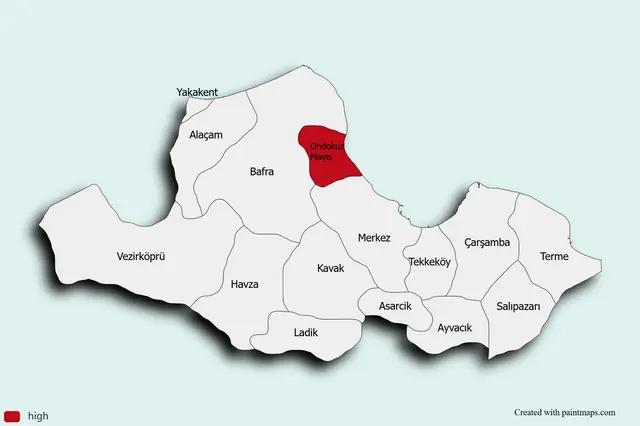
19 May (District)
Province(s) | Samsun | ||||||||
|---|---|---|---|---|---|---|---|---|---|
Area(s) | Central Black Sea Region | ||||||||
Basic Livelihoods | Livestock farming Fishing (Sea and Lake) Agriculture (Greenhouse-Vegetable-Fruit) | ||||||||
Major Natural Areas | Black Sea Coast / Beaches Fish Lakes (Uzungöl- Tatlıgöl- Gıcıgöl- Çernek Lake etc.) Wetland and Bird Sanctuary (Eastern part) Kızılırmak Delta | ||||||||
Mayor(s) | Osman Topaloglu | ||||||||
District Governor | Ibrahim Civelek | ||||||||
The district of 19 Mayıs is located on the Black Sea coast, approximately 33 kilometers west of Samsun's city center. It gained district status in 1987, separating from Bafra and taking its name from the date Mustafa Kemal Atatürk landed in Samsun. Geographically located on the eastern extension of the Kızılırmak Delta, the district is characterized by lagoon-type lakes and wetlands within the delta, known as Balık Lakes. The district's economy is primarily based on agriculture (vegetables, fruit, greenhouse farming), fishing (sea and lake), and animal husbandry.

19 May (Samsun Governorship)
The history of the 19 Mayıs district was shaped by its recent establishment as a separate administrative unit. The area within the current district boundaries was a settlement area within the Bafra district under previous administrative structures. Sources indicate that the area's former name was "Engiz," and that this name remained in use for a long time. During this period, the region continued its administrative existence as a sub-district or village group of Bafra. Due to the area's geographical location on the eastern edge of the Kızılırmak Delta, it may have hosted certain settlements and agricultural activities throughout history, but detailed information on this period is limited in the available sources.
The district's administrative establishment and its current name occurred during the Republic of Türkiye. Law No. 3392, enacted on June 19, 1987, separated Engiz and its surrounding villages from the Bafra district, establishing a new district. This new district was named "May 19" in memory of May 19, 1919, the date Mustafa Kemal Atatürk set foot in Samsun to launch the War of Independence. This naming directly linked the district's identity to a symbolic date in the founding of the Republic of Türkiye.
Following the acquisition of district status, the process of administrative reorganization began. The district's administrative structure was established by establishing a district governor's office, municipality, and other public institutions. From this date on, the district has developed as a local government unit within its own administrative boundaries. The district's history largely encompasses the administrative restructuring after 1987 and the institutional and physical developments this restructuring brought about.
The district of Ondokuz Mayıs, in Samsun province, exhibits typical characteristics of the Black Sea Region in terms of its geographic location and climate. The district is located west of Samsun city center, on the Black Sea coastline, and borders the districts of Bafra and Atakum. Its geographic structure is largely shaped by the eastern part of the delta plain formed by the Kızılırmak River and the coastal plains.
The district's surface formations generally consist of low, flat land. These plains, extending from the coast, form part of the Kızılırmak Delta. This delta plain is characterized by alluvial soil. Towards the southern part of the district, the terrain gradually becomes more rugged, but there are no prominent high mountain masses.
Hydrographically, the district of Ondokuz Mayıs is defined by its coastline on the Black Sea and the wetland ecosystems of the Kızılırmak Delta. Within the district borders, there are lagoon-type lakes (such as Lake Cernek), part of the delta system and referred to as fish lakes. These lakes can exhibit freshwater or slightly brackish water characteristics and may have direct or indirect connections to the sea. The lakes and their surrounding reeds and marshes form an important wetland ecosystem and provide habitat for a variety of bird species. Although the main branch of the Kızılırmak River flows into the sea outside the district borders, the hydrological influence of the delta is evident in the district's geography.
The climate of the 19 Mayıs district exhibits typical Black Sea climate characteristics. Winters are generally mild, while summers are humid and hot. Annual average temperatures and seasonal temperature distributions are consistent with the Black Sea coastal climate. While the heaviest precipitation generally occurs in autumn and winter, the precipitation pattern is spread throughout the year. The maritime influence reduces temperature differences and results in high relative humidity.
The district's natural vegetation varies depending on climate and soil conditions. Coastal vegetation is found in coastal areas, while reeds and other wetland plants are found around deltas and lakes. The inland plains have largely been converted to agricultural land. Remnants of forest cover or maquis-type plant communities can be found in hilly areas.
As of 2024, the total population of the 19 Mayıs district reached 28,318. Of this population, 14,483 were male and 13,835 were female; the gender distribution was recorded as 51.14% male and 48.86% female, respectively.
Looking at the 2014–2024 ten-year period, the district population followed a generally increasing trend, starting from 24,391 in 2014; it increased steadily until 2018, reaching 26,337, and experienced a limited decline to 25,893 in 2019. It recovered in the following years, reaching 26,989 in 2022. As a result of the accelerated growth in the last two years, it reached its highest level in 2024. The strongest annual increase in this period occurred between 2017 and 2018, with the population growing by approximately 5.4%. A decrease of approximately 1.7% was observed between 2018 and 2019. An increase of approximately 1.5% was recorded again in the 2023–2024 period. The gender distribution remained consistent over the years; the male population had a slight predominance over the female population in both absolute and percentage terms.
These fluctuations are primarily driven by seasonal and structural changes in local economic activity, internal migration trends, temporary or permanent relocations to major cities, particularly by young workers seeking education and employment opportunities, and population movements related to agricultural production cycles. Periodic labor migrations driven by the agricultural calendar, particularly during the hazelnut harvest season, can lead to temporary population movements, while the influx of young school-aged people toward higher education centers can lead to permanent population losses in the long term.
A more in-depth analysis of the demographic structure reveals that the median age is gradually rising but has not yet surpassed the fragility fracture threshold. While the distribution of age groups is not numerical, it can be said that, in line with the overall population growth trend, the share of the young population is relatively shrinking, the share of the middle-aged group is strengthening, and the share of the elderly population is showing a slight increase.
The economy of the 19 Mayıs district is shaped by its geographical location and natural resources. Located on the Black Sea coast and in the eastern part of the Kızılırmak Delta, the district offers suitable conditions for agriculture and fishing. These two sectors, along with livestock, constitute the main components of the district's economy.
Agriculture is the foundation of the Ondokuz Mayıs district's economy. The district's lands are part of the delta plain formed by alluvial deposits carried by the Kızılırmak River, providing a suitable environment for agricultural production. Various agricultural sectors, particularly vegetable farming, are well developed. Vegetables such as tomatoes, peppers, cucumbers, and eggplants are widely cultivated. Greenhouse farming, in particular, plays a significant role in the district's agricultural production. Fruit growing, with strawberries and peaches, are prominent. Corn and wheat are also cultivated as part of field farming. Agricultural activities are conducted for both local consumption and market use.
Livestock farming is another sector contributing to the district's economy. In addition to cattle and sheep farming, poultry farming is also practiced. Livestock farming, typically conducted as a family business, produces products such as meat, milk, and eggs.
The district's proximity to the Black Sea and its abundance of freshwater resources, such as the fish lakes in the Kızılırmak Delta, have enabled the development of the fishing industry. Both sea and freshwater fishing are practiced. This sector, which catches a variety of fish species, provides a source of income for the district's residents. Organizations such as fishing cooperatives could also participate in the sector.
Industrial and commercial activities are more limited in the district. Small-scale facilities for processing agricultural products can be found. Trade is generally driven by local markets and proximity to Samsun's city center. The service sector encompasses public services and small businesses providing basic needs. The district's proximity to Samsun can also be considered a factor in economic relations and employment.
The tourism and cultural profile of the 19 Mayıs district is largely built on its natural assets and coastline. The district's most prominent natural and touristic resource is the eastern part of the Kızılırmak Delta. This area is a wetland of international importance under the Ramsar Convention, to which Türkiye is a party, and is known as a Bird Paradise. Within the delta, lagoon-type lakes such as Uzungöl, Tatlıgöl, Gıcı Lake, and Çernek Lake, along with extensive reed beds, are located. This wetland ecosystem provides breeding, resting, and feeding grounds for numerous bird species, particularly waterfowl; sources have recorded the presence of certain bird species (e.g., Dalmatian pelicans, cormorants, and various duck and heron species).
The delta area offers potential for activities such as bird watching, nature photography and controlled fishing.
The district's Black Sea coast is also home to sandy beaches; summertime beaches and related facilities can be found in these areas. Additionally, forested areas along the foothills of Mount Nebiyan in the southern part of the district are known to exist; these areas could be used for activities such as hiking.
Ondokuzmayıs Municipality. "Economy." Ondokuzmayıs Municipality. Accessed April 24, 2025. https://www.19mayis.bel.tr/sayfa/ekonomi.html .
Ondokuzmayıs Municipality. "Places to Visit." Ondokuzmayıs Municipality. Accessed April 24, 2025. https://www.19mayis.bel.tr/sayfa/gezilecek-yerler.html .
Ondokuzmayıs Municipality. "Culture Tourism." Ondokuzmayıs Municipality. Accessed April 24, 2025. https://www.19mayis.bel.tr/sayfa/kultur-turizm.html .
Ondokuzmayıs Municipality. "Our History." Ondokuzmayıs Municipality. Accessed April 24, 2025. https://www.19mayis.bel.tr/sayfa/tarihcemiz.html .
Ondokuzmayıs District Governorship. "About Our District." Ondokuzmayıs District Governorship. Accessed April 24, 2025. http://www.19mayis.gov.tr/ilcemiz-hakkinda .
Ondokuzmayıs District Governorship. "History of the District." Ondokuzmayıs District Governorship. Accessed April 24, 2025. http://www.19mayis.gov.tr/ilcenin-tarihcesi .
Paintmaps. “Turkey Provinces Map – Highlighting 19 May, Samsun.” Access date: April 23, 2025. https://paintmaps.com .
Samsun Provincial Directorate of Culture and Tourism. "19 Mayıs District." Samsun Provincial Directorate of Culture and Tourism. Accessed April 24, 2025. https://samsun.ktb.gov.tr/TR-227126/19-mayis-ilcesi.html .
Samsun Tourism Infrastructure Service Union (SAMTAB). "Samsun Detail: May 19." SAMTAB. Accessed April 24, 2025. https://www.samtab.gov.tr/samsun-detay.asp?il=36-19-mayis .
Samsun Governorship. "Nineteen May." Samsun Governorship. Accessed April 24, 2025. http://www.samsun.gov.tr/19mayis .
Turkish Statistical Institute (TurkStat). Address Based Population Registration System Results, 2024. Access date: April 25, 2025. https://data.tuik.gov.tr/Bulten/Index?p=Adrese-Dayali-Nufus-Kayit-Sistemi-Sonuclari-2024-53783 .

19 May (District)
Province(s) | Samsun | ||||||||
|---|---|---|---|---|---|---|---|---|---|
Area(s) | Central Black Sea Region | ||||||||
Basic Livelihoods | Livestock farming Fishing (Sea and Lake) Agriculture (Greenhouse-Vegetable-Fruit) | ||||||||
Major Natural Areas | Black Sea Coast / Beaches Fish Lakes (Uzungöl- Tatlıgöl- Gıcıgöl- Çernek Lake etc.) Wetland and Bird Sanctuary (Eastern part) Kızılırmak Delta | ||||||||
Mayor(s) | Osman Topaloglu | ||||||||
District Governor | Ibrahim Civelek | ||||||||
History
Geography and Climate
Population and Demography
Economy
Tourism and Culture
This article was created with the support of artificial intelligence.