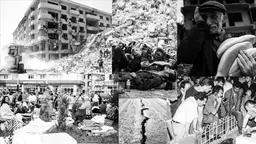

+1 More

Date and Time | 17 August 1999, 03:02 (TST) | ||||||||
|---|---|---|---|---|---|---|---|---|---|
Magnitude | Mw 7.4 | ||||||||
Epicenter | Gölcük (Kocaeli) | ||||||||
Fault Line | North Anatolian Fault Zone (NAFZ) | ||||||||
Earthquake Duration | Approximately 45 seconds | ||||||||
Death Toll | ~18.000 (Official Data) | ||||||||
Injured Count | ~48.000 | ||||||||
Homeless | ~250.000 | ||||||||
Damaged/Destroyed Building | ~300.000 | ||||||||
The 1999 Gölcük Earthquake, which occurred in northwestern Türkiye on August 17, 1999, at 03:02 AM local time, was a seismic and historical event for Türkiye with a moment magnitude of 7.4. Its epicenter was determined as the Gölcük district of Kocaeli province. The earthquake occurred on the western segment of the North Anatolian Fault Zone. Lasting approximately 45 seconds, this earthquake affected Türkiye's Marmara Region.
The earthquake occurred on the North Anatolian Fault Line (NAF), which is located at the boundary between the Eurasian and Anatolian plates. NAF, a strike-slip fault, is one of Türkiye's most active tectonic structures. The rupture in 1999 led to a surface rupture in the western segment of the fault line, spanning approximately 120 km. Observed deformations on the surface showed characteristic right-lateral strike-slip faulting examples.
The earthquake was intensely felt, especially in Kocaeli, as well as in the provinces of Yalova, Sakarya, Istanbul, Bursa, Bolu, and Düzce. In areas close to the epicenter, soil liquefaction, building collapses, and infrastructure damage occurred. Approximately 300,000 residences and workplaces were damaged. A large portion of the damaged areas consisted of buildings not subject to the building inspection system or that had received low engineering services.
"25 years have passed since the August 17 Marmara Earthquake." (TGRT Haber)
According to official statements, approximately 18,000 people lost their lives. The number of injured persons is over 48,000. Approximately 250,000 people became homeless due to the disaster. The majority of deaths occurred as a result of building collapses. Additionally, environmental impacts were observed due to damage in industrial zones and industrial accidents (e.g., Tüpraş İzmit Refinery fire).
The earthquake occurred in Türkiye's most densely industrialized region. Large-scale industrial establishments and infrastructure networks (highways, railways, energy transmission lines) in the Marmara Region were damaged. Disruptions in the communication infrastructure caused delays in post-disaster aid and response processes. Interruptions occurred in energy, water, and transportation services.
Initial post-disaster responses focused on search and rescue and evacuation efforts. Institutions such as the Turkish Armed Forces, Gendarmerie General Command, Civil Defense, and Red Crescent were on duty in the field. However, due to road closures and damage to communication infrastructure in some areas, regional differences occurred in interventions. International humanitarian aid teams also reached the disaster zone.
Following the earthquake, structural changes in disaster management policies came to the agenda in Türkiye. In 2001, Law No. 4708 on Building Inspection came into force. To ensure disaster management and coordination, the Disaster and Emergency Management Presidency (AFAD) was established in 2009. Following these developments, disaster risk reduction strategies began to be developed at national and local levels.
Within the scope of population mobility that occurred after the earthquake, many people migrated from the disaster area. Temporary shelter areas were established; tent cities, container cities, and prefabricated houses were used as temporary solutions. Health, education, and social services continued in temporary settlement areas. Post-disaster psychosocial support activities were carried out in cooperation with the Ministry of National Education and the Ministry of Health.
August 17, 1999 Earthquake - Gölcük (TRT Arşiv)
Technical investigations carried out after the earthquake identified settlements built without considering ground characteristics and inadequate engineering practices. These findings formed the basis for policies making ground surveys mandatory for new constructions, updating earthquake regulations, and transforming risky structures. The 1998 Earthquake Regulations were updated and revised in 2007 and 2018.
Anadolu Agency. "A quarter-century has passed since the August 17 Marmara Earthquake." Accessed July 12, 2025. https://www.aa.com.tr/tr/gundem/17-agustos-marmara-depreminin-uzerinden-ceyrek-asir-gecti/3305405
AFAD. "The August 17, 1999 Earthquake Commemoration Ceremony Was Held in Gölcük with the Participation of the Minister of Interior." Accessed July 12, 2025. https://www.afad.gov.tr/17-agustos-1999-depremi-anma-toreni-golcukte-icisleri-bakaninin-katilimiyla-yapildi
TGRT News. "25 years have passed since the August 17 Marmara Earthquake! The Pains Were Not Forgotten." Accessed July 12, 2025. https://www.youtube.com/watch?v=gckBrGQv0yg
TRT News. "Unforgettable photos from the August 17 Marmara Earthquake." Accessed July 12, 2025. https://www.trthaber.com/foto-galeri/17-agustos-marmara-depreminden-unutulmayan-fotograflar/66816/sayfa-7.html
TRT Archive. "August 17 Earthquake - Gölcük." Accessed July 12, 2025. https://www.youtube.com/watch?v=ea_OKowB1Vc


Date and Time | 17 August 1999, 03:02 (TST) | ||||||||
|---|---|---|---|---|---|---|---|---|---|
Magnitude | Mw 7.4 | ||||||||
Epicenter | Gölcük (Kocaeli) | ||||||||
Fault Line | North Anatolian Fault Zone (NAFZ) | ||||||||
Earthquake Duration | Approximately 45 seconds | ||||||||
Death Toll | ~18.000 (Official Data) | ||||||||
Injured Count | ~48.000 | ||||||||
Homeless | ~250.000 | ||||||||
Damaged/Destroyed Building | ~300.000 | ||||||||
No Discussion Added Yet
Start discussion for "1999 Gölcük Earthquake" article
Geological Background
Area of Impact of the Earthquake
Human Casualties and Injuries
Impacts on Infrastructure and Industry
Disaster Response Process
Legal and Institutional Consequences
Societal Impacts and Population Mobility
Construction and Urban Planning
This article was created with the support of artificial intelligence.