


The 2030 Industry and Technology Strategy is a comprehensive policy document prepared by the Ministry of Industry and Technology of the Republic of Turkey and presented to the public at the presidential level. The strategy systematically outlines Turkey's key directions in industry and technology, its priority goals, and the mechanisms to be implemented, with a perspective extending to the year 2030. The document has been prepared in accordance with long-term planning principles and aims to ensure policy coherence across various structural areas and establish a multi-stakeholder governance framework.
The strategy document is structured around five main objectives. These objectives are: increasing domestic production capacity in high-tech and critical areas, accelerating the transition to a digital economy, transitioning to a green and circular economy, strengthening integration into global markets, and transforming the manufacturing industry based on productivity, capacity, and resilience. A total of 100 strategies and 20 macro-level objectives are defined under each goal, and 37 priority projects and programs have been identified to facilitate the achievement of these objectives.
The strategy encompasses a wide range of thematic areas, including industrial production, technology development, human resources, entrepreneurship, infrastructure, exports, and sustainability. It includes policy areas that directly concern not only public institutions but also the private sector, universities, research organizations, and civil society stakeholders. In this regard, the document serves as a central guide aimed at ensuring the coordination of Turkey’s industrial and technology policies.
The preparation process was carried out under the auspices of the Presidency, and the strategy was publicly announced by President Recep Tayyip Erdoğan at a launch event held on March 26, 2025, at the Presidential Complex. During the same meeting, large-scale industrial investments were shared with the public, and some specific projects and implementation tools included in the strategy were also revealed. Thus, the document not only sets strategic goals but also provides a programmatic framework that will be supported by concrete investments.
With these features, the 2030 Industry and Technology Strategy has been positioned as the primary policy document that will shape Turkey's production, technology, and development policies over the next decade. The document integrates industrialization and technological capacity, offering a multi-layered structure at sectoral, regional, and global levels.

2030 Industry and Technology Strategy (Ministry of Industry and Technology)
The primary goal of the 2030 Industry and Technology Strategy is to increase Turkey's domestic production capacity in high-tech manufacturing areas and ensure technological independence in these sectors. The transformation aimed in this context includes reducing dependence on foreign critical technologies, developing local solutions for strategic products and components, and establishing production infrastructure at scales that can commercialize these solutions. A total of 27 strategies have been defined under this objective, with a particular focus on sectors such as defense industry, space technologies, semiconductors, biotechnology, petrochemicals, and nuclear technology.
One of the key transformation areas within the strategy is the support for research and development (R&D) activities. In this regard, the strategy aims to create an innovation ecosystem in Turkey that prioritizes collaboration between the public sector, universities, and the private sector, covering all stages of the technology production chain. The document states that these efforts will be coordinated under the Industrialization Executive Committee, and that public procurement will be restructured to support domestic and innovative products.
The role of financial instruments in supporting domestic and national production is also addressed in the strategy. In this context, existing programs such as the HIT30 Technology-Focused Industry Initiative Program will be strengthened; new financial instruments, such as project-based incentive systems, investment-backed advance loans, and venture capital funds, will be implemented. This approach aims not only to promote technology production but also to ensure the transformation of this production into economic value.
The strategy also defines specific focus areas for next-generation technologies. These include high-impact technologies such as battery systems, hydrogen fuel cells, electronic fuel technologies, flying cars, and autonomous vehicles. R&D activities for these technologies, along with the establishment of production infrastructures and acceleration of commercialization processes, are also key targets.
Entrepreneurship is another complementary component of these transformation areas, as defined in the document. Structures such as Terminal Istanbul and the Entrepreneurship Offices (GO) are planned to support technology-focused start-ups. These structures aim to attract venture capital investments to Turkey while positioning the country as a hub for global technology entrepreneurship. The strategies under this heading focus not only on increasing technological capacity but also on ensuring the integration of this capacity into production, commercialization, and export processes. Thus, the strategy presents a holistic approach that horizontally connects all stages from R&D to production and from production to market transition.
The second and third goals of the 2030 Industry and Technology Strategy are defined under the headings of transition to a digital economy and alignment with the green and circular economy. These two areas foresee the restructuring of Turkey's industrial infrastructure in line with current global trends, aiming to develop a production and transformation policy centered on sustainability and digitalization.
The strategies prepared for digital transformation focus primarily on advanced manufacturing technologies in industry, the widespread adoption of digital platforms, strengthening cybersecurity infrastructure, and increasing the digital competencies of businesses. The development of fiber communication infrastructure, 5G, and beyond-generation communication technologies have been prioritized within these strategies. Additionally, the aim is to increase domestic production capacity through industrial robots and other advanced manufacturing solutions.
Digital transformation includes not only technology production but also the transformation of the human workforce, which is another critical area. In this context, the strategy aims to develop digital skills, ensure the adaptation of the workforce to new production models, and strengthen vocational education in this field. Furthermore, national digital infrastructure will be made more resilient through the use of domestic cybersecurity applications.
In addition to digitalization, the transition to a green and circular economy is also a core goal within the document. In this context, the third objective of the strategy is to reduce industrial carbon emissions and increase Turkey's alignment with its environmental sustainability goals. Adhering to international regulations such as the European Green Deal and the Carbon Border Adjustment Mechanism are among the key priorities.
The strategies defined within the green transformation focus on increasing domestic production capacity in renewable energy technologies, particularly solar and wind energy, establishing a green hydrogen ecosystem, and developing local solutions for carbon capture, utilization, and storage technologies. Additionally, technical and legal regulations will be implemented to integrate environmental sustainability into technology and production policies.
The strategy views digital and green transformation not only as independent technical areas but also as new guiding frameworks for industrialization. In line with this approach, the goals of digitalization and sustainability have been structured to be applied across a wide range of processes, from production processes to product design, from supply chains to export policies.
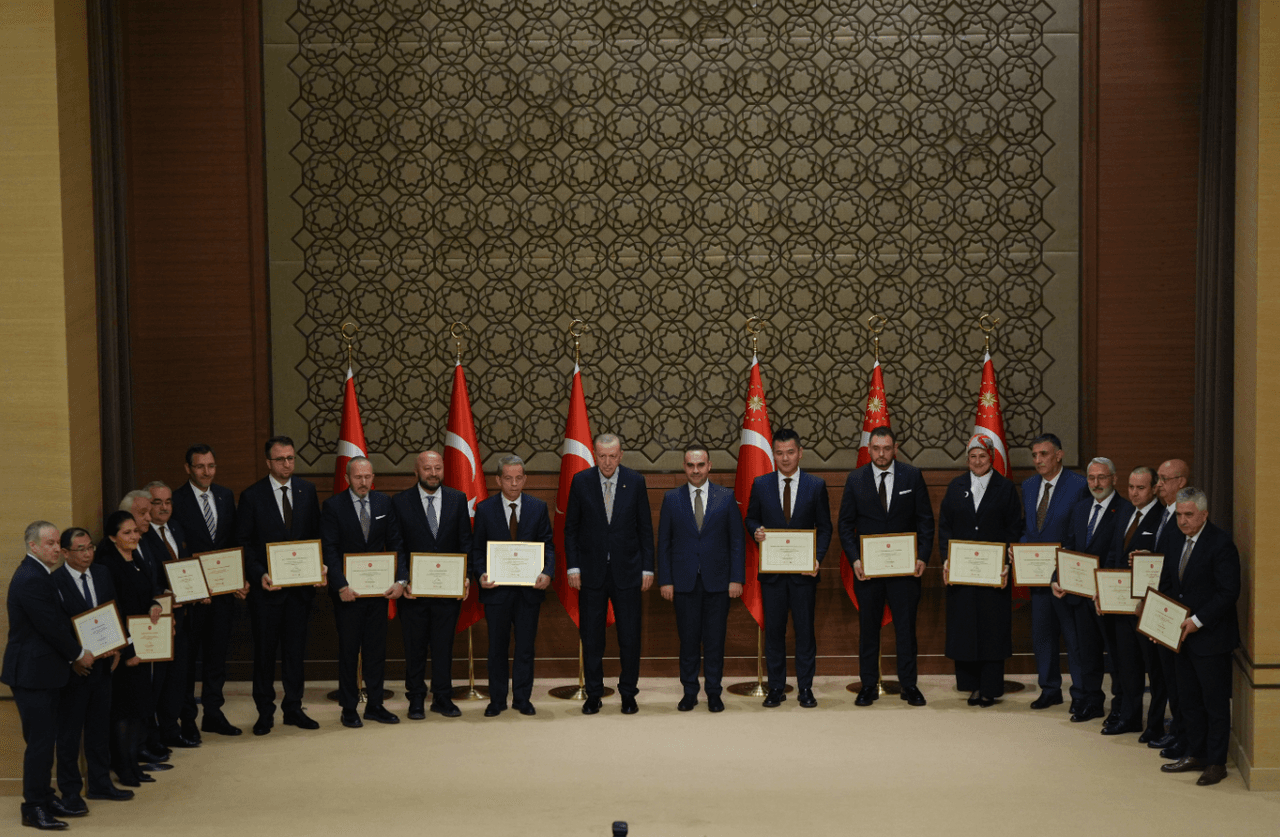
2030 Industry and Technology Strategy Meeting (Presidency of Communications)
The fourth and fifth objectives of the 2030 Industry and Technology Strategy aim to restructure Turkey's industrial infrastructure, strengthen integration into global markets, and support regional development by increasing the geographical diversity of production. In this context, the strategy focuses on spatial development tools such as the improvement of logistics networks, expansion of production infrastructure, and the creation of new industrial corridors.
The strategy proposes the establishment of new regional corridors to assess Turkey's strategic position in international trade. Development and trade corridors centered around El-Fao (Basra) and Zangezur (Caspian) are highlighted among the prominent projects in this regard. These corridors aim to strengthen Turkey’s production and logistics hubs and regional partnerships while securing access to critical raw materials.
Domestically, the strategy aims to increase the number and land area of industrial zones. Under the strategy, it is planned to expand the total size of organized industrial zones (OIZ), industrial zones, and new industrial areas to 350,000 hectares by 2030. Strengthening transportation connections to existing OIZs, renewing their infrastructure, and improving their resilience to disaster risks are prioritized in spatial planning.
Increasing access to financing for small and medium-sized enterprises (SMEs) is also defined as one of the tools supporting the geographical spread of industrialization. The strategy aims to support SMEs' scaling-up investments through specially structured banking systems tailored to industry and technology enterprises. Additionally, the plan includes the widespread adoption of efficiency-enhancing practices through model factories and production-oriented training centers.
Labor force policies are also a complementary component of this spatial transformation process. In this regard, the establishment of industry and technology colleges, strengthening reverse brain drain programs, and creating incentive mechanisms to encourage youth to pursue careers in science and technology are key targets. The strategy aims to employ skilled labor not only in major urban centers but also in newly established industrial hubs across the country.
The ultimate goal of all these policies is to diversify industrial production in a way that reduces regional imbalances, establish a production infrastructure supported by logistics networks, and create a more resilient and inclusive industrial ecosystem that can withstand crises. In this respect, the document adopts a structural approach that strengthens the spatial dimension of industrial policies.
Anadolu Ajansı. “Cumhurbaşkanı Erdoğan: Milli Muharip Uçağımız KAAN Seri Üretime Geçecek.” Erişim 14 Nisan 2024. https://www.aa.com.tr/tr/gundem/cumhurbaskani-erdogan-milli-muharip-ucagimiz-kaan-seri-uretime-gececek/3520374.
Sanayi ve Teknoloji Bakanlığı. 2030 Sanayi ve Teknoloji Stratejisi: Yüksek Teknoloji. Ankara: T.C. Sanayi ve Teknoloji Bakanlığı, Stratejik Araştırmalar ve Verimlilik Genel Müdürlüğü, Mart 2025. Erişim 14 Nisan 2025. https://www.sanayi.gov.tr/plan-program-raporlar-ve-yayinlar/strateji-belgeleri
Sanayi ve Teknoloji Bakanlığı. "2030 Sanayi ve Teknoloji Strateji Belgesi Açıklandı." Erişim 14 Nisan 2025. https://www.sanayi.gov.tr/medya/haber/2030-sanayi-ve-teknoloji-strateji-belgesi-aciklandi.
T.C. İletişim Başkanlığı. “Cumhurbaşkanı Erdoğan 2030 Sanayi ve Teknoloji Stratejisi Tanıtım Toplantısı’nda Konuştu.” Erişim 14 Nisan 2024. https://www.iletisim.gov.tr/turkce/haberler/detay/cumhurbaskani-erdogan-2030-sanayi-ve-teknoloji-stratejisi-tanitim-toplantisinda-konustu.
İstanbul Sanayi Odası. “Cumhurbaşkanı Recep Tayyip Erdoğan’ın Katılımıyla 2030 Sanayi ve Teknoloji Stratejisi ile Büyük Ölçekli Sanayi Yatırımları Tanıtım Toplantısı Yapıldı.” Erişim 14 Nisan 2024. https://www.iso.org.tr/haberler/diger-haberler/cumhurbaskani-recep-tayyip-erdoganin-katilimiyla%C2%A02030-sanayi-ve-teknoloji-stratejisi-ile-buyuk-olcekli-sanayi-yatirimlari-tanitim-toplantisi-yapildi/

No Discussion Added Yet
Start discussion for "2030 Industrial and Technology Strategy" article
Strategic Transformation Areas: Technological Independence and Innovation Ecosystem
Green, Digital, and Integrated Economy Goals
The Geography of Industrialization: Logistics, Employment, and Spatial Development
This article was created with the support of artificial intelligence.