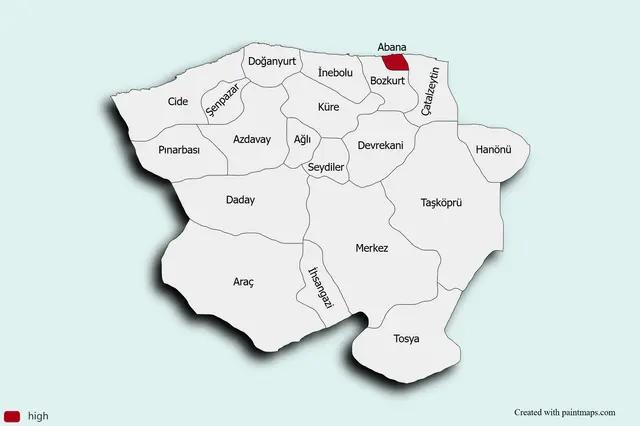
Abana (District)
Province(s) | Kastamonu | ||||||||
|---|---|---|---|---|---|---|---|---|---|
Area(s) | Black Sea | ||||||||
Altitude | 11 meters | ||||||||
Population (2024) | 4,419 | ||||||||
Mayor(s) | Seda Oyar | ||||||||
District Governor | Hilal Buse Ünal | ||||||||
Postal Code | 37970 | ||||||||
License Plate Code | 37 | ||||||||
Climate(s) | Black Sea climate | ||||||||
Economy | Tourism fishing and construction sectors | ||||||||
Abana is a small coastal district located northeast of Kastamonu on the Black Sea coast. The district experiences a period of increased tourism activity during the summer months due to its growing population. Its economy is primarily based on tourism, fishing, and construction.

Abana ( TC Kastamonu Municipality )
The oldest known name for Abana appears in ancient sources as Aiginetes; it is a coastal settlement in the Paphlagonian region, estimated to have been founded in the 7th century BC. While the town's founding date cannot be precisely determined, material finds from excavations in the Hacıveli neighborhood near the Kuruçay Valley indicate that the settlement dates back to 4,000–3,000 BC. The name "Apana," introduced by Strabo in his works as a small port town in Paphlagonian, was translated into Turkish as "Abana" because there is no equivalent for the "p" sound in the Arabic alphabet.
The first written record from the Ottoman period appears in the Anatolian Provincial Accounting Books dated 1530 (Hijri 937); at that time, Abana was identified as a village within the Ayandon district of the Kastamonu province. The 1880 census records indicate that it was granted sub-district status within the Inebolu district. Mehmed the Conqueror's positioning of the Black Sea fleet off Abana in 1461 demonstrates that the region retained its strategic port status during that period. While some of the Pontic Greeks in the region left during the 1923–24 population exchange, the transmission of the district's telephone wires to the front lines for use in the production of defensive equipment during the War of Independence provides a concrete example of local solidarity. In the early years of the Republic, Abana gained district status with its 83 villages and a district headman's office in 1945. However, it lost this status in 1953. Following a 1968 Constitutional Court decision, it regained its district status with its ten villages.
Abana extends over an area of 33 km² on the Black Sea coast; its northern border is the sea, its west is Ezine and İlişi, its east is the Hacıveli and Kuğu streams and Çatalzeytin, and its south is the Bozkurt district. The district center is situated on a coastal plain at elevations ranging from 0 to 300 m. Coastal dunes connected to the 11 km-long coastline form a zone where marine and terrestrial ecosystems intersect, while the steep slopes extending from west to east bear traces of canyoning processes. The Iğrava and Karabalçık caves and the Siyelik cliffs contribute to the local geomorphology as examples of karst formations.
The vegetation consists of chestnut, pine, and oak forests along the coast, shrubs and bushes in the understory, and black pine and fir communities on the inland slopes. The Black Sea climate prevails, with mild summers and mild winters, and regular rainfall throughout the year. Humid climatic conditions support plant diversity, and no significant differences in temperature and precipitation distribution are observed between the coast and inland areas.
The total population of Abana district, which was 3,562 in 2007, increased to 4,419 in 2024. During this period, increases of 338, 413, and 317 people were observed in 2007–2008, 2012–2013, and 2017–2018, respectively, while decreases were observed at different rates in the other years. According to 2024 data, the male population was 2,315 (52.39%) and the female population was 2,104 (47.61%), with the gender gap generally remaining at a few dozen people. Annual population changes have followed a fluctuating course, which can be explained by factors such as residential registration updates and migration movements.
Abana's economy exhibits a multi-sectoral structure based on agriculture, animal husbandry, forestry, fishing, education, and tourism. The Sabahat-Mesut Yılmaz Vocational School, which was founded in 2010 and began operating in 2013, has added human capital and social mobility to the district. Due to geographical conditions, activities carried out on the limited arable land are generally aimed at meeting household consumption; fruit and vegetable production is carried out in 25 greenhouses, while kiwi orchards provide the basis for small-scale commercial cultivation. Chestnut honey and other bee products are produced within the scope of apiculture; four cooperatives (agricultural development, aquaculture, chamber of commerce, and industrial site cooperatives) provide production and marketing infrastructure. Fishing along the coast is a primary source of income for families. The construction sector and building materials trade fuel the activity of the weekly Wednesday market. In recent years, tourism investments have been based on the establishment of three resorts, three hotels, two motels, and a three-star hotel, which opened in 2013, as well as the widespread use of guesthouses.
Abana's tourist attraction is the dunes along the 11 km coastline of the Black Sea, offering opportunities for plateau and coastal ecotourism. While the swimming season falls between July and September, resorts along the coast offer a variety of accommodation options. The Ezine, İlişi, Hacıveli, and Kuğu River canyons, which run along the district's west-east axis, offer a wealth of trekking routes, while the Iğrava and Karabalçık caves attract visitors throughout the winter and winter seasons. Structures such as the Hacıveli Mosque (1805), Harmason Mosque (1846), and Merkez Hacıahmet Mosque (1947) reflect Ottoman-era stone and woodwork. Toza Seyir Tepesi (Toza Seyir Hill), the Urban Forest, and the Yeşilyuva Recreation Area host daily recreational activities.
The Abana Culture, Arts, and Marine Festival, held annually from July 27–30, attracts local and international visitors to the region with concerts, sports, and cultural workshops. During the festival, social venues throughout the district are opened to visitors, and local artisans and producers have the opportunity to showcase their agricultural and handicraft products.
Abana cuisine is based on apiculture, fishing, and small-scale fruit and vegetable production, which are the mainstays of the region's economy. Chestnut honey and other bee products are used in desserts and sauces, as well as breakfast. Family-run businesses along the coast offer freshly caught seafood daily. Kiwifruit production creates opportunities for processing jams, marmalades, and juices beyond fresh consumption. These products, marketed with the support of agricultural cooperatives, enhance the dietary diversity of both accommodation guests and the local population.
Republic of Türkiye Abana Municipality. “History of Abana.” Abana Municipality. Access date: May 11, 2025. https://www.abana.bel.tr/abana-tarihi
Republic of Türkiye Abana Municipality. “Places to Visit.” Abana Municipality. Access date: May 11, 2025. https://www.abana.bel.tr/gezilecek-yerler
Republic of Türkiye Abana Municipality.“Abana Economy.” Abana Municipality. Access date: May 11, 2025. https://www.abana.bel.tr/abana-ekonomisi
Republic of Türkiye Abana Municipality.“Tourism in Abana.” Abana Municipality. Access date: May 11, 2025. https://www.abana.bel.tr/abanada-turizm
Republic of Türkiye Ministry of Culture and Tourism, Kastamonu Provincial Directorate of Culture and Tourism. “Abana.” Kastamonu Provincial Directorate of Culture and Tourism. Access date: May 11, 2025. https://kastamonu.ktb.gov.tr/TR-63808/abana.html
Republic of Türkiye Ministry of Culture and Tourism. “Abana.” Culture Portal. Access date: May 11, 2025. https://kulturportali.gov.tr/turkiye/kastamonu/gezilecekyer/abana
Republic of Türkiye Ministry of National Education, Abana District National Education Directorate. “About Our Abana District.” Abana District National Education Directorate. Access date: May 11, 2025. https://abana.meb.gov.tr/www/abana-ilcemiz/icerik/5
TC Kastamonu Municipality. "Abana Beach." Kastamonu Municipality. Access date: May 11, 2025. https://www.kastamonu.bel.tr/abana-sahili
Turkish Statistical Institute (TurkStat). Address Based Population Registration System Results, 2024. Access date: April 20, 2025. https://data.tuik.gov.tr/Bulten/Index?p=Adrese-Dayali-Nufus-Kayit-Sistemi-Sonuclari-2024-53783

Abana (District)
Province(s) | Kastamonu | ||||||||
|---|---|---|---|---|---|---|---|---|---|
Area(s) | Black Sea | ||||||||
Altitude | 11 meters | ||||||||
Population (2024) | 4,419 | ||||||||
Mayor(s) | Seda Oyar | ||||||||
District Governor | Hilal Buse Ünal | ||||||||
Postal Code | 37970 | ||||||||
License Plate Code | 37 | ||||||||
Climate(s) | Black Sea climate | ||||||||
Economy | Tourism fishing and construction sectors | ||||||||
History
Geography and Climate
Population and Demography
Ecnomy
Tourism, Culture and Cuisine
This article was created with the support of artificial intelligence.