


Scientific Name(s) | Lycaon pictus | ||||||||
|---|---|---|---|---|---|---|---|---|---|
Distribution Area | Sub-Saharan Africa | ||||||||
Habitat | Woodlands and semi-arid regions Open savannas | ||||||||
Diet(s) | Carnivorous primarily medium-sized ungulates | ||||||||
Social Structure | Hierarchical packs Cooperative hunters | ||||||||
Conservation Status | Endangered (IUCN Red List) | ||||||||
African wild dog (Lycaon pictus) is a carnivorous mammal that inhabits open and forested areas of sub-Saharan Africa, notable for its social structure and hunting strategies. As a member of the Canidae family, this species is recognized for its distinct physical characteristics and complex social behaviors. In recent years, populations have experienced significant declines due to habitat loss, human-wildlife conflicts, and diseases. Consequently, scientific research on the African wild dog is crucial for the conservation of the species and for understanding its ecological role.
The African wild dog is a medium-sized carnivore with a body length ranging from 76 to 112 cm, a shoulder height of 61 to 78 cm, a tail length of 30 to 41 cm, and a weight between 17 and 36 kg. One distinctive feature that sets it apart from other canids is its four-toed paws. Its coat consists of irregular patches of black, yellowish-brown, and white, a pattern that helps individuals recognize one another. The species has short, rounded ears that enhance hearing ability, facilitating communication during hunts.

African Wild Dog (Generated by Artificial Intelligence)
Lycaon pictus, commonly known as the African wild dog, is found across various regions of sub-Saharan Africa, although its populations have become fragmented and isolated. The species primarily inhabits open savannas, wooded areas, and semi-arid regions. Protected areas such as Kruger National Park in South Africa and Gorongosa National Park in Mozambique play a critical role in sustaining existing populations and ensuring their long-term survival.
African wild dogs are well-known for their cooperative hunting strategies. Packs are typically organized under the leadership of an alpha breeding pair, with specific roles assigned to individual members during hunts. Their main prey consists of impalas, gazelles, and other medium-sized ungulates. Thanks to their remarkable speed and endurance, they are capable of pursuing prey over long distances. The success of the hunt results in a communal sharing of the captured food, which strengthens social bonds and promotes cooperation within the pack.
Genomic studies conducted on African wild dog populations in Kruger National Park reveal that despite low overall genetic diversity, these populations exhibit low levels of inbreeding. Nevertheless, limited genetic diversity poses a threat to the genetic health and long-term viability of the species. Enhancing genetic variability and preserving the existing gene pool are vital for the future conservation of Lycaon pictus.
Research from Kruger National Park indicates that the diet composition of African wild dogs varies depending on habitat type. Differences in landscape influence prey selection and feeding strategies, reflecting the species' ecological flexibility. This adaptability enhances their survival across diverse ecosystems, but changes in habitat and reductions in prey availability may negatively impact their feeding behavior.

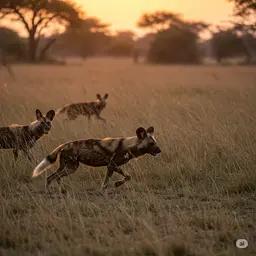
African Wild Dogs Hunting (Generated by Artificial Intelligence)
The African wild dog relocation project in Gorongosa National Park, Mozambique, is considered a significant success in the conservation of the species. This initiative aimed to reintroduce the species into its natural habitat and restore its ecological role within the ecosystem. The relocation process required careful management of habitat selection, availability of prey resources, and mitigation of human-wildlife interactions. Such projects are viewed as promising steps toward the protection and population recovery of the African wild dog.
Comparative genomic analyses have demonstrated that the African wild dog possesses distinctive genetic adaptations. These adaptations are linked to traits such as high-speed running ability, endurance, and cooperative hunting strategies. Genetic studies also provide valuable insights into the species' evolutionary history and its relationships with other members of the Canidae family. This knowledge contributes to the development of scientifically informed strategies for the species’ conservation and management.
The African wild dog (Lycaon pictus) is a species distinguished by its unique morphological and behavioral characteristics but faces multiple threats. Habitat loss, human-wildlife conflict, disease, and decreased genetic diversity jeopardize its long-term viability. Therefore, enhancing conservation efforts, protecting habitats, monitoring genetic diversity, and supporting relocation programs are of paramount importance. Continued scientific research and raising public awareness are critical for securing the future of the African wild dog.
Bouley, P., Paulo, A., Angela, M., Du Plessis, C., & Marneweck, D. G. (2021). The successful reintroduction of African wild dogs (Lycaon pictus) to Gorongosa National Park, Mozambique. PLoS ONE, 16(4), e0249860. https://doi.org/10.1371/journal.pone.0249860
Chavez, D. E., Gronau, I., Hains, T., Kliver, S., Koepfli, K., & Wayne, R. K. (2019). Comparative genomics provides new insights into the remarkable adaptations of the African wild dog (Lycaon pictus). Scientific Reports, 9(1). https://doi.org/10.1038/s41598-019-44772-5
Crossey, B., Chimimba, C., Du Plessis, C., Ganswindt, A., & Hall, G. (2021). African wild dogs (Lycaon pictus) show differences in diet composition across landscape types in Kruger National Park, South Africa. Journal of Mammalogy, 102(5), 1211–1221. https://doi.org/10.1093/jmammal/gyab087
Meiring, C., Schurz, H., Van Helden, P., Hoal, E., Tromp, G., Kinnear, C., Kleynhans, L., Glanzmann, B., Van Schalkwyk, L., Miller, M., & Möller, M. (2022). African wild dogs (Lycaon pictus) from the Kruger National Park, South Africa are currently not inbred but have low genomic diversity. Scientific Reports, 12(1). https://doi.org/10.1038/s41598-022-19025-7

Scientific Name(s) | Lycaon pictus | ||||||||
|---|---|---|---|---|---|---|---|---|---|
Distribution Area | Sub-Saharan Africa | ||||||||
Habitat | Woodlands and semi-arid regions Open savannas | ||||||||
Diet(s) | Carnivorous primarily medium-sized ungulates | ||||||||
Social Structure | Hierarchical packs Cooperative hunters | ||||||||
Conservation Status | Endangered (IUCN Red List) | ||||||||
No Discussion Added Yet
Start discussion for "African Wild Dog (Lycaon pictus)" article
Morphological Characteristics
Distribution and Habitat
Social Behavior and Hunting Strategies
Genetic Diversity and Conservation Status
Feeding Ecology
Relocation and Conservation Efforts
Genetic Adaptations and Evolutionary Traits
Conservation Approaches
This article was created with the support of artificial intelligence.