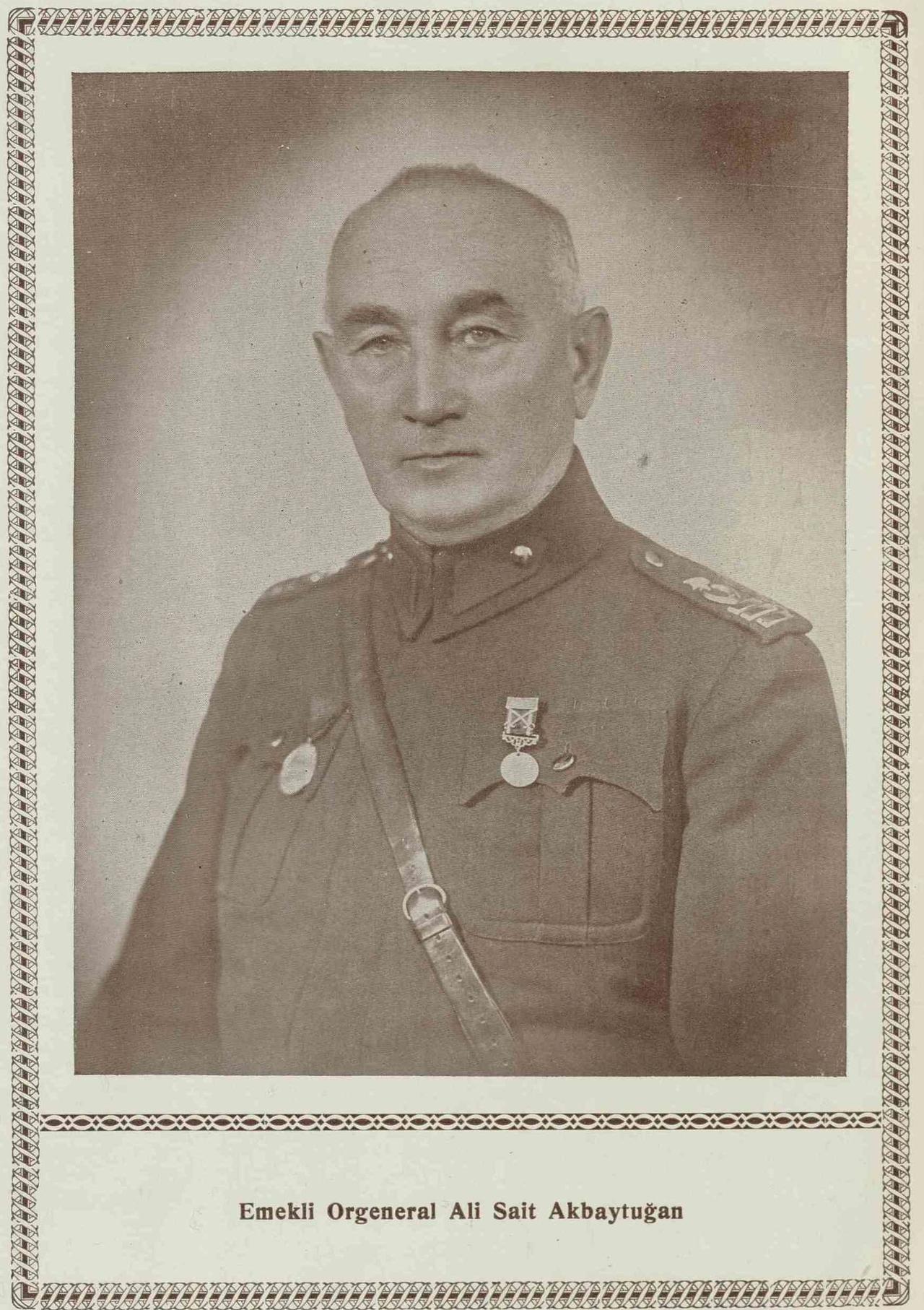



Ali Sait Bey participated in the Tripolitania, Balkan, First World War, and Independence Wars, and also served as a member of parliament after the establishment of the Republic. He assumed important responsibilities during the organization of the Turkish army.
Ali Sait Bey was born in 1872 in Hacı Osman Village, part of the Manyas district of Balıkesir. His father, Khunca Kasbolet (Canbulat) Bey, of Circassian origin, was killed in action during the 1877–1878 Russo-Turkish War; his mother was Ayşe Hanım. He began his education at the Bursa Military Secondary School and continued at the War School, followed by the War Academy. He graduated in 1896 as a second lieutenant and in 1898 as a staff captain.
After completing the War Academy, he held various posts in the General Staff and field units. He served in different regions including Edirne, Mosul, Baghdad, Istanbul, and Yemen. He was promoted to Kolağası in 1901, Binbaşı in 1907, Yarbay in 1911, Albay in 1913, and Tümgeneral in 1915.
He gained prominence due to his success in the Laheç Victory. At the end of the First World War, he was captured by the British in Yemen and held in Egypt before returning to Istanbul in 1919.
After the occupation of Istanbul, he was exiled to Malta in 1920. Following his release in 1921, he moved to Anatolia. He participated in the organization of the Eastern Front and in administrative efforts in Kars, Ardahan, and Batum. In 1922, he held positions including President of the Military Court of Appeals and Commander of the 9th Corps. He was awarded the Independence Medal by the Grand National Assembly of Türkiye.
After the proclamation of the Republic, he played an active role in the reorganization of the army. In 1924 he was appointed Commander of the 4th Corps, followed by appointments as Inspector of the 1st and 3rd Armies. He was promoted to the rank of orgeneral in 1927. In 1935 he was appointed member of the Military Council. He retired in 1937 upon reaching the mandatory retirement age.
He served two terms as a member of parliament for Kocaeli, from 1937 to 1939 and from 1939 to 1943. He held positions on the Budget Committee and various specialized committees.
He died on 20 March 1950 in Istanbul and was buried in Zincirlikuyu Cemetery. His wife, Naciye Hanım, preserved his memory by constructing a hospital pavilion in his honor.
Canbek, Orkun. “Ali Sait Akbaytugan (1872-1950).” *Atatürk Ansiklopedisi*. Date Published May 21, 2023. Accessed July 7, 2025. https://ataturkansiklopedisi.gov.tr/detay/3964/Ali-Sait-Akbaytugan-(1872-1950)
Turkish Ministry of National Defense. "Ali Sait Akbaytugan – Orgeneral (1311 - c.P.1) (1872 - 1950)." *ATA Genelkurmay Arşivleri*. Accessed July 7, 2025. https://ata.msb.gov.tr/Genel/icerik/ali-sait-akbaytugan

No Discussion Added Yet
Start discussion for "Ali Sait Akbaytugan" article
Early Life and Education
Service in the Ottoman Army
National Struggle Period and Assignments
Military and Political Activities in the Republic Era
Death and Legacy