+1 More

Registration Number | 679 | ||||||||
|---|---|---|---|---|---|---|---|---|---|
Registration Date | 18.02.2021 | ||||||||
Applicant/Registrant(s) | Antakya Chamber of Commerce and Industry | ||||||||
Type of Registration | Designation of Origin | ||||||||
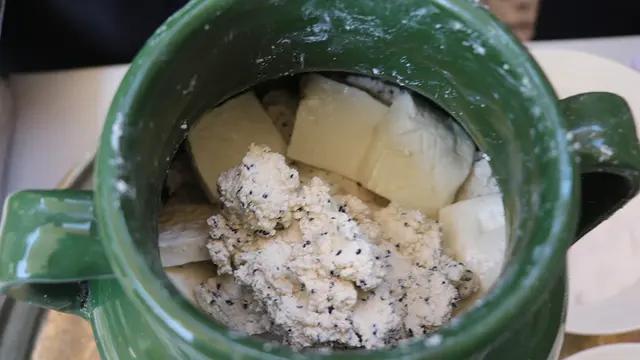
Antakya carra cheese is a traditional cheese variety produced within the districts of Antakya, Arsuz, Belen, Yayladağı, Altınözü, and Reyhanlı in Hatay province, Türkiye. It was registered as a designation of origin by the Turkish Patent and Trademark Office (Türk Patent ve Marka Kurumu) on February 18, 2021. The product is made by placing cheese obtained from raw cow’s or goat’s milk and curd made from cow’s milk into locally crafted earthenware pots known as carra, sealing them airtight, and burying them underground for a minimum of 4 months for maturation.
Due to its unique production method and the specific geographical conditions of the region, Antakya carra cheese possesses the following characteristics:
The cheese is prepared by adding curd along with black cumin (Nigella sativa) and optionally zahter (a local thyme-based herb blend). The composition of the curd also falls within specified ranges.
The production of Antakya carra cheese consists of three main stages: cheese making, curd preparation, and pressing into the carra followed by maturation.
Steps for curd production include:
All stages of production, processing, and maturation of Antakya carra cheese must take place within the districts of Antakya, Arsuz, Belen, Yayladağı, Altınözü, and Reyhanlı in Hatay province. This ensures the preservation of traditional knowledge and the product’s unique characteristics.
Inspections are conducted under the coordination of the Antakya Chamber of Commerce and Industry (Antakya Ticaret ve Sanayi Odası). The inspection authority consists of representatives from the following institutions:
Regular inspections are carried out at least once a year. Additional inspections are conducted when deemed necessary or upon complaints. Inspections focus on the following criteria:
Anadolu Ajansı. “Hatay'ın tescilli peyniri, aylarca toprak altında saklanarak olgunlaştırılıyor.” Published on September 14, 2022. Accessed July 15, 2025. https://www.aa.com.tr/tr/yasam/hatayin-tescilli-peyniri-aylarca-toprak-altinda-saklanarak-olgunlastiriliyor/2643950
Antakya Ticaret ve Sanayi Odası. Antakya Carra Peyniri – Tescil Belgesi (No. 679). Geographical indication registration dated February 18, 2021. Accessed July 15, 2025. https://www.hataytso.org.tr/uploads/general/1621332209-703874.pdf

Registration Number | 679 | ||||||||
|---|---|---|---|---|---|---|---|---|---|
Registration Date | 18.02.2021 | ||||||||
Applicant/Registrant(s) | Antakya Chamber of Commerce and Industry | ||||||||
Type of Registration | Designation of Origin | ||||||||
No Discussion Added Yet
Start discussion for "Antakya Carra Cheese" article
Distinctive Features
Composition of Antakya Carra Cheese:
Production Method
Cheese Making
Curd Preparation
Pressing into Carra and Maturation
Processes Required Within the Geographical Boundary
Inspection and Control
This article was created with the support of artificial intelligence.