

+2 More

Aphrodisias Ancient City
Location | Karacasu Türkiye Aydın | ||||||||
|---|---|---|---|---|---|---|---|---|---|
Foundation | 5th millennium BCE (initial settlement); urbanization: Hellenistic Period | ||||||||
Named After | Aphrodite (Goddess of love and beauty) | ||||||||
Prominent Period | Roman Empire | ||||||||
Key Features | Art, Sculpture, Marble quarries | ||||||||
UNESCO World Heritage Site | Since 2017 | ||||||||
Historical Period(s) | Ottoman Period Late Roman – Byzantine Period Roman Period Hellenistic Period | ||||||||
Major Structures | Temple of Aphrodite, Theatre, Stadium, Sebasteion, Agora, Hadrianic Baths, Tetrapylon, Bouleuterion (Council House) | ||||||||
Aphrodisias Ancient City is located within the boundaries of Karacasu district in Aydın Province, Türkiye. The city takes its name from Aphrodite, the Greek goddess of love and beauty. In antiquity, Aphrodisias was an important cult center, and it experienced significant development in the fields of art, sculpture, and architecture, especially during the Roman period. The ruins of the city are exhibited today at the Aphrodisias Archaeological Site and Museum. Excavations conducted in the second half of the 20th century have revealed numerous new insights into the history and significance of the city.

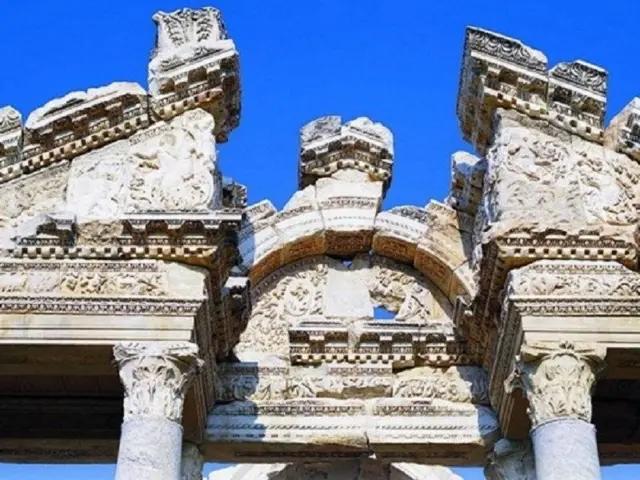
Tetrapylon -Kültür ve Turizm Bakanlığı
The earliest signs of settlement in the region of Aphrodisias date back to the Neolithic Age (circa 5000 BCE). However, the systematic development of the site as an urban settlement began during the Hellenistic Period (4th century BCE). The name of the city derives from Aphrodite, the Greek goddess of love and beauty. The cult of Aphrodite formed the foundation of the region's religious structure and played a significant role in the city's growth.
During the Hellenistic era, Aphrodisias was a small settlement within the region of Caria. The city thrived thanks to the fertile agricultural lands surrounding it, and it gained prominence through agriculture and trade. In the 2nd century BCE, the city witnessed political struggles among various city-states, yet it managed to maintain its status as an independent polis.
Aphrodisias gained significant importance as part of the Roman Empire’s Province of Asia. In the 1st century BCE, the city established strong ties with Rome and, particularly during the reigns of Julius Caesar and Augustus, was granted privileged status. Emperor Augustus is known to have taken a special interest in Aphrodisias, granting it tax exemptions and political autonomy. These privileges enabled the city to flourish economically and culturally.
During this period, the city underwent extensive architectural development. Monumental buildings such as the Temple of Aphrodite, the Sebasteion, the Theatre, the Agora, the Stadium, and the Bouleuterion (Council House) were constructed. Aphrodisias's greatest artistic achievement was in the field of sculpture. Thanks to its high-quality marble quarries and renowned sculpture school, the city became one of the leading artistic centers of the Roman world.

Sculptures Found in Aphrodisias - Müze Kart
The Sebasteion in Aphrodisias was dedicated to the Roman emperors and symbolized the strong ties between Rome and the city. The reliefs within the Sebasteion reflect the ideology of the Roman Empire and its relationship with Aphrodisias, serving both political and cultural functions.
From the 3rd century CE onward, the general economic and political instability of the Roman Empire began to affect Aphrodisias. Despite this, the city remained an important center during the Late Roman Period. With the adoption of Christianity as the official religion in the 4th century, several pagan temples in the city were converted into churches. Notably, the Temple of Aphrodite was transformed into a Christian basilica, marking a shift in the city's religious landscape.
During the Byzantine era, the city continued as a Christian religious center. The cult of Aphrodite was replaced by Christian worship, and the city was renamed Stauropolis, meaning “City of the Cross.” This renaming reflected Byzantine efforts to emphasize the city's Christian identity.
Like many other cities in Anatolia, Aphrodisias suffered from Arab raids and regional conflicts during this period. The Arab incursions in the 7th century caused significant damage to the city and led to a gradual population decline.
Throughout the Middle Ages, Aphrodisias declined into a small and weakened settlement. It lost much of its former significance during the Byzantine era due to internal strife and external threats. From the 11th century onwards, the region came under the control of various Turkish principalities following Turkish incursions into Anatolia. During the Ottoman period, the area remained a rural settlement.
Although Ottoman records contain limited information about Aphrodisias, it is known that the ancient site was largely abandoned and a small village named Geyre was established in its place. For many years, local villagers reused marble blocks from the ruins in the construction of new buildings.
The rediscovery of Aphrodisias began in the late 19th century, initiated by visits from Western travelers. However, systematic archaeological excavations only began in 1961 under the direction of Kenan Erim. His pioneering work uncovered the city’s rich history and emphasized its archaeological significance.
Through these excavations, major structures such as the Temple of Aphrodite, the Sebasteion, the Agora, the Stadium, the Theatre, the Baths, and the Bouleuterion were unearthed and extensively studied. Findings related to the city’s famed sculpture school and marble craftsmanship revealed Aphrodisias as a significant center of art in the ancient world.
In the 1990s, the Aphrodisias Archaeological Site and Museum were established to preserve and display the excavated artifacts. In 2017, Aphrodisias was inscribed on the UNESCO World Heritage List, gaining international recognition. Excavations are ongoing, with new discoveries continuing to expand knowledge about the city’s past.
Aphrodisias is one of the best-preserved examples of Roman urban planning in the ancient world. The city’s architectural layout reflects typical elements of Roman design, featuring well-organized streets, monumental buildings, and public spaces. The extensive use of high-quality local marble and the presence of a renowned sculpture school earned Aphrodisias a distinguished reputation across the Roman Empire.

Aphrodisias Ancient City - T.C. Kültür ve Turizm Bakanlığı
The Temple of Aphrodite was the most important religious structure in the city and was dedicated to the goddess Aphrodite, from whom the city took its name. Initially constructed during the Hellenistic period, the temple underwent significant transformations during the Roman era. The structure followed a classical rectangular plan and originally featured a colonnaded courtyard (peristasis) from the Hellenistic period. During the Roman period, it was expanded and transformed into a more monumental form.
As Aphrodisias remained an important center for the cult of Aphrodite in Roman times, the temple evolved into a symbolic hub of imperial cult practices. During the Byzantine era, the Temple of Aphrodite was converted into a Christian church, leading to substantial alterations to its original structure.
The Theatre of Aphrodisias is a large structure built against the eastern slope of the city. While its initial construction dates back to the Hellenistic period, it was extensively modified during the Roman era. With a seating capacity of approximately 7,000, the theatre was used for both theatrical performances and official gatherings. It features the typical Roman theatre layout, consisting of a cavea (seating area), an orchestra, and a stage building (skene).
The stage building includes reliefs sculpted by local Aphrodisian artists. During the Roman period, the theatre played a vital role in the city's intellectual and artistic life. The decorative façade and sculptural adornments of the stage are considered outstanding examples of Aphrodisias’s sculptural tradition.
The Stadium of Aphrodisias is one of the best-preserved stadiums from the ancient world and is notable for its size. Measuring approximately 270 meters in length and 60 meters in width, it could accommodate around 30,000 spectators. During the Roman Empire, it was used for athletic competitions and gladiatorial games.

Aphrodisias Stadium - Müze Kart
The seating rows of the Aphrodisias Stadium were designed in a well-ordered oval layout, demonstrating the advanced engineering techniques of the Roman period. The stepped entrances and tiered stands on the northwest side of the structure allowed spectators to enter and find seating with ease. Although the stadium has suffered partial damage due to earthquakes over time, it remains remarkably well preserved to this day.
The Sebasteion is one of the most significant monumental structures in Aphrodisias, adorned with reliefs depicting Roman emperors and gods. It was conceived as both a religious and political complex, symbolizing the importance that the Roman Empire attributed to Aphrodisias.
On the façade of the Sebasteion, Roman emperors—most notably Augustus and Tiberius—are portrayed alongside deities. These reliefs express the divine authority of the Roman Empire and the city’s loyalty to Rome. The Sebasteion, structured as a three-story building, features mythological scenes and imperial propaganda imagery on its upper levels, reflecting both artistic mastery and political messaging.

Sebasteion - Kültür ve Turizm Bakanlığı
A significant portion of the reliefs from the Sebasteion has been unearthed through excavations and is now exhibited in the Aphrodisias Museum. These reliefs are among the finest examples of Roman imperial art, showcasing both mythological themes and political symbolism.
The Agora was the heart of Aphrodisias’s social and commercial life, forming a large open space surrounded by colonnaded porticoes. It served as a place for daily trade, public gatherings, and civic activities. Long porticoes on the east and west sides provided shelter from rain and sun. Shops and storage areas were likely located within the Agora, which played a vital role in the development of the city’s economy.
Bathhouses were central to Roman urban life, and Aphrodisias had several large bathing complexes. The most notable is the Hadrianic Baths, constructed during the reign of Emperor Hadrian. This bathhouse featured an advanced system of hot and cold water distribution.
Designed according to typical Roman bath architecture, it included a frigidarium (cold room), tepidarium (warm room), and caldarium (hot room). The walls and floors were decorated with marble cladding, and some areas also contained mosaic designs.
To meet the city’s water needs, Aphrodisias developed an extensive water supply system. Aqueducts and cisterns were discovered throughout the city, delivering clean water to public and private facilities. These features exemplify Roman engineering and significantly contributed to the comfort of daily life in the city.
The Tetrapylon is one of the most iconic structures in Aphrodisias and marked one of the city’s main entrances. This four-columned gateway likely signaled the start of the sacred road leading to the Temple of Aphrodite.
As a monumental entrance, the Tetrapylon reflects the aesthetic and engineering achievements of Roman architecture. It is adorned with intricately carved columns and decorative reliefs, enhancing the grandeur of the city’s approach.
The Bouleuterion served as the administrative center of the city, accommodating meetings of the city council. It had a seating capacity of approximately 1,750 people and was built in a semi-circular form, similar to Roman theaters. Reliefs carved by Aphrodisian artists were discovered on the stage area. Inscriptions around the structure provide information about the decisions and assemblies held there.
Aphrodisias was one of the leading centers of sculpture in the Roman world. Sculptures created by local masters were exported throughout the Roman Empire. The marble quarries surrounding the city enabled artists to produce works of exceptional quality.
Many of the sculptures uncovered during excavations are now on display at the Aphrodisias Museum. The museum houses Sebasteion reliefs, imperial statues, and mythological figures. The sculptural school of Aphrodisias became a major artistic tradition during the Roman era, earning the city widespread acclaim for its contributions to classical art.

Reliefs Found in Aphrodisias - T.C. Karacasu Kaymakamlığı
Aphrodisias was recognized in antiquity as a major religious center. The Temple of Aphrodite, the city's largest and most significant sacred structure, served as the focal point of spiritual life. Religious organizations and festivals that developed around the temple reinforced the city’s sacred atmosphere and drew worshippers from across the region.
During the Roman period, Aphrodisias also gained prominence as a center of imperial cult worship. The construction of the Sebasteion played a key role in this transformation, symbolically linking Roman emperors with deities and promoting the divine status of the imperial family. This reinforced the ideological and political integration of the city within the Roman Empire.
Throughout its history, Aphrodisias stood as a vital religious, cultural, and artistic hub. The city experienced significant growth during the Roman era and earned renown particularly for its achievements in sculpture. The structures unearthed through excavations and archaeological studies highlight Aphrodisias’s status and significance in the ancient world. Preserving and researching the city continues to be of great value for both scholarly work and cultural heritage.
Aphrodisias. "Aphrodisias Tarihçesi ve İlk Kazılar." Access Date: 13.03.2025. https://www.aphrodisias.org/aphrodisias-tarihcesi-ve-ilk-kazilar
Müze Kart. "Afrodisias Müzesi ve Örenyeri." Access Date: 13.03.2025. https://muze.gov.tr/muze-detay?SectionId=AFR01&DistId=AFR
T.C. Karacasu Kaymakamlığı. "Afrodisias." Access Date: 13.03.2025. http://www.karacasu.gov.tr/afrodisias
T.C. Kültür ve Turizm Bakanlığı. Kültür Varlıkları ve Müzeler Genel Müdürlüğü. "Afrodisias Antik Kenti (Aydın)." Access Date: 13.03.2025. https://kvmgm.ktb.gov.tr/tr-44400/afrodisias-antik-kenti-aydin.html
T.C. Kültür ve Turizm Bakanlığı. Kültür Varlıkları ve Müzeler Genel Müdürlüğü. "Aydın Afrodisias Müze Müdürlüğü." Access Date: 13.03.2025. https://kvmgm.ktb.gov.tr/TR-44066/aydin-afrodisias-muze-mudurlugu.html

Aphrodisias Ancient City
Location | Karacasu Türkiye Aydın | ||||||||
|---|---|---|---|---|---|---|---|---|---|
Foundation | 5th millennium BCE (initial settlement); urbanization: Hellenistic Period | ||||||||
Named After | Aphrodite (Goddess of love and beauty) | ||||||||
Prominent Period | Roman Empire | ||||||||
Key Features | Art, Sculpture, Marble quarries | ||||||||
UNESCO World Heritage Site | Since 2017 | ||||||||
Historical Period(s) | Ottoman Period Late Roman – Byzantine Period Roman Period Hellenistic Period | ||||||||
Major Structures | Temple of Aphrodite, Theatre, Stadium, Sebasteion, Agora, Hadrianic Baths, Tetrapylon, Bouleuterion (Council House) | ||||||||
History of Aphrodisias
Early Period and Foundation
Roman Period and the Golden Age (1st century BCE – 3rd century CE)
Late Roman and Early Byzantine Period (3rd – 7th Century CE)
Medieval and Ottoman Period (8th – 19th Century CE)
Modern Excavations and Preservation Efforts (20th – 21st Century)
Urban Architecture and Key Monuments
Temple of Aphrodite
Theatre
Stadium
Sebasteion
Agora (Marketplace) and Porticoes
Baths and Water Structures
Tetrapylon (Monumental Gate)
Council House (Bouleuterion)
Sculpture and Art
Religious Significance of Aphrodisias and Its Role as a Cult Center
This article was created with the support of artificial intelligence.