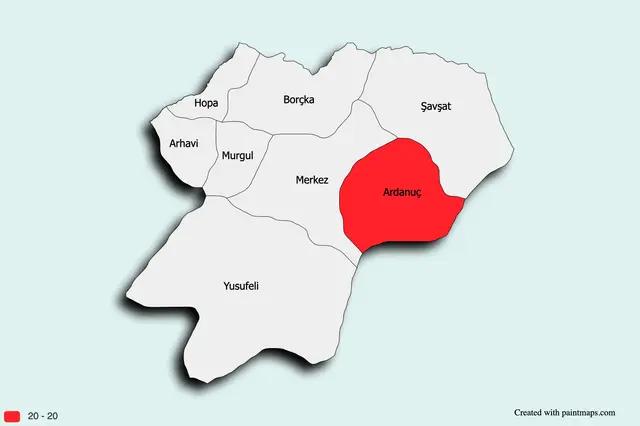
Ardanuç (District)
Province(s) | Artvin | ||||||||
|---|---|---|---|---|---|---|---|---|---|
Area(s) | Eastern Black Sea Region | ||||||||
Mayor(s) | Emrah Yilmaz | ||||||||
District Governor | Alparslan Sozen | ||||||||
Population | 11,006 (2024) | ||||||||
Basic Livelihoods | Livestock farming Agriculture | ||||||||
Major Tourist and Cultural Assets | Ardanuç House / Culture House Çürüspil Plateau Hell Creek Canyon Ruins of Rabat Church Ferhatlı Castle Gevhernik Castle | ||||||||
Ardanuç is a district in northeastern Türkiye, located east of Artvin province. The district center is located at an elevation of 500 meters and covers an area of 989 km², 37 km from the city center via the Artvin–Göle–Ardahan highway. The region exhibits a typical continental climate and consists of 49 villages.

Çuruspil Plateau, Ardanuç ( TC Ardanuç District Governorship )
The district of Ardanuç, located at the intersection of Anatolia and the Caucasus, has witnessed the dominance of numerous civilizations throughout history and is a significant settlement center distinguished by its rich cultural and historical heritage. The first traces of settlement in the region date back to the 8th century BC, during which time Ardanuç and its surrounding area were under Urartian rule. Following the Urartians, the Sakas and Scythian Turks settled in the region in the 7th century BC, and these ancient Turkic communities played a decisive role in the formation of Ardanuç's early ethnic structure.
After 75 AD, Ardanuç was settled by the Khazars, Barsians, and Bagratids, all members of the ancient Oghuz tribes. From this period on, the region gained importance as a transit and settlement area for Turkic communities arriving from the Caucasus. In the 810s, Ardanuç came under the rule of the Georgian Kingdom, and traces of Georgian culture are observed in the region during this period.
Beginning in the 11th century, with the Anatolian Seljuk State's eastern raids, Turkish settlements in and around Ardanuç increased. During the Seljuk period, the region came under Turkish-Islamic influence, both politically and culturally. Subsequent Mongol invasions also affected Ardanuç, and the region remained under Ilkhanate rule for a time. In the 14th and 15th centuries, Ardanuç fell under the rule of Timur, the Karakoyunlu, the Akkoyunlu, and the Safavids, and experienced various political controls during this period, becoming a border region that changed hands over time.
The transition to the Ottoman period occurred in 1551. Ottoman forces under the command of İskender Pasha, the Erzurum Governor of Suleiman the Magnificent, conquered Ardanuç and annexed it to Ottoman territory. After this date, Ardanuç was organized as the "Sanjak of Ardanuç" within the Ottoman administrative structure, and Ottoman rule in the region was stabilized.
In accordance with the agreement signed after the Russo-Turkish War of 1877–1878 (the 93 War), Ardanuç was temporarily transferred to Russian control. However, following referendums held in the region during World War I, Ardanuç was re-joined by Ottoman rule.
Following the Armistice of Mudros, Ardanuç was occupied first by the British and then by the Georgians. These temporary dominances in the region were ended through diplomatic initiatives led by the Turkish Grand National Assembly government. With the Treaty of Gyumri on March 7, 1921, Ardanuç was incorporated into Türkiye, remaining within the borders of the Republic of Türkiye. This date is recognized as Ardanuç's liberation day.
Administered as a sub-district of Artvin in the early years of the Republic, Ardanuç gained district status in 1945, thus reshaping its administrative structure. Today, Ardanuç is a district with a multi-layered history bearing the traces of numerous civilizations throughout history and is a settlement of historical and cultural significance on both a regional and national scale.
Ardanuç district, located in the east of Artvin province at the intersection of the Eastern Black Sea and Eastern Anatolia regions, is a settlement with a rather rugged topography. With an area of 989 square kilometers, the district borders Şavşat to the north, Yusufeli and Olur districts of Erzurum to the south, Ardahan to the east, and the central district of Artvin to the west.
The district center, at an elevation of approximately 500 meters, is geographically surrounded by the Kurdevan, Yanlızçam, and Horosan Mountains. These mountain ranges are key factors in shaping both Ardanuç's physical structure and climate. The district's land is generally fractured. Deep valleys, steep slopes, and high plateaus are characteristic of the district.
Among the major streams flowing through Ardanuç, the Ardanuç Stream stands out, fed by smaller tributaries such as the Bulanık, Horhot, and Ekşinar streams, as well as the Güleş Stream. These streams play a significant role in agricultural irrigation of residential areas and in shaping the natural landscape.
An examination of the district's land use reveals that 32% consists of forested areas, 8% of meadows and pastures, and 56% of the land is unsuitable for agriculture. Only around 11% of the land is suitable for agriculture. This suggests that agricultural activities in Ardanuç are spatially limited and based on subsistence production.
The district generally has a continental climate. Summers are hot and dry, while winters are cold and snowy. This climate type causes harsh winters, especially in higher elevations. The climate can exhibit microclimatic variations depending on the landforms. While valleys and streambeds experience milder climate characteristics, winters are harsher in mountainous areas.
Ardanuç is approximately 39 kilometers from Artvin city center. The Artvin–Göle–Ardahan highway, which runs through the district, provides transportation. This road is a key link between Ardanuç and Artvin city center, as well as neighboring provinces like Erzurum and Ardahan, supporting both trade and social connections.
Administratively, Ardanuç consists of one central municipality and 49 villages. Most of the villages have scattered settlement patterns. The rugged terrain has resulted in settlements being isolated and far from one another, making transportation and infrastructure services between villages difficult.
As a result, the Ardanuç district has a settlement structure shaped by its mountainous and fractured topography, abundance of unsuitable land for agriculture, and continental climate conditions. While its geographical structure limits the population density, its natural resources and ecosystem offer significant potential for the region.
Ardanuç district is located in the northeast of Artvin province, and as of 2024, it had a total population of 11,006. Of this population, 5,729 are male and 5,277 are female. The district center has a population of 5,376, while the population living in the villages is 5,630. Ardanuç consists of one municipality and 49 villages.
The majority of the district's population is engaged in agriculture and animal husbandry. However, due to the rugged terrain and limited arable land, economic activities are limited. This has led to a migration of young people, especially, to larger cities in search of employment opportunities. Villages are characterized by scattered settlements and limited access to infrastructure, making life in rural areas difficult and encouraging migration.
Ardanuç has a high proportion of elderly people in its population. This, coupled with the migration of younger people, is causing the proportion of elderly people in the district to increase. Furthermore, there are limitations to access to education and healthcare. These factors impact the district's demographic structure and quality of life.
As a result, despite its natural beauty and historical riches, the Ardanuç district faces economic and social challenges. An aging population, the exodus of young people, and inadequate infrastructure are the primary factors hindering the district's sustainable development. Addressing these challenges requires coordinated efforts and investments from local and central governments.
Ardanuç district, located in Artvin province, is a predominantly rural settlement. The district's overall economic structure is largely based on animal husbandry and limited agricultural activities. The challenging geographical conditions have significantly limited the development of agricultural and industrial investments, leading to the continuation of traditional production methods.
Livestock farming forms the basis of Ardanuç's economy. Both large and small livestock are raised in the district, with cattle breeding being particularly prevalent. Livestock farming, conducted using a pasture-based grazing system, is locally important for both meat and milk production. The practice of transhumance, which involves moving to the highlands during the summer months, still continues in some places in a traditional manner.
Agricultural activities are limited due to the district's largely mountainous and rugged terrain. Approximately 11% of arable land is utilizable, primarily for growing tobacco, wheat, barley, corn, and beans. Tobacco farming, in particular, has historically been a significant source of income in the district, but has declined in recent years due to diminishing government purchasing guarantees and rising costs.
Beekeeping is another economic activity with potential for growth in Ardanuç. The district's rich flora and extensive forests provide a suitable environment for the production of natural hives. Some locals engage in beekeeping for both subsistence and commercial purposes, and the resulting honey is marketed in surrounding provinces and districts.
Forestry is a significant economic activity in Ardanuç thanks to its forest resources. However, activities in this area are largely limited to controlled felling and fuelwood production, with no industrial-scale production. Carpentry and small-scale woodworking remain traditional crafts, particularly in the villages.
Industrial activity in the district is quite limited. Aside from food production, flour mills, and small-scale manufacturing facilities, there are no organized industries or large-scale production facilities. Agricultural and livestock cooperatives offer local solutions for processing and marketing products. The district also has a strong trade volume based on small businesses and the service sector.
As a result, Ardanuç's economic structure is largely shaped by nature-based subsistence activities, with a rural lifestyle dominating the district. Supporting agriculture and animal husbandry, expanding cooperative activities, and prioritizing rural development projects are crucial for strengthening the district's socioeconomic structure.
The Ardanuç district of Artvin province possesses significant tourism and cultural potential thanks to its historical structures, natural formations, and cultural venues. This identity is shaped by the ruins of medieval castles and churches, natural areas such as canyons and plateaus, and examples of traditional civil architecture and the spaces where these examples are exhibited. The resources provided provide a variety of information on these elements.
Gevhernik Castle (Ardanuç Castle) holds a significant place in the district's historical architectural heritage . Situated on a rock mass overlooking the town center, the castle's history is attributed in various sources to the Urartian period or later periods, and it is particularly noted that it served as a capital or important center during the Georgian Bagratid Kingdom. The surviving sections of the castle, which also served the Ottoman period, include walls, towers, and foundations.
Ferhatlı Castle , located near the village of Ferhatlı , is another historic defensive structure thought to have functioned more as a watchtower. The ruins of the Rabat Church in Bağlıca village (former Rabat) are also examples of religious architecture dating to the Bagratid period; the basilica-planned structure has survived to the present day in ruins. Other structures, such as the Ardanuç House and the Ardanuç Culture House , are reported to have been restored or rebuilt to reflect traditional civilian architecture .

Rabat Church ( TC Ardanuç District Governorship )
In terms of natural resources, the Ardanuç Cehennem Creek Canyon is one of the district's most well-known geographical formations. This canyon, considered one of the world's few high canyons, offers a suitable environment for nature tourism and trekking activities thanks to its steep and narrow structure. Another natural area in the district is the Çuruspil Plateau . Located at a certain altitude, this plateau, with its unique vegetation and geographical structure, can be used for plateau tourism and recreational activities.

Ardanuç Hell Creek Canyon ( TC Ardanuç District Governorship )
The Ardanuç region has a rich culinary tradition:
Artvin Governorship, Directorate of Culture and Tourism. “Ardanuç.” Access date: April 19, 2025. https://artvin.ktb.gov.tr/TR-55834/ardanuc.html
Artvin Governorship, Directorate of Culture and Tourism. “Ardanuç Ferhatlı Castle.” Access date: April 19, 2025. https://artvin.ktb.gov.tr/TR-55866/ardanuc-ferhatli-kalesi.html
Artvin Governorship, Directorate of Culture and Tourism. “Ardanuç Gevhernik Castle.” Access date: April 19, 2025. https://artvin.ktb.gov.tr/TR-55864/ardanuc-gevhernik-kalesi.html
Artvin Governorship, Directorate of Culture and Tourism. “Bilbilan Plateau.” Access date: April 19, 2025. https://artvin.ktb.gov.tr/TR-55896/bilbilan-yaylasi.html
Artvin Governorship, Directorate of Culture and Tourism. “History.” Access date: April 19, 2025. https://artvin.ktb.gov.tr/TR-55832/tarihce.html
Paintmaps. “Turkey Provinces Map – Highlighting Ardanuç, Artvin.” Access date: April 15, 2025. https://paintmaps.com .
Republic of Turkey Ardanuç District Governorship. "Ardanuç Cehennem Creek Canyon." Ardanuç District Governorship. Access date April 25, 2025. http://www.ardanuc.gov.tr/ardanuc-cehennem-deresi-kanyonu
Republic of Turkey Ardanuç District Governorship. "Ardanuç House." Access date April 25, 2025. http://www.ardanuc.gov.tr/ardanuc-evi
Republic of Turkey Ardanuç District Governorship. "Ardanuç Gevhernik Castle." Access date April 25, 2025. http://www.ardanuc.gov.tr/ardanuc-gevhernik-kalesi
Republic of Turkey Ardanuç District Governorship. "Ardanuç Culture House." Access date April 25, 2025. http://www.ardanuc.gov.tr/ardanuc-kultur-evi
Republic of Turkey Ardanuç District Governorship. "Ardanuç History." Access date April 25, 2025. http://www.ardanuc.gov.tr/ardanuc-tarihi
Republic of Turkey Ardanuç District Governorship. "Cürüspil Plateau." Access date April 25, 2025. http://www.ardanuc.gov.tr/curuspil-yaylasi
Republic of Turkey Ardanuç District Governorship. "Ferhatlı Castle." Access date April 25, 2025. http://www.ardanuc.gov.tr/ferhatli-kalesi
Republic of Turkey Ardanuç District Governorship. "Rabat Church." Access date April 25, 2025. http://www.ardanuc.gov.tr/rabat-kilisesi
Turkish Republic Artvin Provincial Mufti's Office. "Our Ardanuç District Mufti's Office." Access date: April 25, 2025. https://artvin.diyanet.gov.tr/ardanuc/Sayfalar/contentdetail.aspx?MenuCategory=Kurumsal2&ContentId=muftulugumuz
Turkish Statistical Institute (TurkStat). "Address Based Population Registration System Results, 2024." Access date April 25, 2025. https://data.tuik.gov.tr/Bulten/Index?p=Adrese-Dayali-Nufus-Kayit-Sistemi-Sonuclari-2024-53783

Ardanuç (District)
Province(s) | Artvin | ||||||||
|---|---|---|---|---|---|---|---|---|---|
Area(s) | Eastern Black Sea Region | ||||||||
Mayor(s) | Emrah Yilmaz | ||||||||
District Governor | Alparslan Sozen | ||||||||
Population | 11,006 (2024) | ||||||||
Basic Livelihoods | Livestock farming Agriculture | ||||||||
Major Tourist and Cultural Assets | Ardanuç House / Culture House Çürüspil Plateau Hell Creek Canyon Ruins of Rabat Church Ferhatlı Castle Gevhernik Castle | ||||||||
History
Geography and Climate
Population and Demography
Economy
Tourism and Culture
Kitchen
This article was created with the support of artificial intelligence.