

+2 More

Aydın Chestnut
Region of Cultivation | Aydın | ||||||||
|---|---|---|---|---|---|---|---|---|---|
Climate(s) | Mediterranean Climate | ||||||||
Altitude | 500 – 1000 meters | ||||||||
Soil Type | Rich in organic matter Permeable Loamy | ||||||||
Average Weight | 14–20 grams | ||||||||
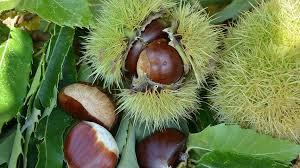
The Aydın chestnut is a native type of chestnut grown in the Aydın province of Türkiye, characterized by its strong aroma, large size, and shiny shell. Protected by a geographical indication registration, this product reflects the agricultural identity of its region and stands out with its high economic value in both national and international markets. The traditional production methods grant the Aydın chestnut a unique flavor profile and high-quality attributes.
The Aydın chestnut is cultivated in the mountainous and highland areas of the province from which it takes its name, generally at altitudes between 500 and 1000 meters. The districts with the highest chestnut production are Nazilli, Köşk, Sultanhisar, Bozdoğan, Yenipazar, and Efeler. Chestnuts are produced on approximately 70,000 decares of land in these districts. With its high production capacity, Aydın has become one of Türkiye’s major chestnut production centers. Furthermore, the scattered structure of the production areas and the presence of small plots have ensured the continued widespread use of traditional farming methods.
Aydın Chestnut (AA)
One of the most significant factors determining the quality of the Aydın chestnut is the region’s specific climatic and soil characteristics. The Aydın province is under the influence of the Mediterranean climate; summers are hot and dry, while winters are mild and rainy. The annual average temperature is around 17–18°C, which is suitable for the healthy development of chestnut trees. The dry periods in summer, in particular, enhance the aroma and dry matter content of the chestnut fruit. Additionally, the chestnut orchards located in the mountainous areas of Aydın are mostly on north-facing slopes, and these microclimatic conditions help the fruit grow larger and the shell become shinier. The soil is loamy, permeable, and rich in organic matter. Chestnut trees, which thrive in acidic soils (pH 5.5–6.5), show high yield potential in this region.
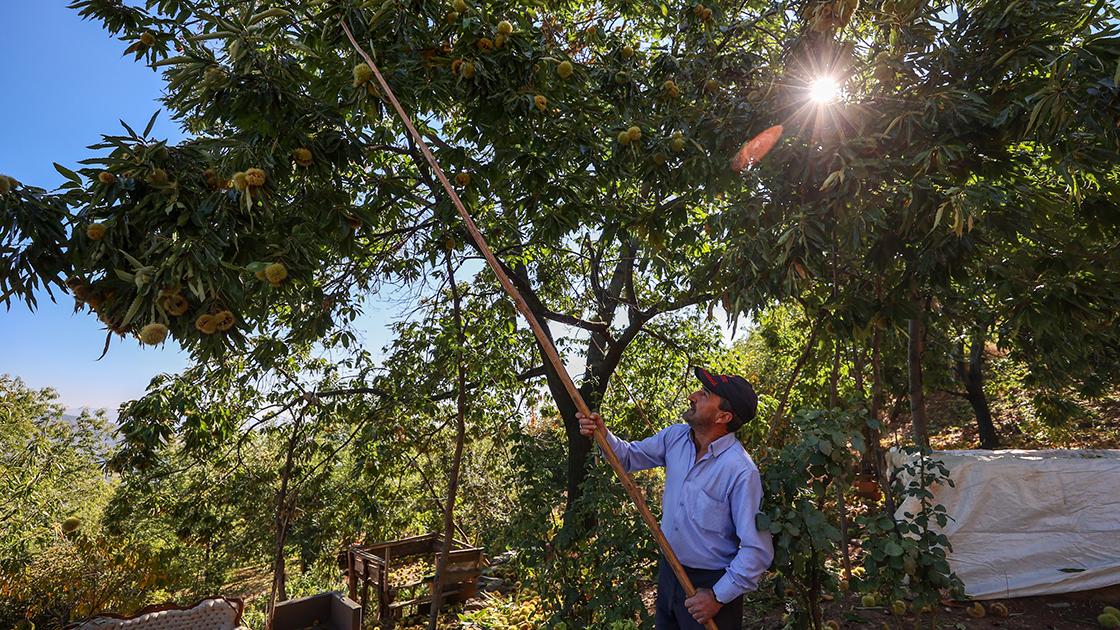
The Aydın chestnut is generally produced using traditional agricultural methods. Although seed propagation was common in the past, grafted saplings are now more widely used to preserve quality varieties. Chestnut trees can grow up to 8–10 meters tall and remain productive for 50–60 years. Young trees start bearing fruit at the age of 5–6. Farmers in the region manage pruning, fertilizing, and irrigation based on traditional knowledge. The harvest begins in the second half of October and continues throughout November. When ripe, the chestnuts fall to the ground inside their spiny husks. During this period, farmers go to the orchards early in the morning and collect the fruit by hand or using special collection tools. The harvested chestnuts are first subjected to a drying process, typically in the shade and with natural airflow. This is followed by sorting and packaging.
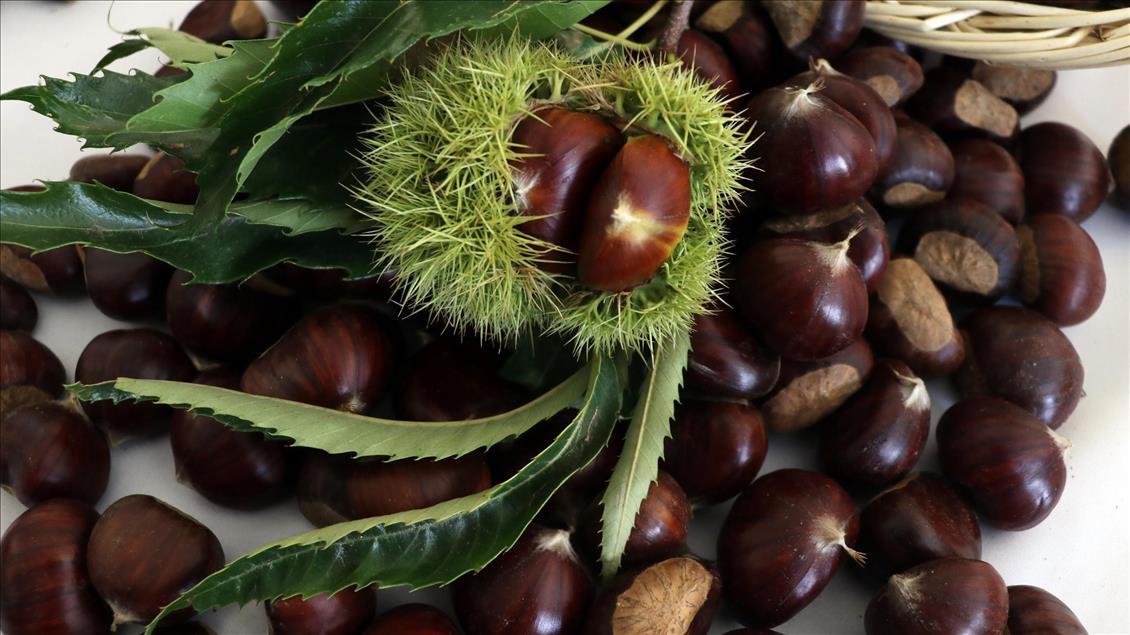
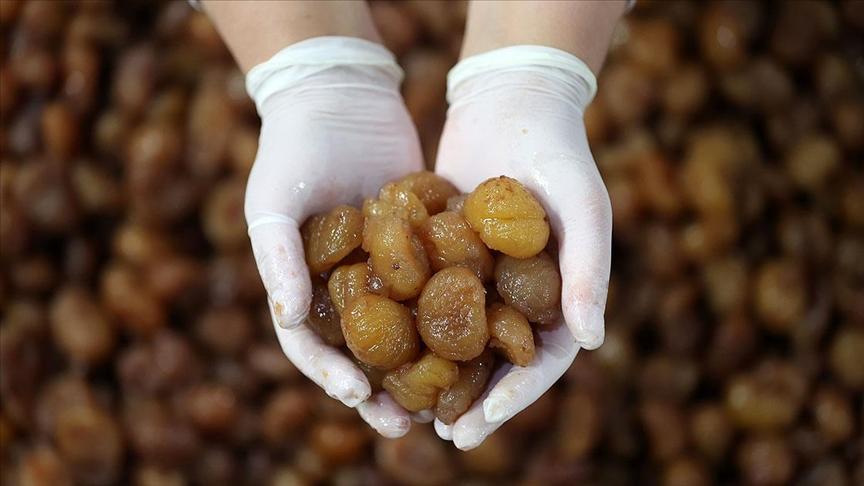
The Aydın chestnut has an average weight of 14–20 grams and an inner fill rate of up to 70%. Its shell is shiny brown, thin, and easy to peel. The inside is yellowish-white with a floury texture. These features make it ideal for boiling and roasting. The Aydın chestnut is also a preferred variety in the confectionery industry and is widely used in processed products such as candied chestnuts, chestnut puree, chestnut flour, and chestnut paste.
Aydın Chestnut (AA)
The Aydın chestnut was registered with a geographical indication by the Turkish Patent and Trademark Office in 2012. This registration certifies that the product has unique features specific to the Aydın province and that these qualities can only be obtained under certain conditions. The quality criteria specified in the geographical indication certificate include fruit size, glossiness, shell thinness, harvest time, and adherence to traditional production techniques. At the same time, inspection mechanisms ensure that producers comply with these standards, preserving the product’s standardized value in the market.
The Aydın chestnut accounts for approximately 25–30% of Türkiye’s chestnut production. This figure indicates that the Aydın province holds a significant share in Türkiye’s chestnut production. The harvested chestnuts are consumed fresh in local markets and also processed into products such as candied chestnuts and frozen chestnuts. Some of these processed products are exported to European countries.
Aydın Chestnut (AA)
For the local people, the Aydın chestnut is not just an agricultural product but also a cultural heritage. Chestnut festivals held annually in November in the districts of Köşk and Nazilli promote the product and preserve traditional folk dances and culinary culture. Chestnut harvesting and processing techniques are passed down through generations.
Anadolu Agency. "Bursa'nın Tescilli Lezzeti Kestane Şekeri Üreticileri Satışlarını E-Ticaretle Artıracak". Anadolu Agency. Accessed May 29, 2025. https://www.aa.com.tr/tr/ekonomi/bursanin-tescilli-lezzeti-kestane-sekeri-ureticileri-satislarini-e-ticaretle-artiracak/2188946
Anadolu Agency. "Kestane üretim merkezlerinden Aydın'da zorlu hasat mesaisi başladı". Anadolu Agency. Accessed May 29, 2025. https://www.aa.com.tr/tr/ekonomi/kestane-uretim-merkezlerinden-aydinda-zorlu-hasat-mesaisi-basladi/2400574
Anadolu Agency. "Aydın'da sezonun ilk kestanesi kilogramı 50 liradan satıldı". Anadolu Agency. Accessed May 29, 2025. https://www.aa.com.tr/tr/pg/foto-galeri/aydinda-sezonun-ilk-kestanesi-/0
Aydın Commodity Exchange. "Aydın Kestanesi". Aydın Commodity Exchange Website. Accessed May 29, 2025. https://www.aydinticaretborsasi.org.tr/aydin-kestanesi
Başpınar, Nevin and Çaçamer, Adnan. Chestnut. Ministry of Agriculture and Forestry Aydın Provincial Directorate, 2019. Accessed May 29, 2025 https://aydin.tarimorman.gov.tr/Belgeler/%C4%B0l%20M%C3%BCd%C3%BCrl%C3%BC%C4%9F%C3%BC%20Bas%C4%B1l%C4%B1%20Yay%C4%B1nlar/AYDIN%27IN%20D%C3%96RT%20EFES%C4%B0/KESTANE%20K%C4%B0TABI%20.pdf
Republic of Turkey South Aegean Development Agency. "Aydın Province Chestnut Investment Report". South Aegean Development Agency Website. Accessed May 29, 2025. https://geka.gov.tr/uploads/pages_v/aydin-ili-kestane-yatirim-raporu-basili_1992017142633.pdf
Turkey Culture Portal. "Aydın Kestanesi". Turkey Culture Portal Website. Accessed May 29, 2025. https://www.kulturportali.gov.tr/portal/aydin-kestanesi
Turkish Patent and Trademark Office. "Aydın Kestanesi". Turkish Patent and Trademark Office Website. Accessed May 29, 2025. https://ci.turkpatent.gov.tr/Files/GeographicalSigns/306dfbee-2985-4697-884c-78d36d7502c5.pdf
Yüksel, Nergiz, Eda Ülkeryıldız Balçık, Derya Deniz Şirinyıldız, Ziya Binat, Olcay Boyacıoğlu. The Importance of Chestnut Fruit, One of Aydın's Values. Turkish Journal of Natural and Applied Sciences, 9/1 2020:162-166 Accessed May 29, 2025. https://dergipark.org.tr/en/download/article-file/1157391

Aydın Chestnut
Region of Cultivation | Aydın | ||||||||
|---|---|---|---|---|---|---|---|---|---|
Climate(s) | Mediterranean Climate | ||||||||
Altitude | 500 – 1000 meters | ||||||||
Soil Type | Rich in organic matter Permeable Loamy | ||||||||
Average Weight | 14–20 grams | ||||||||
Geographical Distribution and Production Areas
Climate and Soil Characteristics
Agricultural Characteristics, Cultivation Techniques, and Harvesting Process
Product Characteristics and Usage Areas
Geographical Indication and Quality Control
Economic Contribution and Export
Traditional and Cultural Significance
This article was created with the support of artificial intelligence.