
+1 More

Class | Aves (Birds) | ||||||||
|---|---|---|---|---|---|---|---|---|---|
Order | Passeriformes | ||||||||
Family | Sturnidae | ||||||||
Genus | Leucopsar | ||||||||
Habitat | Lowland Monsoon Forests Tree Cavities Open Woodland Areas Savannas | ||||||||
Conservation Status | IUCN Red List: Critically Endangered (CR) | ||||||||
Scientific Name(s) | Leucopsar rothschildi | ||||||||
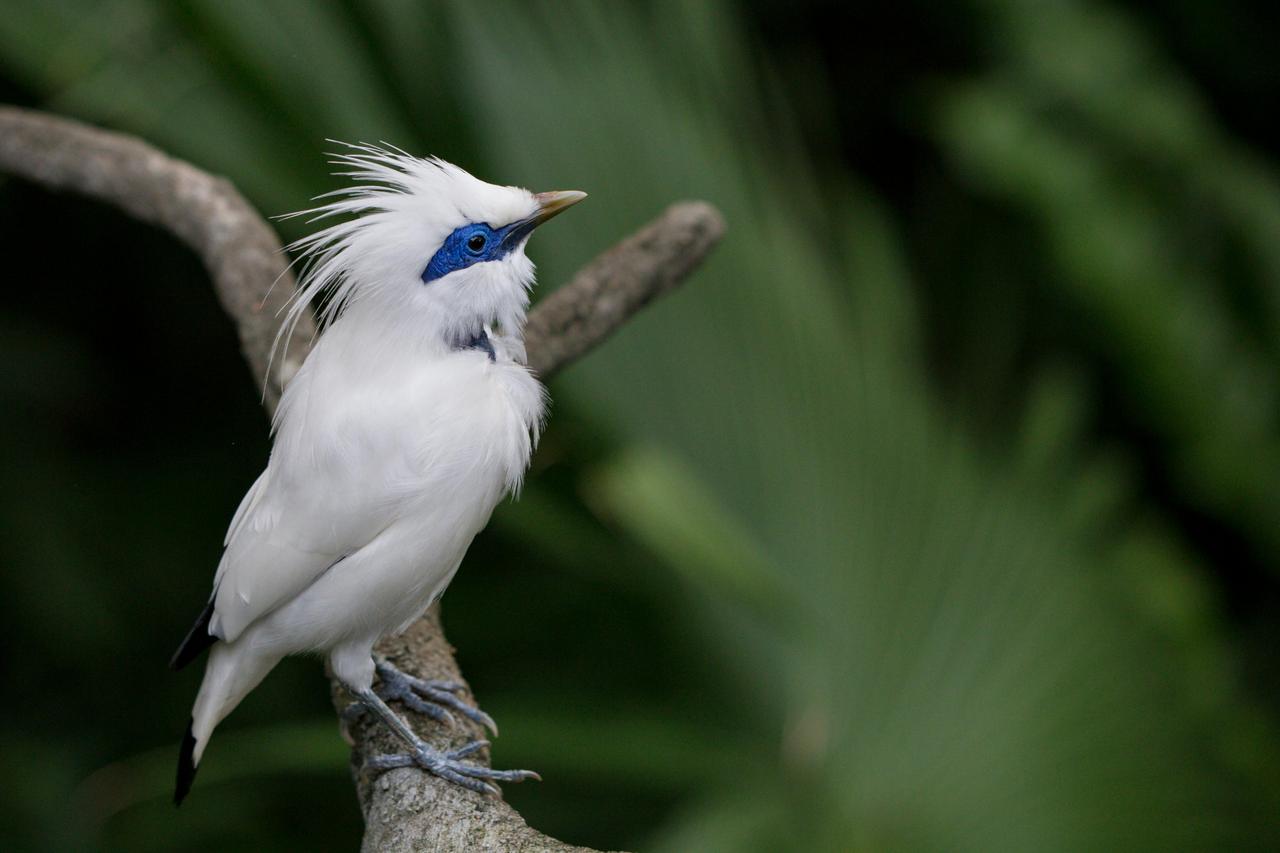
The Bali Myna, also known as the Bali starling (Leucopsar rothschildi), is a critically endangered bird species belonging to the family Sturnidae within the order Passeriformes (perching birds). Measuring approximately 25 cm (10 inches) in length and weighing around 3 ounces (about 85 grams), this species is notable for its snow-white plumage, black wingtips and tail tips, and distinctive patches of bare blue skin around the eyes. The beak is bluish-gray with a dull yellowish tip. Male individuals feature an elegant, lacy crest extending from the back of the head.

Bali Myna (Pexels)
This species is endemic to the island of Bali, Indonesia, and is naturally found only in the northwestern region of the island, particularly in and around Bali Barat National Park. Historically, the species was distributed throughout the northwestern third of Bali, but today it survives in a much narrower range due to illegal hunting and habitat loss. During the breeding season, it is typically found in lowland monsoon forests and palm savannas below 175 meters in elevation, while in the non-breeding season, it disperses to more open areas and forest edges.
Bali mynas are social and monogamous birds that live in pairs. Both males and females build nests, incubate eggs, and feed the young. They nest in tree cavities, using leaves, grass, and feathers as nesting materials. Each breeding season, pairs typically lay two to three eggs, which are bluish-green in color. Chicks hatch after 12–28 days of incubation. After fledging, the young are fed by their parents for several more weeks and acquire adult plumage within a few months. The breeding season usually coincides with the rainy period between January and April, when insect abundance is at its peak.
The Bali myna is omnivorous, feeding on a variety of insects such as ants, termites, dragonflies, grasshoppers, and caterpillars, as well as fruits like figs and papaya, nectar, and other soft fruits. It may also consume small reptiles and worms.
This species has a rich vocal repertoire consisting of hisses, high-pitched screams, whistling notes, and vibrating calls. During courtship or territorial defense, it displays behaviors such as fluffing up the head feathers, puffing out the chest, spreading the tail in a fan shape, and rhythmically bobbing its body.
Classified as Critically Endangered (CR) by the International Union for Conservation of Nature (IUCN), the Bali myna faces severe threats primarily due to its popularity in the illegal cage bird trade. In the 1990s, the wild population dropped to just 15 individuals. By 2001, only six were recorded. High black market prices (e.g., $2,000 per bird in 1999) have fueled poaching, and in one notable case in 1999, an armed gang stole 39 birds that were awaiting release into the wild. Other threats include habitat destruction, genetic erosion, predation, and disease.
The Bali myna has been protected under Indonesian law since 1970 and is listed in CITES Appendix I. The Bali Starling Project, initiated in 1983, involves the release of captive-bred birds, public education, and community-based conservation initiatives. In 2006, a local decree on Nusa Penida Island made the protection of the species mandatory, resulting in the release of 65 birds and the birth of 62 chicks in the wild by 2009. As of 2019, a survey in Bali Barat National Park recorded 191 individuals, including released birds. However, IUCN emphasizes that reintroduced individuals must successfully breed in the wild to be counted as mature individuals.
International collaboration with institutions such as the San Diego Zoo supports Species Survival Plans (SSPs) that monitor genetic diversity and coordinate breeding pairings to maintain lineage health. Additionally, strict enforcement against illegal wildlife trade and educational campaigns aim to reduce poaching pressure.
BirdLife International. “Species Factsheet: Leucopsar rothschildi (Bali Myna).” BirdLife International. Accessed June 23, 2025. https://datazone.birdlife.org/species/factsheet/bali-myna-leucopsar-rothschildi
Lincoln Park Zoo. “Bali Myna.” Lincoln Park Zoo. Accessed June 23, 2025. https://www.lpzoo.org/animals/bali-myna/
Pexels. “Close-Up Photo of a White Bird.” Accessed June 23, 2025. https://www.pexels.com/tr-tr/fotograf/beyaz-kusun-yakin-cekimi-18003138/
Pexels. “Selective Focus Photo of a Perched Bali Myna on a Branch.” Accessed June 23, 2025. https://www.pexels.com/tr-tr/fotograf/dalda-tuneyen-bali-myna-nin-secici-odak-fotografi-1362571/

Class | Aves (Birds) | ||||||||
|---|---|---|---|---|---|---|---|---|---|
Order | Passeriformes | ||||||||
Family | Sturnidae | ||||||||
Genus | Leucopsar | ||||||||
Habitat | Lowland Monsoon Forests Tree Cavities Open Woodland Areas Savannas | ||||||||
Conservation Status | IUCN Red List: Critically Endangered (CR) | ||||||||
Scientific Name(s) | Leucopsar rothschildi | ||||||||
No Discussion Added Yet
Start discussion for "Bali Myna (Leucopsar rothschildi)" article
Geographic Distribution and Habitat
Behavior and Reproduction
Diet
Vocalization and Communication
Conservation Status and Threats
Conservation Efforts and Reintroduction
This article was created with the support of artificial intelligence.