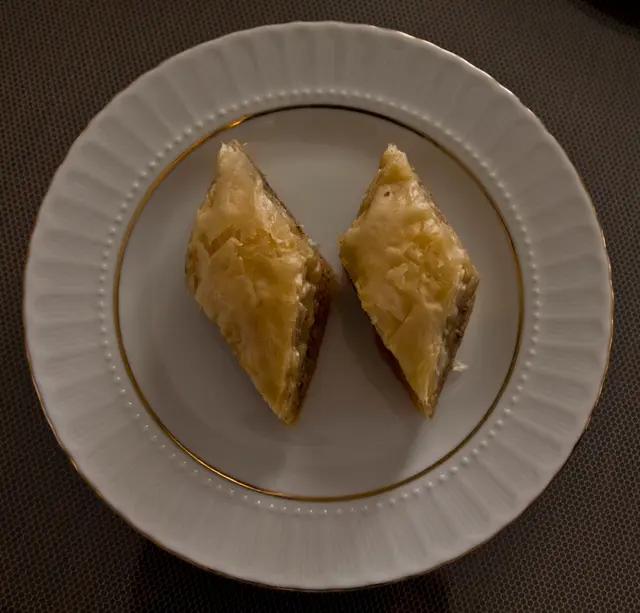



Bartın White Baklava is a traditional pastry unique to Bartın province in the Black Sea region of Türkiye, prepared using traditional methods and registered with a Protected Geographical Indication. This product was granted geographical indication protection by Bartın Municipality on October 9, 2020, under Law No. 6769 on Industrial Property. Thanks to its historical and cultural ties to the region, it has become part of Bartın’s regional identity.
The production of Bartın White Baklava can only be carried out within the borders of Bartın province. The product’s reputation is linked to the mastery of traditional production methods. Therefore, all stages of production must take place within the designated geographical area.
Bartın White Baklava is prepared with a filling of walnuts and starch, cut into equilateral diamond shapes, left to dry overnight, then combined with butter and baked in the oven for an extended period. Its most distinctive feature is that, unlike classic baklavas, its surface is not browned and maintains a white appearance. This effect is achieved through careful control of baking time and temperature.
Approximately a century ago, this dessert was made in small home ovens in Bartın, and over time it became a local symbol. Its continued production using the same method demonstrates the preservation of cultural continuity and the connection to local craftsmanship.
The production of Bartın White Baklava involves dough preparation, filling preparation, layering, cutting, drying, baking, and syruping.
The production and proper use of the geographical indication is overseen by a control board coordinated by Bartın Municipality, including experts from Bartın Provincial Directorate of Agriculture and Forestry, Bartın Provincial Directorate of Culture and Tourism, and Bartın Chamber of Commerce and Industry. Inspections are conducted at least annually and can also take place whenever needed or upon complaints. The inspections focus on the quality of ingredients, adherence to production steps, and correct use of the Protected Geographical Indication mark.
Türk Patent ve Marka Kurumu. "Bartın Beyaz Baklavası Coğrafi İşaret Sicil Belgesi." Türk Patent ve Marka Kurumu. Accessed October 25, 2025. https://ci.turkpatent.gov.tr/Files/GeographicalSigns/47156082-6c0c-4082-8010-f596e420b6ce.pdf
Türk Patent ve Marka Kurumu. "Bartın Beyaz Baklavası." Coğrafi İşaretler Portalı. Accessed October 25, 2025. https://ci.turkpatent.gov.tr/cografi-isaretler/detay/38665

No Discussion Added Yet
Start discussion for "Bartın White Baklava " article
Geographical Boundary and Production Conditions
Product Characteristics
Preparation Method
Inspection
This article was created with the support of artificial intelligence.