


Beyblade is a spinning top-themed game developed in 1999 by the Japanese toy company Takara Tomy, which has since evolved into a media franchise. Initially designed solely as a toy, it quickly expanded into a multifaceted entertainment field enriched with anime, manga, video games, and tournaments.
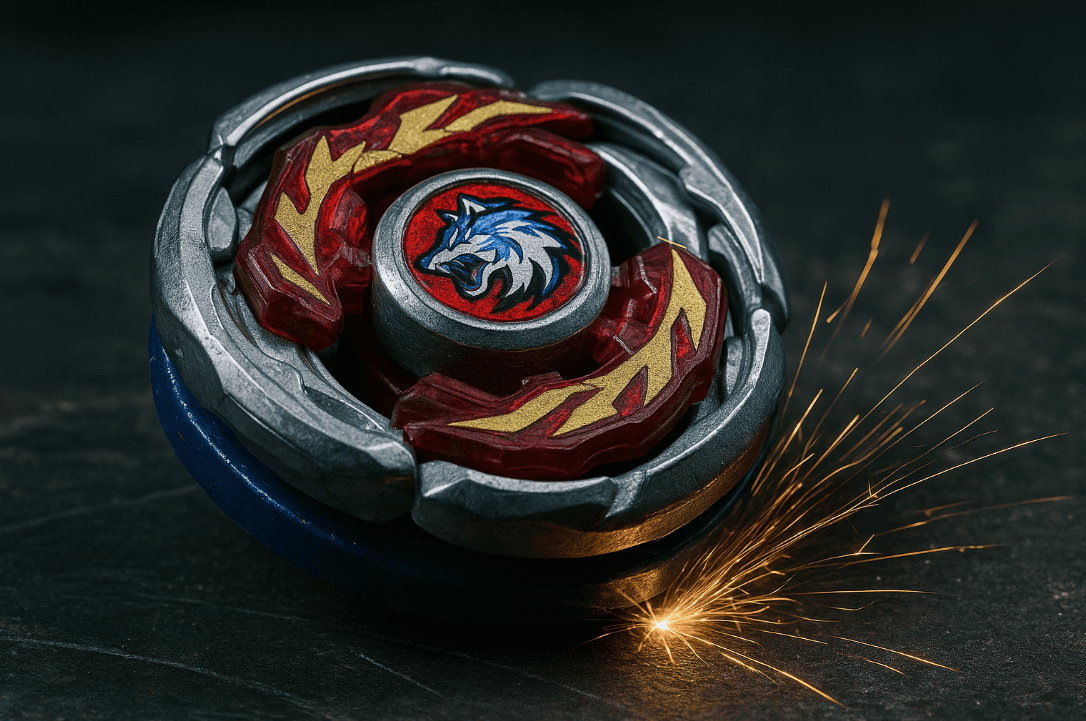
Beyblade (Created with artificial intelligence.)
Beyblade is a competitive spinning top game where two or more players launch their Beyblades into a specially designed arena (called a "Beystadium") using a launcher. The main objective is to outlast or overpower the opponent’s Beyblade through collisions and strategic movement within the arena. Players often customize their Beyblades to suit their strategy and gain an edge in battle.
Victory Conditions
There are three primary ways to win in a Beyblade match:
Official Rules
Official tournaments—organized by communities such as the World Beyblade Organization (WBO) or by the product manufacturers—follow standardized rules, including:
Beyblade Components
Each Beyblade consists of several interchangeable parts that influence its performance:
Types of Beyblades
Based on the combination of parts, Beyblades are generally categorized into four main types:
Strategy and Launching Techniques
Success in Beyblade battles relies not only on part combinations but also on strategy. Players often adjust their Beyblade setup depending on their opponent’s style and the arena conditions. Launching techniques—such as angled launches, varying speed, and targeting specific contact points—can dramatically influence the outcome of a battle..
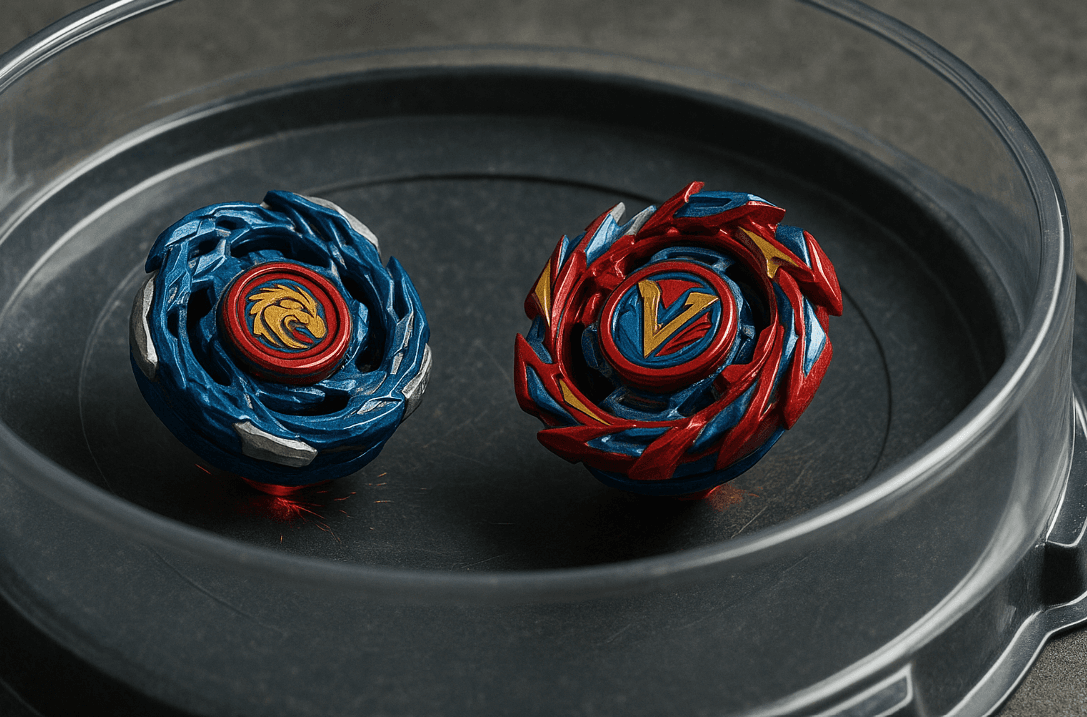
A Beyblade Match (Created with artificial intelligence.)
Originally introduced as just a toy, Beyblade quickly transformed into a multifaceted media product. After its launch in Japan in 1999, it gained popularity among children, and this interest further increased with the release of the animated series in 2001. The first anime series aired in Japan under the name "Bakuten Shoot Beyblade" and was later translated into English for the international market. The series enriched the basic game mechanics of the toys with fictional characters and stories, turning Beyblade from a physical toy into a character-based media product.
Following the success of the anime series, the Beyblade brand expanded into manga series, video games, movies, accessories, and collectible products. Video games, in particular, appeared on portable gaming consoles (such as Game Boy Advance, Nintendo DS) and home consoles, providing an interactive experience in the digital realm. This strategy led to the perception of Beyblade not only as a toy but also as an entertainment universe.
Post-2009, the Beyblade brand restructured itself, particularly with Metal Fight Beyblade (internationally known as Beyblade: Metal Fusion). During this period, both the design and story structure differed from previous versions. The new design featured more robust materials and more complex part systems, making the game more competitive and customizable.
In 2015, the "Beyblade Burst" series introduced an innovation with a "burst mechanism" that allows the spinning top to burst into pieces during collisions. This mechanism added a new strategic dimension to the game dynamics and diversified the toy experience. The Burst series was also restructured with a concurrently aired anime series. Similar to previous series, the new series revolved around fictional characters participating in Beyblade tournaments but adopted a new storytelling style incorporating dramatic tension through the burst effect.
With the Beyblade Burst series, the product range expanded, and more modern animation techniques were used. Subtitles like Beyblade Burst Evolution, Turbo, Rise, Surge, QuadDrive, and QuadStrike introduced different game mechanics along with new characters and Beyblade models. Consequently, Beyblade managed to reach new generations even years later and consistently renewed itself to maintain its place in the market.
The physical design of Beyblade has been developed to enable interaction with the spinning top from different angles. The metal disks at the center of Beyblades and the plastic teeth surrounding them are designed to enhance both spin speed and durability. The Beyblade Burst series offered a different game experience to players with the burst mechanism during spinning, allowing for a variety of designs to be used, both in terms of physical features and aesthetics.
Over time, Beyblade transitioned from being a toy played individually for fun to a competitive gaming culture with organized tournaments worldwide. Initially, local competitions held by Takara Tomy in Japan quickly gained international dimensions, becoming widespread in North America and Europe, thanks to Hasbro's contributions. These developments led to the emergence of large-scale organizations like the Beyblade World Championship, where players from different countries participated in events that received media attention.
The World Beyblade Organization (WBO), established in 2008, has played a significant role in standardizing this competitive structure. The organization supports hosting both offline and online tournaments by publishing rules on Beyblade types, arena dimensions, scoring rules, and modification limits.
The 2023 Beyblade Grand Finale (CEO Gaming)
Success in tournaments relies not only on physical speed and reflexes but also on strategy. Players choose their equipment according to the opponent's Beyblade type and try to gain an advantage with various launching techniques. Beyblades with characteristics like attack, defense, and balance play a crucial role in this strategic selection process.
Beyblade tournaments also serve as a means of social connection between players. Through local events and clubs, players communicate with each other, sharing information and experiences. This process creates an environment that encourages cooperation as much as competition among children and young people.
With the advancement of technology, digital competition formats have become widespread alongside physical tournaments. Especially with the Beyblade Burst series, mobile applications released allowed players to scan QR codes of physical Beyblades to compete in virtual environments—this digital integration aids Beyblade in adapting to the changing gaming culture of the era.
Asmodee UK. "What Are Beyblades?" Asmodee UK. Accessed May 8, 2025. https://www.asmodee.co.uk/blogs/news/what-are-beyblades.
BeyWarehouse. "So, What Are Beyblades?" BeyWarehouse. Accessed May 8, 2025. https://beywarehouse.com/blogs/news/so-what-are-beyblades.
Curious and Geeks. "Beyblade Burst Guide." Curious and Geeks. Accessed May 8, 2025. https://curiousandgeeks.com/beyblade-burst-guide/.
IMDb. "Beyblade X (TV Series 2023– )." IMDb. Accessed May 8, 2025. https://www.imdb.com/title/tt27865962/?ref_=mv_close.
Web Japan. "Beyblades." Kids Web Japan. Accessed May 8, 2025. https://web-japan.org/kidsweb/archives/cool/01-04-06/beyblades.html.
World Beyblade Organization. "Beyblade X Rules." World Beyblade Organization. Accessed May 8, 2025. https://worldbeyblade.org/Thread-Beyblade-X-Rules.


Game Mechanics and Rules
Evolution of Beyblade and Media Expansion
Equipment and Technological Innovations
Tournaments and Competitive Gaming Culture
This article was created with the support of artificial intelligence.