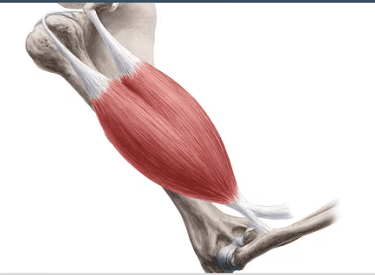
Starts | Long Head (supraglenoid tubercle) Short Head (coracoid process) | ||||||||
|---|---|---|---|---|---|---|---|---|---|
Handhold | Radial Tuberosity (radius) | ||||||||
Nerve Source | Musculocutaneous Nerve (C5-C7) | ||||||||
Artery | Brachial Artery | ||||||||
The Biceps Brachii Muscle is a muscle located in the anterior region of the upper arm and is known for its two-headed structure (long and short). It is responsible for elbow flexion and forearm supination. It crosses the shoulder and elbow joints, contributing to both upper extremity movement and stabilization.
The Biceps Brachii Muscle is the most well-known two-headed muscle of the upper extremity, acting on both the shoulder and elbow joints. The long head ( caput longum ) of the muscle originates from the supraglenoid tubercle of the scapula, fuses with the glenoid labrum, and passes through the shoulder joint capsule. This head extends along the intertubercular groove (sulcus intertubercularis) to the forearm. The short head ( caput breve ) originates from the coracoid process of the scapula, where it is adjacent to the coracobrachialis muscle. Its insertion point is the radial tuberosity of the radius. The bicipitoradial bursa is located at this insertion site to reduce friction between the tendon and the bone. Furthermore, the lacertus fibrosus (biceps aponeurosis), which extends medially from the muscle and attaches to the deep fascia of the forearm, contributes functionally by supporting flexion force. Among the adjacent muscles, the brachialis muscle, located beneath the biceps brachii and extending between the humerus and ulna, serves as a pure flexor. The coracobrachialis muscle extends from the coracoid process to the humerus. Furthermore, the brachioradialis, a superficial muscle of the forearm, plays a supporting role, particularly in rapid and resistive elbow flexion.
The Biceps Brachii is a muscle derived from the ventral (flexor) mass of the forelimb muscles. Developmentally, it is among the multi-joint and multifunctional muscles that cross the shoulder and elbow joints. Due to this structure, it participates in both upper arm and forearm movements. Classification-wise, it is included in the group of flexor muscles located in the anterior compartment and innervated by the musculocutaneous nerve.
The Biceps Brachii Muscle is innervated by the musculocutaneous nerve (C5–C7). This nerve also supplies the brachialis and coracobrachialis muscles. This muscle's innervation allows for controlled and effective movements such as elbow flexion and forearm supination. The muscle's vascular supply is provided by branches of the brachial artery. Particularly in the proximal forearm, the artery's muscular branches provide adequate blood flow to both heads of the biceps brachii.
The primary function of the biceps brachii is elbow flexion. This muscle is most effective when the forearm is supinated. It also functions as a powerful supinator, engaging in movements such as external rotation of the forearm (e.g., opening a bottle cap). The short head of the muscle assists in shoulder flexion, that is, lifting the arm forward. The long head acts as a stabilizer in the shoulder joint. It pulls the humeral head toward the glenoid cavity, maintaining shoulder stability, and this stability is critical, especially during excessive shoulder movements. Clinically, the biceps brachii is a muscle prone to various pathologies. Biceps tendonitis is an overuse-related inflammation that typically develops on the tendon of the long head. In more severe cases, biceps rupture can occur. This usually occurs when the long head tendon ruptures suddenly, resulting in the characteristic muscle mass known as a "Popeye deformity." Furthermore, SLAP lesions, which occur when the long head tendon separates from the glenoid labrum, are a common cause of shoulder pain. Speed and Yergason tests are used during the physical examination to establish a diagnosis. Imaging methods such as ultrasonography and MRI are effective in evaluating tendon and soft tissue structures. Conservative methods (rest, NSAIDs, physical therapy) are the primary treatment options. However, full-thickness tears may require surgical tendon repair.
National Center for Biotechnology Information. “Anatomy, Shoulder and Upper Limb, Biceps Brachii.” StatPearls. Last updated August 8, 2023. Accessed July 23, 2025. https://www.ncbi.nlm.nih.gov/books/NBK519538/
Yılmaz, Özkan, and Adem Kızılkurt. “A Study on the Morphometric Properties of the Biceps Brachii Muscle.” Gaziosmanpaşa Medical Journal 11, no. 1 (2019): 1–6. Accessed July 23, 2025. https://dergipark.org.tr/tr/download/article-file/816915
Ertekin, Cengiz, and M. Cemil Yücesoy. “Anatomical Variation in the Biceps Brachii Muscle.” Eastern Journal of Medicine 7, no. 2 (2002): 60–62. Accessed July 23, 2025. https://www.eajm.org/content/files/sayilar/138/buyuk/101.pdf
Aydın, Fatih, and Emrah Kovalak. “Rupture of the Long Head of the Biceps Tendon: Clinical Evaluation and Treatment Options.” Acta Orthopaedica et Traumatologica Turcica 46, no. 6 (2012): 421–425. Accessed July 23, 2025. https://www.aott.org.tr/Content/files/sayilar/529/529-5080.pdf
Kaur, Jaspreet, and Harsimranjit Singh. “Anatomy Shoulder and Upper Limb: Biceps Muscle.” ResearchGate, 2018. Accessed July 23, 2025. https://www.researchgate.net/publication/329717432_Anatomy_Shoulder_and_Upper_Limb_Biceps_Muscle
YouTube. Biceps Brachii Muscle Anatomy. June 12, 2018. Video, 4:22. Accessed July 23, 2025. https://www.youtube.com/watch?v=v0GJltQp6R0&pp=ygUdQmljZXBzIEJyYWNoaWkgbXVzY2xlIGFuYXRvbXk%3D

Starts | Long Head (supraglenoid tubercle) Short Head (coracoid process) | ||||||||
|---|---|---|---|---|---|---|---|---|---|
Handhold | Radial Tuberosity (radius) | ||||||||
Nerve Source | Musculocutaneous Nerve (C5-C7) | ||||||||
Artery | Brachial Artery | ||||||||
No Discussion Added Yet
Start discussion for "Biceps Brachii Muscle" article
Anatomy
Morphology and Connection Points
Embryological Origin and Classification
Nerve Innervation and Vascular Supply
Function and Clinical Relationships