


In physics, mass generates a gravitational field and interacts with it. Similarly, an electric charge creates an electric field and experiences a force within it. When electric charges move (i.e., when they create a current), they interact with a magnetic field. Therefore, it is predictable that moving charges (electric current) produce a magnetic field.
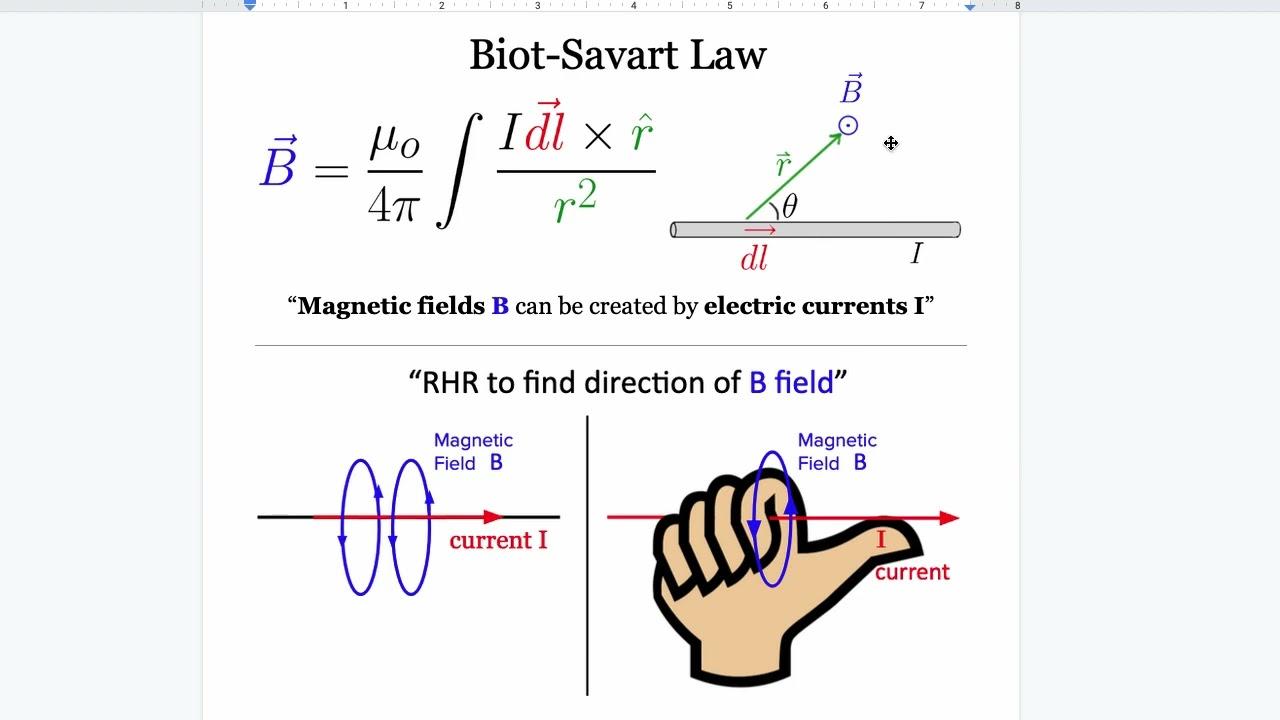
In this context, the Biot-Savart Law calculates how a current generates a magnetic field. This law is an experimental law that mathematically defines the magnetic field produced at a specific point by a small segment of a current-carrying wire. The law is named after Jean-Baptiste Biot and Félix Savart, who studied the interactions between magnetic fields and current-carrying wires. experimental law

Jean-Baptiste Biot ve Félix Savart

Where:
The direction of the magnetic field is determined by the right-hand rule: when the thumb points in the direction of the current, the curled fingers indicate the direction of the magnetic field.
To find the total effect of the magnetic field dB, the generalized Biot-Savart Law is obtained by integrating all current elements:

This formula is used to calculate the total magnetic field produced by a current-carrying wire.
The Biot-Savart Law is commonly used to calculate magnetic fields for various current geometries. Some common applications include:

Where R is the radius of the current loop.
The Biot-Savart Law is a fundamental law used to calculate the magnetic field produced by an electric current. It is particularly suitable for cases involving small current elements or circular current loops. However, due to its complexity, alternative methods such as Ampère's Law may be preferred for some special cases. Nevertheless, the Biot-Savart Law has a wide range of applications in magnetic field calculations and plays a fundamental role in the study of electromagnetism.
Landau, L. D., ve E. M. Lifshitz. The Classical Theory of Fields: Volume 2. 4. baskı. Oxford: Butterworth-Heinemann, 1980. ISBN 978-0750627689.
Jackson, John David. Classical Electrodynamics. 3. baskı. New York: Wiley, 1999. Bölüm 5. ISBN 0-471-30932-X.
"The Biot-Savart Law." University Physics 2. UCF Press, 2020. https://pressbooks.online.ucf.edu/osuniversityphysics2/chapter/the-biot-savart-law/.
"The Biot-Savart Law." Introductory Physics - Building Models to Describe Our World. LibreTexts, 2020.
"Biot-Savart Law." HyperPhysics, Georgia State University, 2020. http://hyperphysics.phy-astr.gsu.edu/hbase/magnetic/Biosav.html.

Mathematical Expression of the Biot-Savart Law
Applications and Examples of the Biot-Savart Law
Advantages and Disadvantages of the Biot-Savart Law
Advantages
Disadvantages
This article was created with the support of artificial intelligence.