


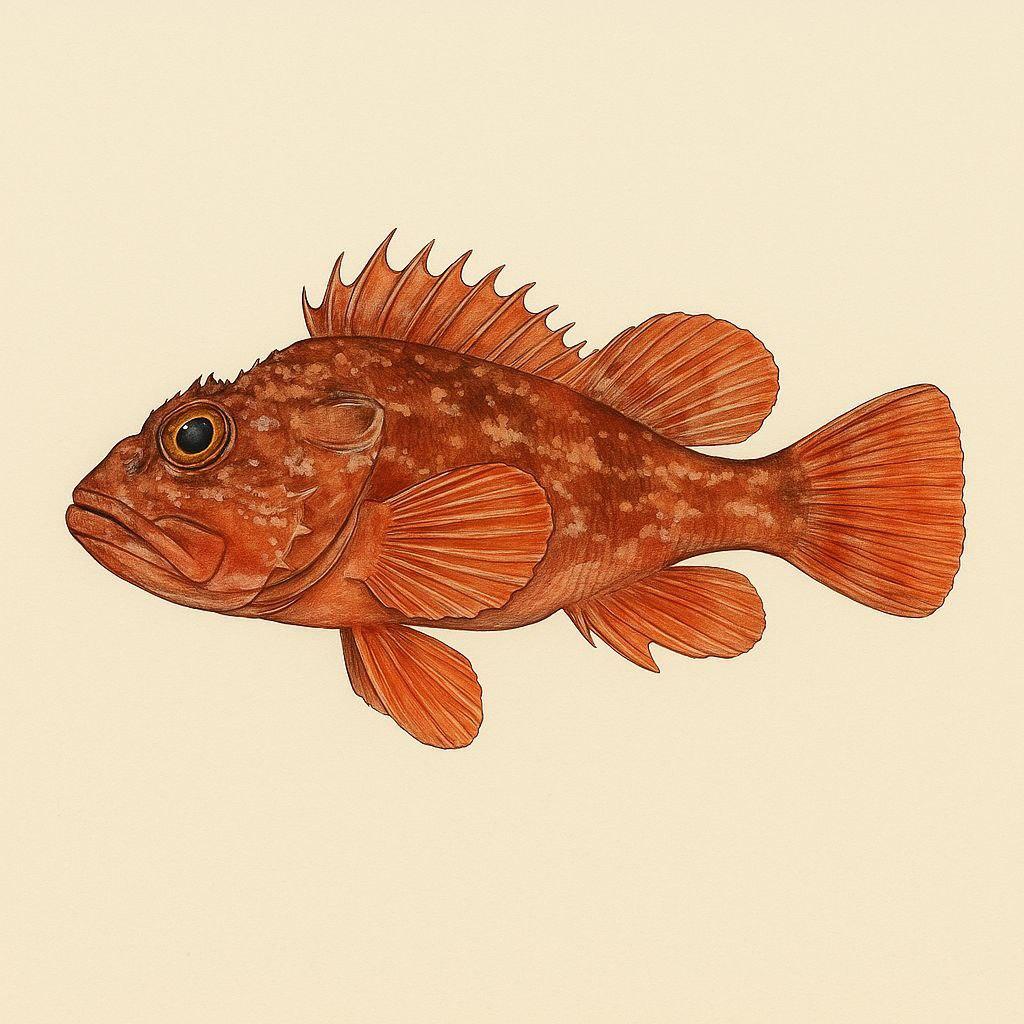
Black Scorpionfish (Scorpaena porcus)
Produced with Artificial Intelligence
Scientific Name(s) | Scorpaena porcus | ||||||||
|---|---|---|---|---|---|---|---|---|---|
Type(s) | Scorpaena | ||||||||
Geographical Distribution | Mediterranean - Black Sea - East Atlantic | ||||||||
Reproduction Period | Spring - summer | ||||||||
Conservation Status (IUCN) | Least Concern | ||||||||
The Black scorpionfish (Scorpaena porcus) is a benthic marine fish belonging to the family Scorpaenidae, which is widespread in the Mediterranean and Black Sea coasts. This species, which is adapted to live in rocky, muddy and vegetated seabeds, is a hidden predator that mostly remains motionless and waits for its prey. It attracts attention with its morphological structure, poisonous spines and colouring in harmony with its environment. It has an important place in coastal ecosystems in terms of its biological and ecological characteristics.
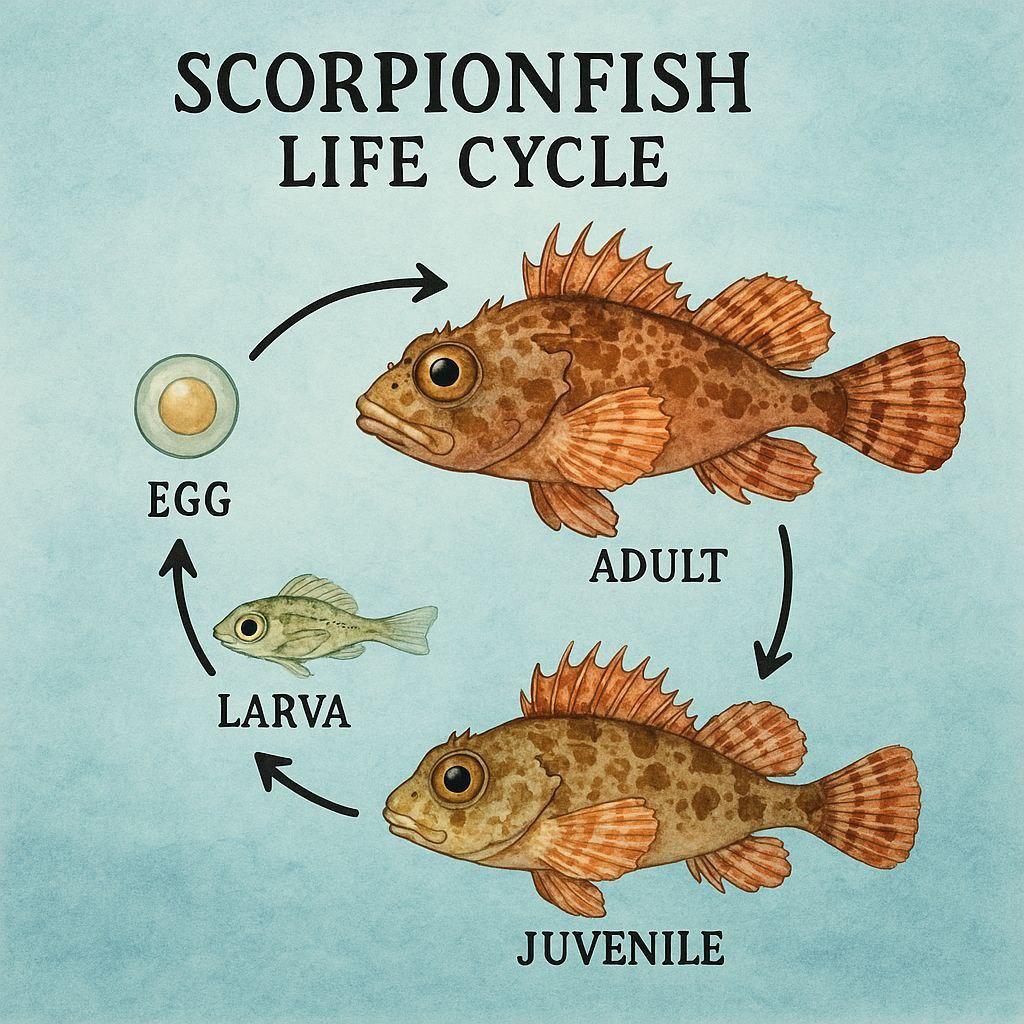
Life Cycle of Scorpion Fish (Produced with Artificial Intelligence.)
The scorpionfish is a short and flattened species with a body usually ranging from 10-20 cm in length, rarely growing up to 30 cm. The skin is covered with spiny protrusions and there are prominent bony protrusions on the head. Colouration; red, brown and dark tones, usually changing according to the environment it lives in, provides an effective camouflage. Its eyes are large and directed upwards, so it can easily focus on its prey.
It has 12-13 hard spines on its dorsal fin; these spines contain toxic secretions and may cause pain, swelling and localised symptoms of poisoning in humans upon contact. It has typical morphological characteristics of the family Scorpaenidae and is distinguished from similar species by this spine structure and head form.
The Black scorpionfish is widespread in the Mediterranean, Black Sea and East Atlantic coasts. It has dense populations along the Turkish coasts, especially in the eastern Black Sea and the Aegean Sea. It lives at depths between 5 and 100 metres in rocky, muddy or vegetated areas. It generally prefers shallow areas close to the shore.
The Black scorpionfish (Scorpaena porcus) is a benthic and carnivorous species. It spends most of the day motionless on the bottom, camouflaged by its colouration in harmony with its surroundings. During this passive wait, it waits for potential prey to approach it, and then catches it with a sudden and fast move. This hunting strategy both saves energy and offers high hunting success.
Although its food preference varies depending on the habitat structure and seasonal variability; it mainly feeds on benthic invertebrates such as small fish, shrimps, crabs, polychaeta and various crustaceans. Stomach content analyses revealed that S. porcus individuals feed mainly on shrimps (especially Palaemon species), small crustaceans and fish.
During hunting, its large, upward-positioned eyes allow it to scan its surroundings carefully. Its strong jaws and back-curved teeth prevent the prey from being grabbed and escaping. With these characteristics, S. porcus is among the mid-level predators in coastal and rocky areas.
The breeding period of the Black scorpionfish usually coincides with the spring and summer months. The female fish lays her eggs in rocky or vegetated areas. The eggs hatch in a short time and the larvae become free-swimmers. The larval stage covers the period until the fish grows to maturity and may vary depending on environmental conditions. Studies on reproductive behaviour have shown that the mating and egg protection behaviour of the species can vary regionally. This is considered as a result of adaptation to habitat conditions.
It is not currently threatened with extinction on a global scale due to its wide geographical distribution and capacity to adapt to different habitats. It is categorised as ‘Least Concern’ by the International Union for Conservation of Nature (IUCN).
However, there are some environmental pressures on local populations. Increasing pollution especially in coastal ecosystems, habitat destruction, temperature increases due to climate change and by-catch in some regions require attention in terms of the long-term sustainability of this species.
Çorapcı, Bengünur. ‘Quality of Black Scorpionfish (Scorpaena porcus, Linnaeus 1758) Meat Cooked in Different Cooking Materials.’ FOOD 46, no. 6 (2021): 1415-1424. Last accessed: 25 June 2025. https://dergipark.org.tr/en/download/article-file/1921420
Erbay, Murat. ‘Research on Population Structure and Reproductive Biology of Scorpionfish (Scorpaena porcus, Linnaeus, 1758) in the Eastern Black Sea.’ Master's thesis, Recep Tayyip Erdoğan University, 2013. http://acikerisim.erdogan.edu.tr/xmlui/handle/11436/496
Samsun, Serap, and Naciye Erdoğan Sağlam. ‘Biology of Scorpionfish (Scorpaena porcus Linnaeus, 1758) in the Black Sea (Samsun, Ordu, Giresun).’ Acta Aquatica Turcica 14, no. 4 (2018): 291-302. Last accessed: 25 June 2025. https://dergipark.org.tr/tr/download/article-file/593251

Black Scorpionfish (Scorpaena porcus)
Produced with Artificial Intelligence
Scientific Name(s) | Scorpaena porcus | ||||||||
|---|---|---|---|---|---|---|---|---|---|
Type(s) | Scorpaena | ||||||||
Geographical Distribution | Mediterranean - Black Sea - East Atlantic | ||||||||
Reproduction Period | Spring - summer | ||||||||
Conservation Status (IUCN) | Least Concern | ||||||||
No Discussion Added Yet
Start discussion for "Black Scorpionfish (Scorpaena porcus)" article
Morphological Characteristics
Habitat and Distribution
Diet and Behaviour
Reproduction and Life Cycle
Conservation Status
This article was created with the support of artificial intelligence.