

+2 More

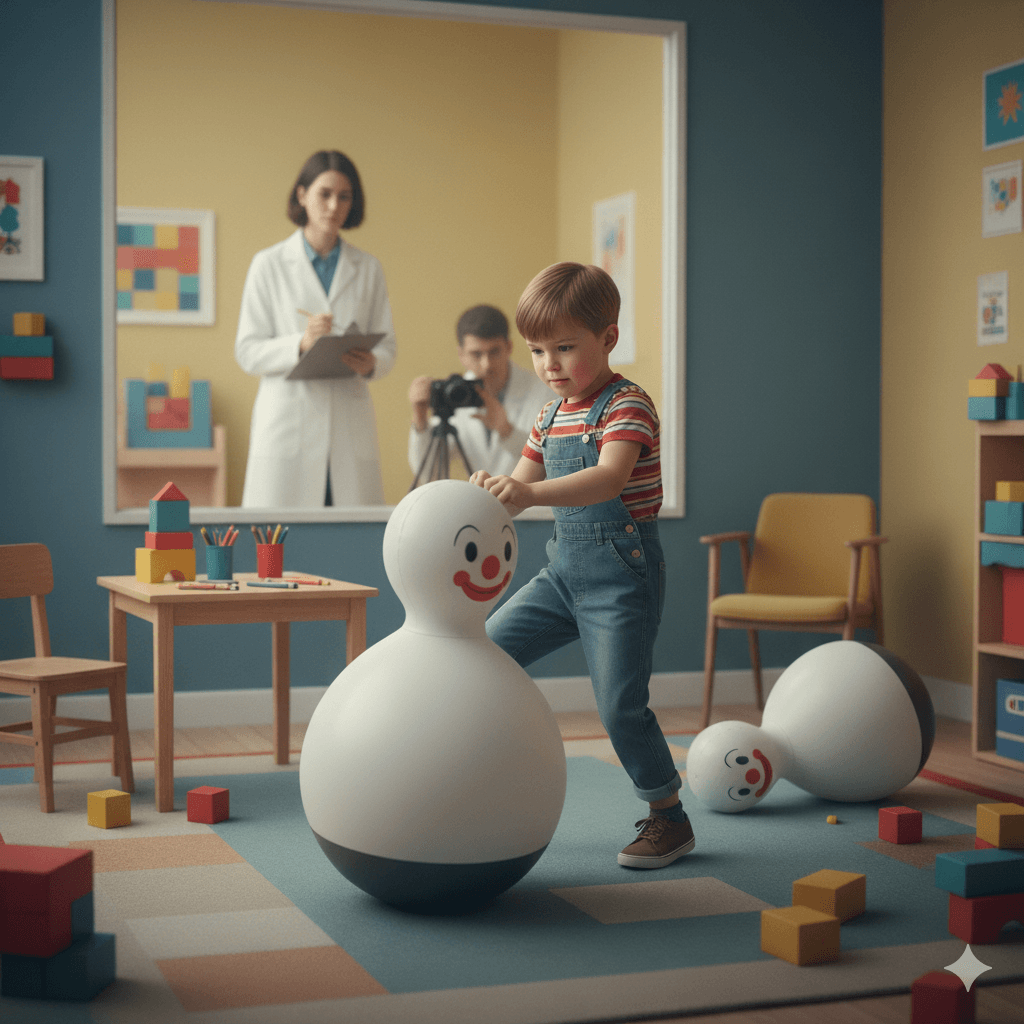
Bobo Doll Experiment (Created with artificial intelligence)
Name of the Experiment | Bobo Doll Experiment | ||||||||
|---|---|---|---|---|---|---|---|---|---|
Researcher | Albert Bandura | ||||||||
Location | Stanford University USA | ||||||||
Date(s) | 1961 and 1963 | ||||||||
Participants | 72 children aged 3-6 (36 boys, 36 girls) | ||||||||
Field | Psychology, Social Learning Theory | ||||||||
Main Subject | Learning aggression through observation | ||||||||
The Bobo Doll experiment is a series of psychology experiments conducted in 1961 and 1963 by Canadian-American psychologist Albert Bandura. The experiment specifically aimed to test whether aggressive behavior in children is learned through imitation. This study became a turning point in the formation of the Social Learning Theory, which suggests that learning can occur not only through reward and punishment mechanisms but also by observing others.
The experiment was conducted at Stanford University Nursery School with 72 children (36 boys, 36 girls) aged between 3 and 6. Before the experiment, the children's aggression levels were assessed by observers, and they were randomly distributed into three groups based on these levels.

An image representing the Bobo Doll Experiment (Created with artificial intelligence)
The experiment was carried out with a three-stage methodology where children were exposed to three separate conditions.
Aggressive Model Group: Children in this group were shown an adult model (an actor) who exhibited physically and verbally aggressive behaviors towards an inflatable toy called a Bobo doll. The model punched and kicked the doll, using phrases like "Hit him!" and "Kick him!" Non-Aggressive Model Group: Children in this group observed an adult model who was in the same environment but played passively with other toys, ignoring the Bobo doll. Control Group: Children in this group were not exposed to any model.
Children from all three groups were taken to a room full of toys but were frustrated by being told they were "forbidden" from playing with the most attractive ones. This stage was designed to increase the children's aggressive tendencies and to observe their potential reactions more clearly.
The children were left alone in a room containing a Bobo doll and various other toys. Their behavior in this room was secretly observed from behind a one-way mirror.

An image representing the Bobo Doll Experiment (Created with artificial intelligence)
The results of the experiment supported Bandura's Social Learning Theory:
Imitation of Aggression: It was observed that children who watched the aggressive model exhibited significantly more physical and verbal aggression towards the Bobo doll compared to the other groups. These children not only imitated the model's behaviors but also developed their own new methods of aggression.
Gender Role: It was found that boys showed a greater tendency for both physical and verbal aggression than girls, and they were more likely to imitate a model of their own gender.
Learning-Performance Distinction: The conclusion was reached that children who observed the aggressive model learned the behavior even if they did not immediately display it, and they could exhibit this behavior later when appropriate conditions arose.
The Bobo Doll experiment has secured an important place in the history of psychology by proving the power of observational learning. Contrary to the behaviorist approach, the experiment emphasized the role of cognitive processes and modeling in learning. The study laid the foundation for discussions on how children can be affected by the violence they are exposed to through media (television, films, video games, etc.) and has been influential in media ethics and regulations for children's programming.
The experiment received some criticism for its methodology and ethical dimensions:
Artificial Environment: The fact that the experiment was conducted in a controlled and artificial laboratory setting, rather than a natural one, may limit the generalizability of the results.
Lasting Impact: Ethical concerns were raised that children might acquire aggressive behaviors as a result of exposure to the experiment and that this could leave lasting psychological effects. The inability of children to give informed consent led to moral questioning of the experiment.
The Nature of the Toy: The fact that the Bobo doll is a toy designed to be hit and kicked led to interpretations that children might be more inclined to behave aggressively towards this specific toy.
Bobo Doll Experiment (Everywhere Psychology YouTube Channel)
Everywhere Psychology. "Bandura's Bobo Doll Experiment." YouTube video. April 18, 2022. 13:42. https://www.youtube.com/watch?v=dmBqwWlJg8U.
Sangeeth, V. T. P., S. Shobha, S. Prajwal, G. R. Sudeep, B. V. Ashish Kumar, and Prateek Sharma. "The impact of COVID-19 pandemic on the healthcare workers: a systematic review." Cureus 14, no. 12 (2022). https://www.ncbi.nlm.nih.gov/pmc/articles/PMC9733593/.
Saul Mcleod. "Bandura's Bobo Doll Experiment." Simply Psychology. Accessed September 10, 2025. https://www.simplypsychology.org/bobo-doll.html.
Tatlıoğlu, Sevra Su. “A Social-Cognitive Look at Learning: Albert Bandura.” Sosyoloji Notları 5, no. 1 (June 2021): 15-30. Accessed September 10, 2025. https://dergipark.org.tr/tr/download/article-file/1622510.

Bobo Doll Experiment (Created with artificial intelligence)
Name of the Experiment | Bobo Doll Experiment | ||||||||
|---|---|---|---|---|---|---|---|---|---|
Researcher | Albert Bandura | ||||||||
Location | Stanford University USA | ||||||||
Date(s) | 1961 and 1963 | ||||||||
Participants | 72 children aged 3-6 (36 boys, 36 girls) | ||||||||
Field | Psychology, Social Learning Theory | ||||||||
Main Subject | Learning aggression through observation | ||||||||
No Discussion Added Yet
Start discussion for "Bobo Doll Experiment" article
The Beginning and Development of the Experiment
The Stages of the Experiment
First Stage (Observing the Model)
Second Stage (Arousal of Aggression)
Third Stage (Observation of Behavior)
The Results of the Experiment
Criticisms

