+1 More

Province(s) | Çorum | ||||||||
|---|---|---|---|---|---|---|---|---|---|
Area(s) | Black Sea | ||||||||
Altitude | 1.036 m | ||||||||
Population (2024) | 3,673 | ||||||||
Postal Code | 19310 | ||||||||
Climate(s) | Continental Climate | ||||||||
Economy | Agriculture Livestock and Tourism | ||||||||
Mayor(s) | Adem Özel | ||||||||
District Governor | Emine Karataş Yıldız | ||||||||
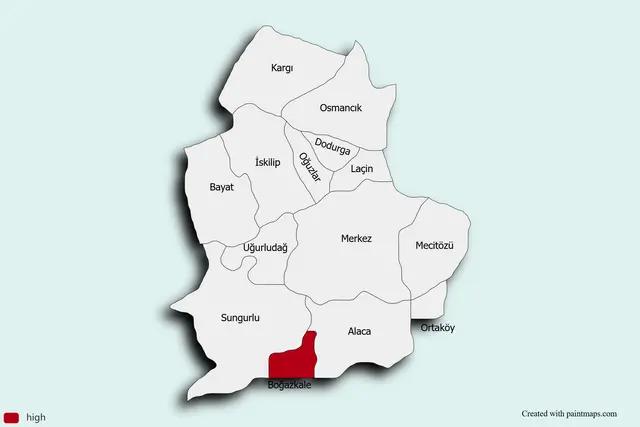
Boğazkale is a district located southeast of Çorum, with a predominantly rural population. Agriculture and animal husbandry are the primary sources of income. The district is home to important archaeological sites, including the Hittite-era ancient city of Hattusa and the Yazılıkaya Temple.

Boğazkale ( Çorum Provincial Directorate of Culture and Tourism )
The ancient city of Hattusa, located in the Boğazkale district, is the capital of one of the first organized states in Anatolia. Traces of settlement in the region date back to the Chalcolithic Age, and the influence of Hattian and Assyrian trading colonies is evident in the Bronze Age. Hattusa, which became the political and cultural center of the Hittites in the 2nd millennium BC, served as their capital, particularly around 2000 BC. The Great Citadel, the Great Temple in the Lower City, and the Yazılıkaya Open Air Temple stand out as important sites of religious ritual and imagery.
Rediscovered in 1834, the ancient city was unearthed through excavations conducted by the German Research Center for Oriental Cultures beginning in 1904, and continued uninterrupted since 1939. Thousands of cuneiform tablets unearthed during excavations in the region include the texts of the Treaty of Kadesh, which shed light on Hittite-Egyptian relations. Inscribed on the UNESCO World Cultural Heritage List in 1986 and designated as National Parks in 1998, Hattusa and Yazılıkaya are becoming a resource for conservation and promotion efforts.
Turkish rule began with the Danishmend conquest in 1075; Turkmen settlements moved to the present-day district center in the 16th century, and by the end of the 17th century. During the Republican era, Boğazköy was renamed Boğazkale in 1936, and it gained municipality status in 1967 and district status in 1987.
The district's borders cover an area of 260 km², with an average elevation of 1,036 m above sea level. Average annual rainfall is 490.3 mm. The topography is intertwined with mountainous and plain areas; land use includes 12,110 hectares of fields, 3,784 hectares of pastures, 23 hectares of meadows, and 6,165 hectares of forest. The vegetation generally exhibits steppe characteristics, with poplars prevalent in the district center and oak and pine species prevalent in the mountainous regions.
The mainstream is the Budaközü Stream, which also irrigates the ancient city. Due to its geographical location, the region has a continental climate, with cold and snowy winters and hot and dry summers. These climatic conditions are among the primary factors determining agricultural activities and natural vegetation.
While the total population of the Boğazkale district was 5,696 in 2007, it decreased to 3,673 in 2024, and during this period, increases of 489 and 484 people were recorded in 2017–2018 and 2022–2023, respectively, while decreases were observed at varying rates in the other years. According to 2024 data, the male population was 1,864 (50.75%) and the female population was 1,809 (49.25%).
The district's economy is largely based on agriculture and animal husbandry. 12,110 hectares of arable land allow for the cultivation of traditional crops, particularly wheat, barley, and industrial crops. 3,784 hectares of pastureland support the sustainability of small and large livestock farming. 6,165 hectares of forestland offer potential for wood and other forest products.
In addition, the increasing number of domestic and international visitors to the Hattusa and Yazılıkaya archaeological sites increases the tourism sector's share of the district's revenue. Their National Park and UNESCO World Heritage statuses allow for the development of tourism infrastructure and the local community to generate income from tourism. Thus, cultural heritage contributes to economic diversification.
Boğazkale, with its ancient Hattusha ruins and Yazılıkaya Rock Temple, is valuable for cultural tourism. The sites, listed as a UNESCO World Cultural Heritage Site, welcome visitors year-round. A total of 17 hiking trails, 11 short and 6 long-distance, offer opportunities for nature walks and cycling. The 9-km İbikcam–Hattusha trail, which passes through the Budaközü Valley, is supported by wooden platforms and bridge crossings. Areas designated for camping and caravan tourism cater to nature sports enthusiasts.
The Boğazköy Museum's cultural richness can be witnessed through the stone artifacts, sphinxes, and hieroglyphic Luwian inscriptions displayed in its three exhibition halls and outdoor garden. The museum presents a comprehensive chronological overview of the region's history, spanning from the Chalcolithic Age to the Byzantine Period.
The district's cuisine exhibits a wide variety of dishes unique to the Çorum region. Known for its roasted chickpea production, the region's cuisine includes yeast-raised and pan-leavened varieties, yanıç (a type of flatbread), cızlak (a type of flatbread), kömbe (a type of flatbread), oğmaç (a type of flatbread), hingal (a type of flatbread with yeast), borhani (a type of flatbread with dough, egg, and mushroom), helise (a type of flatbread with dough, egg, and mushroom), çullama (a type of flatbread with yeast), tırit (a type of flatbread with dough, egg, and mushroom), iskilip dolma (a type of flatbread with yeast), keşkek (a type of flatbread with yeast), kara sack helvası (a type of flatbread with yeast), hedik (a type of flatbread with yeast), teltel (a type of flatbread with yeast), and has baklava (a type of flatbread with yeast). These products contribute to gastronomic tourism by being served both daily and at local events and festivals.
Boğazkale District Governorship. “Our District.” Boğazkale District Governorship. Access date: May 4, 2025. http://www.bogazkale.gov.tr/ilcemiz
Boğazkale District Governorship. “History.” Boğazkale District Governorship. Access date: May 4, 2025. http://www.bogazkale.gov.tr/tarihce
Paintmaps. “Turkey Provinces Map – Highlighting Boğazkale, Çorum .” Access date: April 15, 2025. https://paintmaps.com .
Republic of Turkey, Çorum Governorship. “Boğazkale.” Çorum Governorship. Access date: May 4, 2025. http://corum.gov.tr/bogazkale
Republic of Turkey Ministry of Culture and Tourism. “Boğazkale Hattusa.” Ministry of Culture and Tourism Promotion Portal. Access date: May 4, 2025. https://tanitma.ktb.gov.tr/tr-22643/bogazkale-hattusa.html
Republic of Turkey Ministry of Culture and Tourism, Çorum Provincial Directorate of Culture and Tourism. “Boğazkale.” Çorum Provincial Directorate of Culture and Tourism. Access date: May 4, 2025. https://corum.ktb.gov.tr/TR-58695/bogazkale.html
Turkish Statistical Institute (TurkStat). Address Based Population Registration System Results, 2024. Access date: April 20, 2025. https://data.tuik.gov.tr/Bulten/Index?p=Adrese-Dayali-Nufus-Kayit-Sistemi-Sonuclari-2024-53783

Province(s) | Çorum | ||||||||
|---|---|---|---|---|---|---|---|---|---|
Area(s) | Black Sea | ||||||||
Altitude | 1.036 m | ||||||||
Population (2024) | 3,673 | ||||||||
Postal Code | 19310 | ||||||||
Climate(s) | Continental Climate | ||||||||
Economy | Agriculture Livestock and Tourism | ||||||||
Mayor(s) | Adem Özel | ||||||||
District Governor | Emine Karataş Yıldız | ||||||||
No Discussion Added Yet
Start discussion for "Boğazkale (District)" article
History
Geography and Climate
Population and Demography
Economy
Tourism, Culture, and Cuisine
This article was created with the support of artificial intelligence.