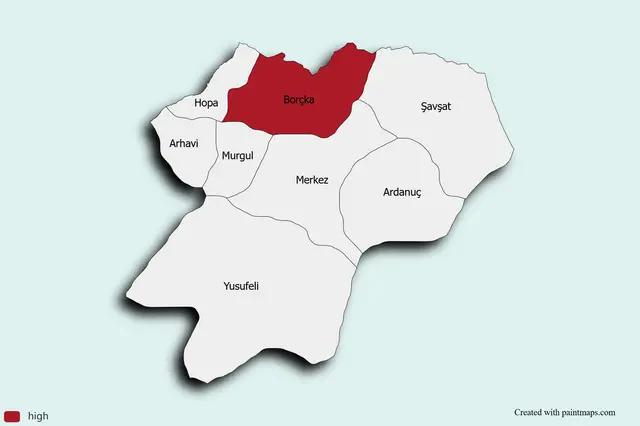


Borçka (District)
Province(s) | Artvin | ||||||||
|---|---|---|---|---|---|---|---|---|---|
Area(s) | Eastern Black Sea Region | ||||||||
Mayor(s) | Ercan Orhan | ||||||||
District Governor | Betül Büyükkılıç | ||||||||
Altitude | 125m | ||||||||
Population | 22,288 (2023) | ||||||||
Climate(s) | Black Sea climate | ||||||||
Tourist Spots | Ibriga Chapel Vergetil Ridge Karchal Mountains Star Lake Black Lake | ||||||||
Borçka is a district of Artvin Province in northeastern Türkiye. The district center is located in the Çoruh River valley, on the Artvin–Hopa highway; its administrative borders cover an area of 762 km² and its average elevation is 125 m. It is 30 km from the city center and 36 km from Hopa; it consists of 36 villages and a central settlement.

Borçka Karagöl ( Turkiye Culture Portal )
The earliest traces of the settled history of Borçka and its surroundings indicate that Hurrians, arriving from Central Asia , established in the region around 2000 BC . Following the collapse of the Hittite Empire, the Urartians expanded into the region and ruled from 720 to 714 BC. The Cimmerians then dominated the region from 720 to 714 BC, the Sakas from 655 BC, and later the Arsacids (Parthians). These complex ethnic and cultural transitions point to Borçka's multilayered history.
From 576 AD onward, the Byzantine Empire began to rule Borcka as the Eastern Roman Empire's easternmost defensive line. In 645 , Islamic armies under the command of Caliph Osman defeated the Byzantine forces and controlled the region; the periods of the Umayyads, Khazar Turks, and the Georgian Bagratid Kingdom further cemented the region's status as a constantly changing crossroads.
With the expansion of the Great Seljuk State in the mid-11th century, Borçka, Artvin, and the surrounding area were annexed to Seljuk rule in 1063. Mongol invasions in the 13th century temporarily disrupted the political order in the region, but geographical difficulties prevented the permanence of Mongol rule on a local scale.
Within the Ottoman imperial system, Borçka was officially incorporated into Ottoman territory during the campaigns organized by Yavuz Sultan Selim while he was Governor between 1490 and 1512. The region , which was annexed to the Sanjak of Ardanuç in 1551 , was administered as part of the Ottoman administrative hierarchy, with changes in province and sanjak in the following centuries.
Following the 1877–1878 Russo-Turkish War, the Treaty of Kars - Ardahan ceded Borçka, with Artvin, Ardahan, and Batum , to frequent conflict due to its border proximity . Immediately after the Armistice of Mudros ( October 30 , 1918), the British, followed by Georgian forces, occupied Borçka. Georgian rule ended on February 9, 1921, with an ultimatum from the Turkish Grand National Assembly. On 7 , 1921, Borçka, along with the eastern countryside of Artvin Province, was definitively incorporated into the borders of the Republic of Türkiye.
Within the framework of the administrative regulations of the new Republic of Türkiye, Borçka began organizing as a sub-district center on 7 , 1921. Its sub-district structure was formalized with Law No. 877 dated June 26, 1926, and it regained district status with Law No. 1288 dated May 28, 1928. Since this date, Borçka has maintained its administrative structure as one of district centers in the coastal region of Artvin province.
Throughout these periods, Borçka has consistently been on the border of various tribes and empires, its geographical location serving both as a strategic defensive line and a cultural corridor throughout history. , the district exhibits its multilayered historical heritage, including ancient defensive remains, Ottoman-era artifacts, and administrative documents that bear witness to the founding of the Republic.
Borçka is a settlement located at the bottom of the deep Çoruh Valley in the Eastern Black Sea region, surrounded by steep mountains and dense forests . Located 36 km from the town center at an elevation of 125 m, Borçka is bordered by Hopa to the west, Artvin and Murgul to the south, Şavşat to the east, and Georgia to the north.
The landforms consist primarily of the Karçal Mountains, whose peaks exceed 3,414 meters, and the steep ridges that bisect the Çoruh Valley. Balıklı Mountain and Cankurtaran Pass are the most important points providing passageways south of the valley. The hills of various sizes, rising as extensions of these main masses, create a characterized by deep valleys and sharp ridges . Arable land is limited to the limited plains and designated valley floors; flat plains are virtually nonexistent within the district's borders.
The Çoruh River, rising in the Artvin highlands, joins the Murgul, İçkale, and Deviskel streams within Borçka. It also receives water from the Aralık , Karşıköy, and Güreşen streams before flowing towards Georgia. This rapid -flowing river network poses both hydropower and flood risk .
The climate throughout the district is influenced by the Black Sea climate, but regional variations occur due to elevation differences. The Çoruh Valley floor has a slightly milder microclimate with relatively little rainfall compared to the coast , while coastal areas experience abundant rainfall and high humidity throughout the year . At higher elevations, winters are long , cold, and constantly covered in snow ; summers are cool and short.
Vegetation gradually from sea level to the high mountain slopes . Forests dominate almost everywhere except for the valley floor, which is designated for agriculture. Mixed oak, chestnut , and alder trees are common in the lower elevations; broad-leaved trees beech and hornbeam are common in the middle elevations ; and coniferous forests, predominantly spruce, fir , and pine, are prevalent at higher elevations . Alpine meadow and pasture ecosystems near complete the diversity.
Borçka district is located in the northeast of Artvin province and has an administrative structure consisting of one municipality , four neighborhoods , and 36 villages. According to the 2007 General Census, the district's total population was recorded as 29,079. Of this number, 10,433 live in the district center and 18,646 in the villages. While the population decreased to 24,343 in 2009, according to current TurkStat data, Borçka's total population is 22,288 as of 2023. This decline clearly reflects the district's long-standing rural population loss and migration trends.
The district's geographic structure is the primary factor determining the spatial distribution of the population. Borcka, with its forested and mountainous topography, is primarily populated on narrow, arable plains in the valleys. While a concentrated settlement model prevails in the district center, the villages are characterized by dispersed settlements due to the rugged terrain. This creates challenges in the provision of rural infrastructure services and , over time, becomes a factor encouraging migration.
In Borçka, migration is particularly pronounced among the young population. Limited educational and employment opportunities have increased mobility outside the district and towards larger cities. This has led to and a thinning of the population density in rural areas. However, the district's population can experience temporary increases during certain periods due to seasonal agricultural activities.
The agricultural sector provides the livelihood for a significant portion of the district's population. Tea , hazelnut , production, and forest products, in particular, constitute the primary economic activities of rural residents . There is one publicly owned and two privately owned tea factories in the district. These facilities contribute to local employment and facilitate the marketing of agricultural produce .
Overall, Borçka's population and demographic structure are undergoing a dynamic due to geographical constraints, limited economic opportunities, and imbalances in the social service infrastructure . For the district's sustainable development, service planning appropriate to the age and gender composition of the population, local employment projects to reduce migration, and strengthening rural infrastructure are among the key needs.
Borçka district, located east of Artvin, in the interior of the Black Sea mountain range, is situated in a region with limited agricultural opportunities. The rugged topography and narrow valley structure significantly restrict the area available for agriculture. However, despite these limitations, Borçka's economy thrives on the rational use of natural resources and small- scale local production .
Agriculture plays a significant role in the district's rural economy. Tea and hazelnut production is widespread, particularly in villages nestled on the valley slopes, and is one of the primary sources of income for the local population. The Muratlı Tea Factory, which began operations in 1984 , is the primary facility responsible for processing tea production in the district . According to 2002 data, 13,507 tons of fresh tea was purchased from 4,008 producers operating on 18,379 decares of land, and 2,015 tons of dried tea were produced from these products. The factory employs approximately 620 people.
Forestry and forest products are another important sector of the district's economy. The rich forest reserves have fostered the development of small-scale carpentry workshops focused on the and furniture sectors . The 17 active carpentry workshops in the district typically employ three people each. Additionally, four Agricultural Development Cooperatives and various small privately owned facilities contribute to the regional economy by processing forest products.
Livestock farming in the district is conducted entirely for domestic consumption. According to 2002 data, there were 10,760 head of cattle and 3,453 head of sheep in the district . Livestock farming is carried out using traditional methods, particularly in rural villages; there are no industrial-scale milk or meat processing facilities.
Beekeeping is a widespread occupation, particularly in forest villages . There are 10,711 registered hives and 2,080 black hives in the district, with an average annual honey production of around 255 tons. This production supports both family incomes and the marketing of local products. Additionally, two trout farms operate in the district, producing for both the domestic market and regional consumption.
Cooperatives are a common form of organization in the Borçka economy. A total of 27 cooperatives operate in the district, including 22 for agricultural development, 1 for motor carriers, 1 for minibus drivers, 1 for tradesmen and surety , 1 for housing , and 1 for dump truck drivers. These structures help small producers overcome the challenges of organized production, marketing, and financing.
Borcka has significant tourism potential, but the economic returns are limited. The plateaus at the foot of the Karçal Mountains (Karçal Plateaus, Küçük Yayla) are suitable for mountain hiking and nature tourism. Natural resources such as Vergetil Ridge, Soğuksu, and Beyazsu, as well as glacial lakes such as Karagöl and Yıldız Lake, are valuable for ecotourism.
Karagöl, within the village of Aralık, is a major attraction for camping and nature observation . Fishing (especially trout) and hunting (bear, boar , jackal, fox, wolf , mountain goat, and lynx ) constitute Borçka's other potential economic opportunities. However, these activities are currently limited and seasonal.
Overall, Borçka's economy is diversified by small-scale agriculture, animal husbandry, forestry, beekeeping, and limited industrial activity. Conserving and utilizing natural resources and supporting tourism potential with infrastructure investments are among the priorities for the district's economic sustainability.
Borçka has the potential to offer a wide variety of activities, including cultural tourism, highland tourism, canoe -rafting, mountain and nature hiking, camping and caravan tourism, sport fishing, birdwatching , botanical exploration , wildlife viewing, Jeep safaris, and religious tourism. Among its natural and historical assets , the forests adorned with monumental trees in the Camili-Maçahel Valley, the glacial lakes known as Karagöl, canoe-rafting tours on the Çoruh River, and a 19th-century structure like the İbriga Chapel stand out. Traditional practices in the district include animal husbandry and shepherding, folk medicine and veterinary medicine, traditional theater , folk dances , local music and instruments, handicrafts, and folk architecture.
The rich culinary tradition of the Artvin region is also evident in Borçka. Many traditional delicacies are prepared daily and for special occasions in the district. Among the dishes based on milk and dairy products, cheese kuymak and kaymak kuymak stand out. Dishes made with mountain herbs include mountain beets, bird meal, and gımı.
Among pastries , varieties such as Laz böreği, katmer, noodles, and hınkal are common. Among meat dishes, winter kavurma and wood shish kebabs are notable. Among grain dishes, keşkek , gendima, herisa, and şilav are well-known. Desserts include hasuta, kaysefe, zurbiyet, and honey . Additionally, local soups like püşürük soup, ayran soup, tutmaç, and chinçar soup are among the most popular choices on the tables of the locals.
Borçka Municipality. “The City’s Population and History.” Borçka Municipality. Access date: April 19, 2025. https://www.borcka.bel.tr/sehrin-nufusu-ve-tarihi/
Paintmaps. “Turkey Provinces Map – Highlighting Borçka, Artvin.” Access date: April 15, 2025. https://paintmaps.com
Republic of Turkey Ministry of Culture and Tourism. “Borçka.” Artvin Governorship Directorate of Culture and Tourism. Access date: 19 April 2025. https://artvin.ktb.gov.tr/TR-55836/borcka.html
Republic of Turkey Ministry of Culture and Tourism. “Ibriga Chapel.” Artvin Governorship Directorate of Culture and Tourism. Access date: April 19, 2025. https://artvin.ktb.gov.tr/TR-55883/ibriga-sapeli.html
Republic of Turkey Ministry of Culture and Tourism. “Topography.” Artvin Governorship Directorate of Culture and Tourism. Access date: April 19, 2025. https://artvin.ktb.gov.tr/TR-55831/topografya.html
Republic of Turkey Ministry of Culture and Tourism. “Local Cuisine.” Artvin Governorship Directorate of Culture and Tourism. Access date: April 19, 2025. https://artvin.ktb.gov.tr/TR-55844/yore-mutfagi.html
Republic of Turkey Ministry of Culture and Tourism. “Borçka Karagöl.” Turkey Culture Portal. Accessed 20 April 2025. https://kulturportali.gov.tr/turkiye/artvin/gezilecekyer/borcka-karagol

Borçka (District)
Province(s) | Artvin | ||||||||
|---|---|---|---|---|---|---|---|---|---|
Area(s) | Eastern Black Sea Region | ||||||||
Mayor(s) | Ercan Orhan | ||||||||
District Governor | Betül Büyükkılıç | ||||||||
Altitude | 125m | ||||||||
Population | 22,288 (2023) | ||||||||
Climate(s) | Black Sea climate | ||||||||
Tourist Spots | Ibriga Chapel Vergetil Ridge Karchal Mountains Star Lake Black Lake | ||||||||
History
Geography and Climate
Population and Demography
Economy
Tourism and Culture
Kitchen
This article was created with the support of artificial intelligence.