
+1 More

Kingdom(s) | Animalia | ||||||||
|---|---|---|---|---|---|---|---|---|---|
Phylum | Chordata | ||||||||
Class | Mammalia | ||||||||
Order | Cetacea | ||||||||
Family | Delphinidae | ||||||||
Genus | Tursiops | ||||||||
Specie(s) | Tursiops truncatus | ||||||||
Conservation Status | Least Concern (LC) | ||||||||
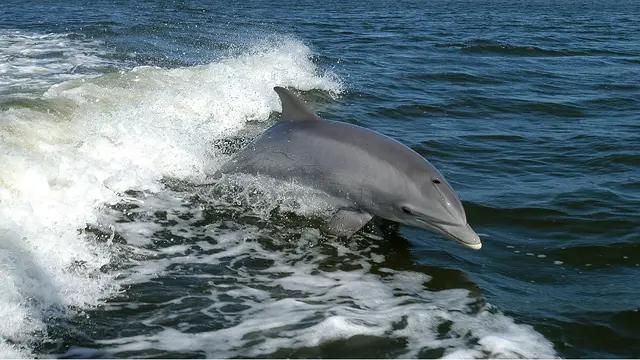
The bottlenose dolphin (Tursiops truncatus) is a species of dolphin found in temperate and tropical seas, known for its high intelligence and social behavior. It has a gray, spindle-shaped body and a short, thick snout. It feeds on fish, squid, and shellfish and hunts through echolocation and cooperation. Due to its proximity to shore, it is vulnerable to human-induced threats, particularly fishing gear and pollution.
Bottlenose dolphins have a spindle-shaped body that lacks many external features of terrestrial mammals, such as hair, external ears, and hind legs. This spindle-shaped body structure reduces turbulence and allows them to travel at high speeds underwater. They have front flippers, a dorsal fin, and a tail, which they use for swimming. The dorsal fin is long, curved, and located near the middle of the back.
Their sides range from black to light gray, while their undersides are white or sometimes have a slight pink tinge. They are generally slate gray or charcoal, with a paler underbelly. Individuals living in coastal waters are generally smaller and lighter in color than those in the open sea. Adult males can range from 244 to 381 cm in length and weigh approximately 500 kg, although specimens have been recorded reaching lengths of 3.8 m and weighing 600 kg.
Adult females typically stand between 228 and 366 cm tall and weigh approximately 250 kg; in this sexual dimorphism (having two distinct forms within a species), males tend to be larger than females. The average mass ranges from 260 to 500 kg, with an average of 400 kg. Dolphins are both homeotherms (warm-blooded) and endotherms (the state of maintaining a metabolically appropriate body temperature); they provide insulation in the form of fatty tissue and use vascular shunts to aid in thermoregulation (maintaining body temperature).

Bottlenose dolphins are found in all temperate and tropical marine waters worldwide, excluding polar waters, and are considered the most cosmopolitan of all dolphin species. Their geographic range includes the Indian Ocean, Atlantic Ocean, Pacific Ocean, and the Mediterranean Sea. They generally inhabit waters with surface temperatures between approximately 10–30°C. Their habitats are diverse and include harbors, bays, gulfs, estuaries (where rivers meet the sea), open coastlines, large river mouths, nearshore waters, deep waters above the continental shelf, and offshore waters.
Their habitats include temperate, tropical, saltwater, marine, and brackish waters. While some populations of this species migrate seasonally, they are generally found in tropical, subtropical, and temperate waters. Their population in the Moray Firth, Scotland, is the world's northernmost resident population. Dolphins surface to breathe; deep-water dolphins breathe every 1-2 minutes, while coastal dolphins breathe twice per minute; however, they have been known to dive deep for up to 4.5 minutes without breathing.
Bottlenose dolphins are an intelligent species. They use sound to communicate and locate prey. They typically travel alone or in small groups, but groups of hundreds can also be seen in the open sea. Their travels are characterized by continuous movement in a consistent direction, while their rests are typically characterized by tight group formations, slow movement, and regular breathing intervals. They exhibit active swimming behaviors such as tail flapping, splashing, and aerial displays. Their social behaviors include breeding, play, aggression, and body contact such as rubbing.
Their diet consists of a variety of prey, including fish, squid, and crustaceans such as crabs or shrimp. They use various techniques to stalk and capture prey, either individually or cooperatively; for example, they gather fish in schools and then take turns feeding among them. They use echolocation and/or passive listening to locate their prey. Instead of chewing, they grasp fish with their teeth and swallow them whole, head first, to prevent the spines from getting lodged in their throats.

Bottlenose Dolphin (Pixabay)
Bottlenose dolphins have a polygamous breeding system and mate in alliances or individually. Females generally reach sexual maturity between 5 and 10 years of age, and males between 8 and 13 years of age. However, even after reaching sexual maturity, males generally do not reproduce until around 20 years of age. Gestation lasts approximately 12 months, with one calf born per pregnancy. Females reproduce every 3 to 6 years. The young nurse for 18 to 20 months from nipples on either side of their genital slits. After birth, the young remain with their mothers for 3 to 6 years. Females can continue to reproduce until they are 45 years old.
Females provide the majority of parental investment, particularly during lactation. Allomaternal care, where other females in the group assist with the offspring, is also observed in this species. In the wild, male dolphins typically live for 40 to 45 years, while females have been observed to live for over 50 years (the oldest documented female was 53 years old). The overall lifespan is reported to be 40 to 60 years.
Bottlenose dolphins, like all marine mammals, are protected under the Marine Mammal Protection Act (MMPA). However, five stocks along the Atlantic Coast are considered "extinct" under the MMPA. They are rated as Least Concern (LC) on the International Union for Conservation of Nature's (IUCN) Red List of Threatened Species.
The species faces a number of threats, both natural and human-induced. Threats include bycatch in commercial and recreational fisheries; dolphins can become entangled in nets or ingest fishing gear. Dolphins living near shore are vulnerable to habitat destruction and degradation due to chemical pollutants (such as PCBs), oil spills (the 2010 Deepwater Horizon oil spill resulted in immune system impairment, lung disease, and reproductive failure), shoreline development, increased boat traffic, and overexposure to freshwater.
Biotoxin exposure (biologically derived toxic substances) associated with harmful algal blooms (HABs) such as red tides is also a threat. Illegal feeding and harassment cause dolphins to associate humans with food, making them vulnerable to ship strikes and entanglement in fishing gear. Natural causes of mortality include injury, disease, and predation (sharks). Depletion of prey resources due to overfishing and increased underwater noise are additional threats.
ASCOBANS. “Tursiops truncatus.” ASCOBANS. Accessed October 25, 2025. https://www.ascobans.org/en/species/tursiops-truncatus.
Janeb13. "Tursiops Trauncatus JPG." Pixabay. Accessed October 25, 2025. https://pixabay.com/tr/photos/yunus-okyanus-dalgalar-z%C4%B1plamak-1167996/.
Jenkins, Jessica. “Tursiops truncatus (Bottlenosed Dolphin).” Animal Diversity Web. Accessed October 25, 2025. https://animaldiversity.org/accounts/Tursiops_truncatus/.
NOAA Fisheries. “Common Bottlenose Dolphin.” NOAA Fisheries. Accessed October 25, 2025. https://www.fisheries.noaa.gov/species/common-bottlenose-dolphin.
axelle b. “Dolphin, Tursiops Truncatus JPG.” PublicDomainPictures.net . Accessed October 25, 2025. https://www.publicdomainpictures.net/en/view-image.php?image=151147&picture=dolphin-tursiops-truncatus.

Kingdom(s) | Animalia | ||||||||
|---|---|---|---|---|---|---|---|---|---|
Phylum | Chordata | ||||||||
Class | Mammalia | ||||||||
Order | Cetacea | ||||||||
Family | Delphinidae | ||||||||
Genus | Tursiops | ||||||||
Specie(s) | Tursiops truncatus | ||||||||
Conservation Status | Least Concern (LC) | ||||||||
No Discussion Added Yet
Start discussion for "Bottlenose Dolphin (Tursiops truncatus)" article
Morphological Features
Geographic Distribution and Habitat
Behavior and Diet
Reproduction and Life Span
Conservation Status and Threats
This article was created with the support of artificial intelligence.