+2 More

Definition(s) | Religious and Philosophical Tradition Founded on the Teachings of Siddhartha Gautama Known as the Buddha | ||||||||
|---|---|---|---|---|---|---|---|---|---|
Founder(s) | Siddhartha Gautama (the Buddha) | ||||||||
Key Concepts | Four Noble Truths, Eightfold Path, Karma and Rebirth, Nirvana | ||||||||
Historical Origin | Originated in ancient India Around the 5th Century BCE | ||||||||
Branch | Vajrayāna Mahāyāna Theravāda | ||||||||
Sacred Texts | Tipiṭaka (Pāli Canon), Mahāyāna Sutras, Others | ||||||||
Practice | Meditation, Ethical Conduct, Monastic Life, Devotional Practices | ||||||||
Buddhism is one of the world’s major religions and philosophical systems, originating in the Indian subcontinent in the 6th century BCE with the teachings of Siddhartha Gautama, known as the Buddha (“the awakened one”). It encompasses a complex system of spiritual doctrines, ethical precepts, meditative practices, and cultural traditions aimed at overcoming suffering (dukkha) through insight, moral discipline, and liberation from the cycle of birth and rebirth (saṃsāra).

Buddhist Monks (Pixabay)
The historical Buddha lived and taught in present-day Nepal and northern India. His core teaching centers on the Four Noble Truths, which diagnose suffering and outline the Noble Eightfold Path as its remedy. Early Buddhism spread via oral tradition and monastic communities throughout India.
A major expansion occurred during Emperor Ashoka’s reign (c. 268–232 BCE), whose patronage spread Buddhism across South Asia and into Central and Southeast Asia.
Doctrinal diversity later gave rise to multiple schools, notably:
While doctrines like rebirth and karma are not empirically verifiable, their adaptability has supported Buddhism's transmission across cultures.
Buddhism often serves as a marker of cultural identity—as in Sri Lanka, where it aligns with Sinhalese nationalism and political movements. Monastic institutions historically held significant political and economic influence through royal patronage, land grants, and tax exemptions, occasionally leading to legal regulation.
Buddhist ethics stress compassion, altruism, and social responsibility, fostering social cohesion beyond kinship networks. Indeterminate metaphysical doctrines support moral behavior and community identity.
Buddhism includes metaphysical and mystical elements such as rebirth, karma, and enlightenment experiences. Though unverifiable, these beliefs foster communal unity and delineate cultural boundaries. Their flexibility contributes to Buddhism’s ongoing relevance in varied contexts.
In Japan, esoteric schools such as Shingon and Tendai integrated ritual, meditation, and doctrinal synthesis.

Buddha (World History Encyclopedia)
The term Buddha (“the awakened one”) refers primarily to Siddhartha Gautama (circa 5th–4th century BCE), founder of Buddhism and teacher of the path to liberation through insight into reality.
Born into royalty in Lumbini (modern Nepal), Siddhartha encountered suffering in the forms of aging, sickness, and death, prompting his renunciation of worldly life. After years of asceticism and meditation, he attained awakening (bodhi) beneath the Bodhi Tree in Bodh Gaya, realizing the impermanence, unsatisfactoriness, and non-self nature of existence.
The Buddha’s teachings (Dharma) emphasize:
Central to his doctrine are the Four Noble Truths and the Noble Eightfold Path, guiding practitioners toward nirvana and liberation from saṃsāra.
The Buddha taught that no permanent self exists. Instead, a “person” is a contingent assemblage of five aggregates (skandhas): form, sensation, perception, mental formations, and consciousness. This rejects eternal soul theories and grounds Buddhist psychology, ethics, and soteriology.
Intentional actions (karma) produce effects that condition rebirths, without requiring a permanent self. The causal continuity between lives preserves moral responsibility while avoiding metaphysical claims of an enduring soul.
The Buddha adopted a pragmatic approach, avoiding speculative metaphysics that do not lead to liberation. His use of tetralemma (fourfold logic) reflects a method of navigating beyond binary logic, favoring practical insight over abstract theorization.
The Buddha’s life and teachings have inspired a global tradition grounded in direct experience, ethical living, and insight. Scholars continue to examine his thought through textual studies and comparative philosophy, revealing its enduring significance.

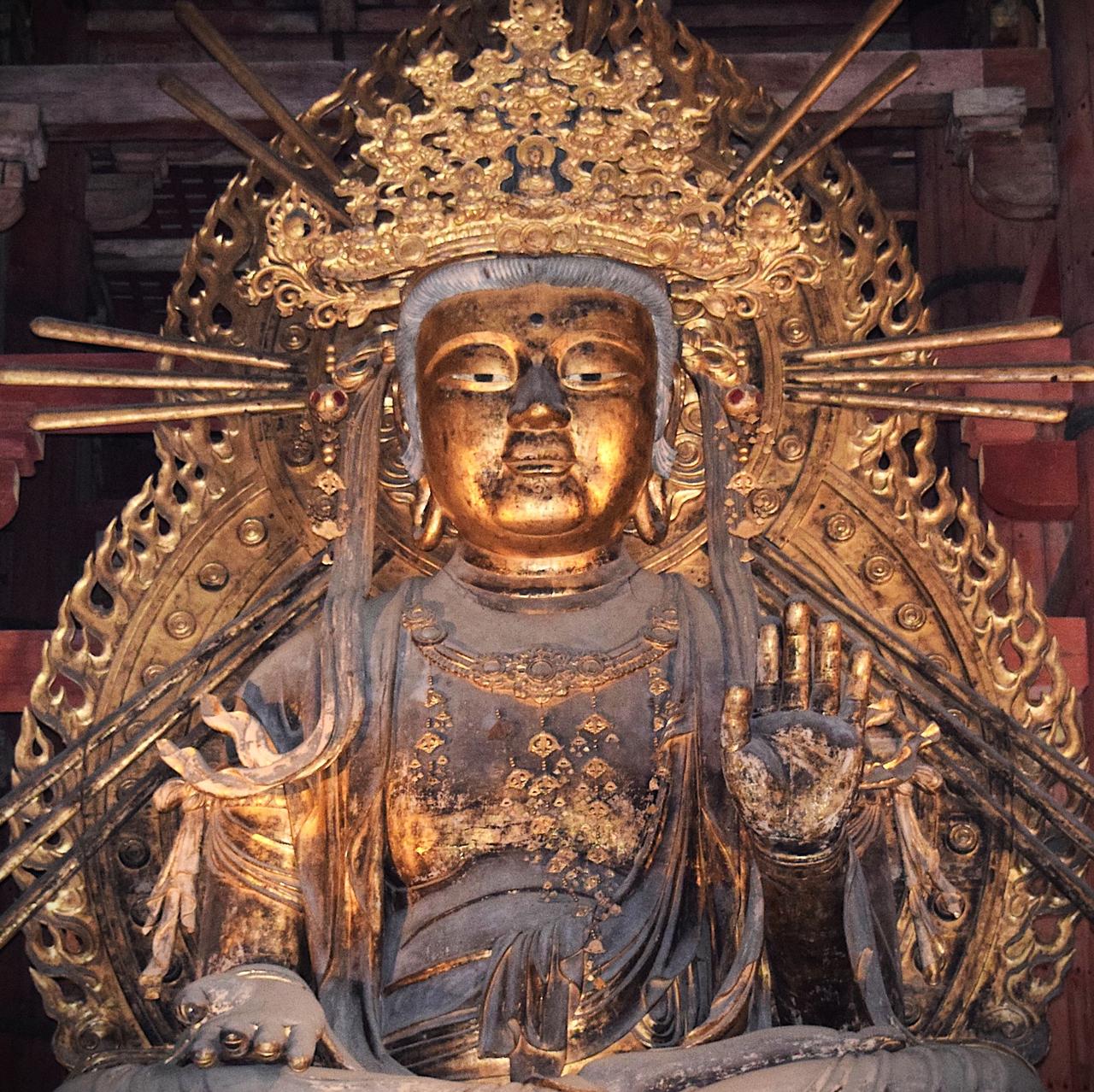
Todaiji Temple, Japan (taken by Ömer Faruk Bilcan)
Buddhism entered Japan around 552 CE via the Korean kingdom of Baekje, initially supported by the Soga clan and Korean immigrants. Despite opposition from Shinto factions, it gained imperial backing under Emperor Yomei and later flourished under Prince Shotoku (574–622 CE), who promoted it as a state religion and emphasized the “Three Treasures” (Buddha, Dharma, Sangha).
Rather than displacing Shinto, Buddhism merged with it, leading to Ryōbu Shintō, wherein Buddhist deities were identified with Shinto kami. Temples gained wealth and autonomy, sometimes possessing land and military forces, prompting 8th-century reforms to limit their political influence.
Key figures include:
Later schools such as Pure Land and Zen emerged and gained widespread popularity in medieval Japan.
Buddhist temples played major roles in education, welfare, and cultural patronage. Despite later Shinto revival movements, Buddhism remains deeply embedded in Japanese society as a syncretic and influential tradition.
Brown, Waka Takahashi. Introduction to Buddhism. SPICE (Stanford Program on International and Cross-Cultural Education), December 2002. Excerpt from Religions and Philosophies in China: Confucianism, Daoism, and Buddhism. Accessed July 10, 2025. https://spice.fsi.stanford.edu/docs/introduction_to_buddhism.
Buswell, Robert E., Jr., ed. Encyclopedia of Buddhism. 2 vols. New York: Macmillan Reference Books, 2004. Accessed July 10, 2025. https://buddhism.lib.ntu.edu.tw/en/search/search_detail.jsp?seq=120846.
Cartwright, Mark. “Buddhism in Ancient Japan.” World History Encyclopedia, June 19, 2017. Accessed July 10, 2025. https://www.worldhistory.org/article/1080/buddhism-in-ancient-japan/.
Mark, Joshua J. “Buddhism.” World History Encyclopedia. Last modified September 25, 2020. Accessed July 10, 2025. https://www.worldhistory.org/buddhism/.
Prat, Monica-Lopez. “Buddhism.” National Geographic Education. Last updated September 20, 2024. Accessed July 10, 2025. https://education.nationalgeographic.org/resource/buddhism/.
sasint. “Buddhism Asia Boys Cambodia.” Pixabay, November 18, 2016. Accessed July 10, 2025. https://pixabay.com/photos/buddhism-asia-boys-cambodia-1822518/.
Siderits, Mark. “Buddha.” Stanford Encyclopedia of Philosophy. First published February 17, 2011; substantive revision March 6, 2023. Accessed July 10, 2025. https://plato.stanford.edu/entries/buddha/.
Southwold, Martin. “Buddhism and the Definition of Religion.” Man 13, no. 3 (1978): 362–79. https://doi.org/10.2307/2801935.
“Buddhism — Definition, Founder & Origins.” History.com, A&E Television Networks. Accessed July 10, 2025. https://www.history.com/articles/buddhism.

Definition(s) | Religious and Philosophical Tradition Founded on the Teachings of Siddhartha Gautama Known as the Buddha | ||||||||
|---|---|---|---|---|---|---|---|---|---|
Founder(s) | Siddhartha Gautama (the Buddha) | ||||||||
Key Concepts | Four Noble Truths, Eightfold Path, Karma and Rebirth, Nirvana | ||||||||
Historical Origin | Originated in ancient India Around the 5th Century BCE | ||||||||
Branch | Vajrayāna Mahāyāna Theravāda | ||||||||
Sacred Texts | Tipiṭaka (Pāli Canon), Mahāyāna Sutras, Others | ||||||||
Practice | Meditation, Ethical Conduct, Monastic Life, Devotional Practices | ||||||||
Historical Development and Transmission
Core Doctrines and Philosophical Concepts
Key Doctrines:
Social, Cultural, and Political Roles
Mystical and Epistemic Characteristics
Diversity of Schools and Traditions
Major Branches:
The Buddha
Early Life and Awakening
Teachings
Doctrine of Non-Self (Anatta)
Karma and Rebirth
Attitude Toward Philosophical Inquiry
Legacy
Buddhism in Japan
Syncretism and Institutional Power
Intellectual and Sectarian Development
Cultural Impact
This article was created with the support of artificial intelligence.