

Type of Geographical Indication | Protected Designation of Origin | ||||||||
|---|---|---|---|---|---|---|---|---|---|
Registration Number | 1611 | ||||||||
Registration Date | 08.07.2024 | ||||||||
Product / Product Group(s) | Processed and Unprocessed Fruits and Vegetables and Mushrooms | ||||||||
Province(s) | Manisa | ||||||||
Applicant / Registrant | Manisa Commodity Exchange | ||||||||
Büyükbelen Tekir olive is a local olive variety grown in the Büyükbelen and Çullugörece neighborhoods of the Saruhanlı district in Manisa, Türkiye. Classified as a table green olive, it was registered as a Protected Designation of Origin under the Industrial Property Law No. 6769 and received geographical indication protection on 8 July 2024. The registration was carried out by the Manisa Commodity Exchange.
Büyükbelen Tekir olive is obtained either by grafting the Uslu olive variety (Olea europaea L.) onto Eşek (Ödemiş) olive rootstock or directly onto wild olive rootstocks. This olive is strictly associated with the climate and soil characteristics of the Büyükbelen and Çullugörece neighborhoods.
Olive groves are established on deep, nutrient-rich, calcareous-sandy soils at an elevation of 300 meters. Trees are productive, yielding over 40 kilograms of fruit per tree. The region has a Mediterranean-type continental climate, with hot summers and mild winters, promoting early ripening and a harvest period between September and October.
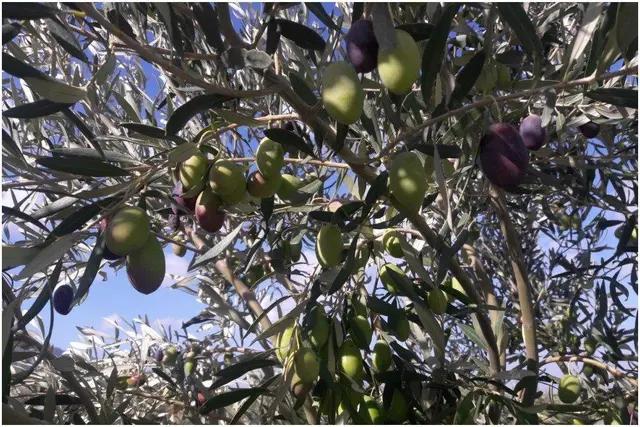
Büyükbelen Tekir olives are notable for their large fruit size. The flesh is firm and does not soften during processing, extending shelf life. The pit is large and difficult to separate from the flesh. The spotted surface of the fruit gives the olive its local name “Tekir.”
Olives are marketed whole, either cracked or pitted. The raw fruit is green, and ripe fruit ranges from dark green to quince yellow. Flesh content is 80–85%, and oil content ranges from 6–12%. The moisture content of the olives is 60–70%.
The production process covers orchard establishment, seedling propagation, soil preparation, planting, maintenance, harvest, and processing. Seedlings are produced by eye or whip grafting onto rootstocks. Planting occurs between November and April, with spacing of 7x7 m to 10x10 m.
Harvesting is done by hand; unblemished, healthy olives are sorted and processed. Bitterness is removed using a 2–3% NaOH solution, followed by washing and soaking in a citric acid–salt brine. Cracking and pitting are done with specialized machinery. Products are packaged in plastic, glass, or tin containers.
Shelf life varies by packaging: 2 years in tins, 3 years in glass, 6 months in plastic. Products are stored at 20–25 °C in low-humidity environments.
Raw olives have a pH of 4.5–5, and oleuropein content of 600–800 mg/kg. The fatty acid composition is dominated by oleic acid (68–75%), with palmitic (12–17%), linoleic (7–11%), and stearic (2.75–4%) acids present.
The olive trees in the region have a history of at least 600 years. Büyükbelen Tekir olive is a cornerstone of the local agricultural economy, providing livelihoods for nearly every family. The Büyükbelen Culture and Olive Festival, held during harvest, reinforces the cultural value of the product.
Geographical origin protection is overseen by the Manisa Commodity Exchange, with a three-member inspection committee including experts from the Saruhanlı District Directorate of Agriculture and Forestry and the Saruhanlı Chamber of Agriculture. Inspections are conducted at least once a year during the harvest season. Compliance with production methods, product characteristics, and the use of the protected designation of origin is monitored, and results are reported to the Turkish Patent and Trademark Office.
Türk Patent ve Marka Kurumu. "Büyükbelen Tekir Zeytini Coğrafi İşaret Sicil Belgesi." Coğrafi İşaretler Portalı. Accessed October 25, 2025. https://ci.turkpatent.gov.tr/Files/GeographicalSigns/ee409280-37bd-4227-94f9-638e1ec00756.pdf
Türk Patent ve Marka Kurumu. "Büyükbelen Tekir Zeytini." Coğrafi İşaretler Portalı. Accessed October 25, 2025. https://ci.turkpatent.gov.tr/cografi-isaretler/detay/5385

Type of Geographical Indication | Protected Designation of Origin | ||||||||
|---|---|---|---|---|---|---|---|---|---|
Registration Number | 1611 | ||||||||
Registration Date | 08.07.2024 | ||||||||
Product / Product Group(s) | Processed and Unprocessed Fruits and Vegetables and Mushrooms | ||||||||
Province(s) | Manisa | ||||||||
Applicant / Registrant | Manisa Commodity Exchange | ||||||||
No Discussion Added Yet
Start discussion for "Büyükbelen Tekir Olive " article
Origin and Cultivation Features
Distinguishing Characteristics
Production Process
Chemical and Physiological Properties
Cultural and Economic Value
Inspection and Protection
This article was created with the support of artificial intelligence.