


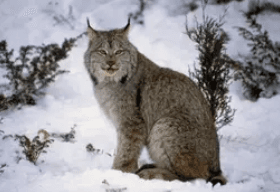
Canada Lynx (Lynx canadensis)
Kingdom(s) | Animalia | ||||||||
|---|---|---|---|---|---|---|---|---|---|
Phylum | Chordata | ||||||||
Class | Mammalia | ||||||||
Order | Carnivora (Carnivores) | ||||||||
Family | Felidae (Cats) | ||||||||
Genus | Lynx | ||||||||
Specie(s) | L. canadensis | ||||||||
Average Length | 76 - 106 cm (from head to tail tip) | ||||||||
Average Weight | 5 - 17 kg | ||||||||
Canada Lynx (Lynx canadensis) is a medium-sized feline species living in the cold and forested regions of North America. This species, common especially in the northern forests of Canada and the United States, has adapted to cold climate conditions. The Canada lynx plays an important role in ecosystems by maintaining a predator-prey relationship with the snowshoe hare in its natural habitat. It has unique characteristics in terms of its habitat and hunting strategies, and is protected due to environmental threats such as habitat loss and climate change.
The Canada lynx is distributed over a wide area along the boreal forests of North America, from Alaska to the northern states of the USA. It is commonly found in Canadian provinces such as Quebec, Ontario, Manitoba, Alberta, and British Columbia, extending eastward to the Newfoundland and Labrador regions. The species prefers habitats covered with dense pine, spruce, and fir forests that receive heavy snowfall during winter. Its large, furry paws increase mobility on snow in winter. The lynx interacts with predators and competitors in its habitat; therefore, wide and sheltered areas are considered important.

Canada Lynx - Lynx canadensis (Pexel)
The Canada lynx is a medium-sized member of the cat family, recognized by its long legs, short tail, and black tufts of fur on the ear tips. The length of its legs provides adaptation for hunting and moving on deep snow. Its body length ranges from 76 to 106 cm, and its weight varies between 5 and 17 kilograms. The fur color changes throughout the year; it is thick and insulating gray-brownish in winter, while in summer it is thinner and has lighter reddish tones. The tip of the tail is black, and the black tufts on the ears play an important role in communication and intraspecies recognition.
The primary diet of the Canada lynx consists of the snowshoe hare. There is a critical relationship between these two species in terms of population dynamics; an increase in the hare population supports lynx reproduction, while a decrease in hare numbers lowers lynx numbers. Lynxes hunt snowshoe hares by silently and carefully stalking them; they are more active during nighttime and twilight hours. Their diet may also include small mammals, birds, and other small vertebrates. Their wide paws allow quiet movement on snow and help them survive harsh winter conditions.
Canadalynxs enter their breeding season once a year. Female lynxes have a gestation period of 8 to 10 weeks and usually give birth to 1 to 5 kittens. The newborn kittens are blind and vulnerable. The mother nurses and protects them for about 5 months. During this period, the kittens learn to hunt and stay with the mother until about the tenth month. After becoming independent, the young establish their own territories. Reproductive success largely depends on the availability of food resources.

Canada Lynx - Lynx canadensis (Pexel)
Canada lynxes generally live solitary lives and defend their individual territories. Males distinctly mark the boundaries of their ranges through urine, feces, and scratching. Hunting, resting, and breeding activities mostly occur during night and twilight hours. Social interactions are rare and typically limited to the breeding season.
The Canada lynx has been listed as a "threatened species" in the USA since 2000. The main factors causing this status are habitat loss, climate change, and human impact. Climate change indirectly threatens lynxes by affecting snowshoe hare populations and their habitats. Habitat fragmentation and the reduction of forested areas limit the species' movement range. Conservation projects in some US states aim to create new habitats and restore existing ones. Various laws and programs in Canada and the USA target the protection and population increase of the species.
National Wildlife Federation. "Canada Lynx". National Wildlife Federation Website. Accessed May 29, 2025. https://www.nwf.org/Educational-Resources/Wildlife-Guide/Mammals/Canada-Lynx
Government of Newfoundland and Labrador. "Canada Lynx". Government of Newfoundland and Labrador Website. Accessed May 29, 2025. https://www.gov.nl.ca/ffa/wildlife/snp/programs/education/animal-facts/mammals/lynx/
Animal Diversity. "Lynx canadensis". Animal Diversity Website. Accessed May 29, 2025. https://animaldiversity.org/accounts/Lynx_canadensis/
U.S. Fish and Wildlife Service ECOS. "Canada Lynx (Lynx canadensis)". U.S. Fish and Wildlife Service ECOS Website. Accessed May 29, 2025. https://ecos.fws.gov/ecp/species/3652
U.S. Fish and Wildlife Service. "Canada Lynx". U.S. Fish and Wildlife Service Website. Accessed May 29, 2025. https://www.fws.gov/species/canada-lynx-lynx-canadensis
Patrice Schoefolt. "Lynx canadensis". Pexel Website. Accessed May 29, 2025. https://www.pexels.com/photo/a-canada-lynx-in-close-up-shot-11612026/
Patrice Schoefolt. "Lynx canadensis". Pexel Website. Accessed May 29, 2025. https://www.pexels.com/photo/a-canada-lynx-lying-beside-wooden-log-11612085/

Canada Lynx (Lynx canadensis)
Kingdom(s) | Animalia | ||||||||
|---|---|---|---|---|---|---|---|---|---|
Phylum | Chordata | ||||||||
Class | Mammalia | ||||||||
Order | Carnivora (Carnivores) | ||||||||
Family | Felidae (Cats) | ||||||||
Genus | Lynx | ||||||||
Specie(s) | L. canadensis | ||||||||
Average Length | 76 - 106 cm (from head to tail tip) | ||||||||
Average Weight | 5 - 17 kg | ||||||||
No Discussion Added Yet
Start discussion for "Canada Lynx (Lynx Canadensis)" article
Distribution and Habitat
Physical Characteristics
Diet and Hunting
Reproduction and Development
Behavior and Social Life
Conservation Status and Threats
This article was created with the support of artificial intelligence.