
+2 More

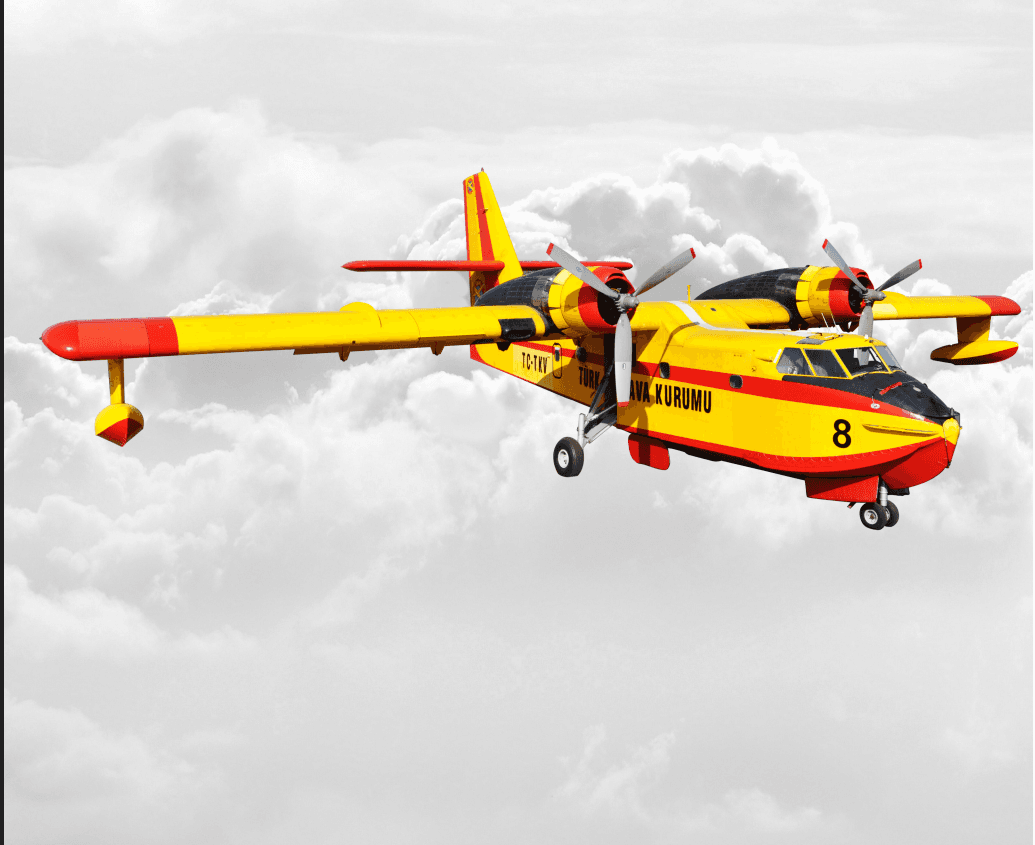
Canadair CL-215
First Production Year | 1966 | ||||||||
|---|---|---|---|---|---|---|---|---|---|
Production Quantity | 125 units | ||||||||
Manufacturer(s) | Canadair (Canada-based) | ||||||||
Main User Countries | Canada Turkey (Turkish Aeronautical Association) Spain France Greece | ||||||||
Purpose(s) | Firefighting and personnel transport cargo search and rescue | ||||||||
Engine(s) | 2 x Pratt & Whitney R-2800 piston engines | ||||||||
Capacity | 2 pilots + additional crew | ||||||||
Length(s) | 19.82 m | ||||||||
Wingspan | 28.60 m | ||||||||
Height(s) | 8.93 m | ||||||||
Maximum Takeoff Weight | 19,730 kg | ||||||||
Cruising Speed | 290 km/h | ||||||||
Range(s) | 2 427 km | ||||||||
Canadair CL-215 is an amphibious aircraft specifically developed for firefighting by the Canada-based company Canadair. It is recognized as one of the first aircraft capable of quickly refilling water from nearby natural sources thanks to its ability to take off and land on water. The aircraft was primarily designed for aerial firefighting missions, but it can also be used for various secondary purposes such as search and rescue, cargo transport, and personnel transportation.

CL-215 Aircraft Belonging to the Turkish Aeronautical Association(Gökçen Havacılık)
The CL-215 is a high-wing, twin-engine aircraft. Its engines are mounted on the wings and were originally equipped with two Pratt & Whitney R-2800-83AM piston engines, each producing approximately 2,100 horsepower. The aircraft is fitted with underbelly scoops that allow it to draw water from the surface, enabling it to take in approximately 5,346 liters (1,410 US gallons) of water in about 12 seconds. The fuselage is reinforced with water-resistant materials and designed to enhance maneuverability on water.
Key technical specifications include:
The CL-215 operates by dropping water or foam directly onto fire zones. The aircraft can fill two separate tanks in the fuselage with water and discharge them over targeted fire areas. The drop can be executed either manually or automatically, in single or dual-stream configurations. The aircraft has been actively used in regions prone to forest fires, especially where ground access is limited.
The CL-215 is capable of taking off from a water surface as short as 90 meters and requires only about 1,340 meters of smooth water for scooping. With a water loading time of just 12 seconds, its operational turnaround time is highly efficient. Additionally, the aircraft can increase extinguishing effectiveness by mixing fire retardant foam with water—up to 2,700 liters of foam solution.
The CL-215 has been used by civil and military aviation agencies in countries with high fire risk, including Canada, Spain, France, Greece, and Turkey. In Turkey, the Turkish Aeronautical Association (THK) has actively deployed the CL-215 in firefighting operations since the 1990s. Aircraft in the THK fleet have been in aerial forest fire response service for over 20 years. Based on the needs of the General Directorate of Forestry, THK aircraft were stationed in specific regions and assigned through national tenders during fire seasons. These aircraft have been noted for their ability to remain airborne for up to four hours, withstand harsh field conditions, and undergo short maintenance cycles.
The CL-215 fleet of THK has undergone periodic maintenance and modernization, with some aircraft receiving avionics upgrades. The crew typically consists of Turkish pilots and maintenance technicians, operating in coordination with fire management teams during missions.
Production of the CL-215 began in 1966 and continued until 1989, with a total of 125 units manufactured. Over time, to meet evolving operational requirements, various modernization efforts were undertaken. Some aircraft were upgraded to the CL-215T variant, replacing piston engines with Pratt & Whitney Canada PW123AF turboprop engines.
The CL-415, an advanced version of the CL-215, was later developed by Canadair and subsequently produced by Bombardier Aerospace and Viking Air. The CL-415, also known as the “Super Scooper,” features enhanced performance, upgraded avionics, increased water capacity, higher takeoff weight, an improved fire suppression system, and upgraded flight safety features.
The Canadair CL-215 represents one of the first amphibious aircraft specifically designed for aerial firefighting, making it a pioneering model in its category. Its systems for water intake, storage, and discharge allow direct intervention in fire zones. The aircraft has been widely used for many years in numerous countries around the world. In Turkey, it has played a vital role in the national firefighting capacity as part of the Turkish Aeronautical Association fleet. The aircraft’s functional design and operational versatility have made the CL-215 a historical milestone in aerial firefighting aviation.
Gökçen Aviation. "CL-215, THK Firefighting Fleet." Ankara. Accessed July 16, 2025.
Viking Air Aerial Firefighter. “CL-215 Aircraft.” Accessed July 16, 2025.
Viking Air. "Canadair CL-215 Specifications Flyer." Accessed July 16, 2025.

Canadair CL-215
First Production Year | 1966 | ||||||||
|---|---|---|---|---|---|---|---|---|---|
Production Quantity | 125 units | ||||||||
Manufacturer(s) | Canadair (Canada-based) | ||||||||
Main User Countries | Canada Turkey (Turkish Aeronautical Association) Spain France Greece | ||||||||
Purpose(s) | Firefighting and personnel transport cargo search and rescue | ||||||||
Engine(s) | 2 x Pratt & Whitney R-2800 piston engines | ||||||||
Capacity | 2 pilots + additional crew | ||||||||
Length(s) | 19.82 m | ||||||||
Wingspan | 28.60 m | ||||||||
Height(s) | 8.93 m | ||||||||
Maximum Takeoff Weight | 19,730 kg | ||||||||
Cruising Speed | 290 km/h | ||||||||
Range(s) | 2 427 km | ||||||||
Design and Technical Specifications
Firefighting Capabilities
Applications and Operators
Development and Successor Models
This article was created with the support of artificial intelligence.