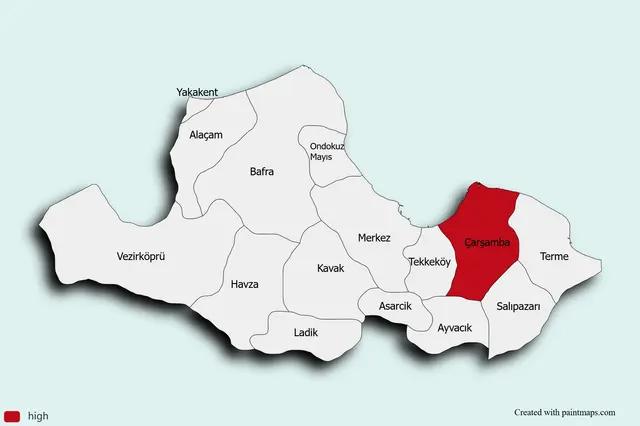
Çarşamba (District)
Province(s) | Samsun | ||||||||
|---|---|---|---|---|---|---|---|---|---|
Area(s) | Central Black Sea Region | ||||||||
Origin of the Name | Wednesday market | ||||||||
Basic Livelihoods | Trade Livestock farming Agriculture-Based Industry Agriculture (Hazelnuts - Corn - Rice - Vegetables) | ||||||||
Major Tourist and Cultural Assets | Wednesday Shoes (Egg Heel - Local Craft) Historical Bedesten and Hamam (Pasha Hamam) Ridvan Pasha Mosque Historical Yeşilırmak Bridge (Stone Bridge) Göğceli Mosque (Wooden nail-free structure) | ||||||||
Mayor(s) | Huseyin Dundar | ||||||||
District Governor | Mehmet Kamil Saglam | ||||||||
Located in the east of Samsun province, approximately 36 kilometers from the city center, Çarşamba district lies on the Çarşamba Plain, one of Türkiye's fertile delta plains formed by the Yeşilırmak River, which bears its name. The river flows through the district center to the Black Sea. Home to prominent structures such as the historic Yeşilırmak Bridge and the 13th-century Göğceli Mosque (Cemetery Mosque), known for its wood and nail-free construction technique, the district's economy is largely based on the plain's agricultural activities (hazelnuts, corn, vegetables, rice, etc.). Agricultural industries, animal husbandry, and fishing are also economic drivers.

Çarşamba (Samsun Governorship)
The history of Çarşamba, a district of Samsun province, is closely linked to its location on the fertile Çarşamba Plain, formed by the Yeşilırmak River. The region's geographical features have allowed it to serve as a settlement area for various civilizations throughout history. While precise information on the region's ancient names and settlements is limited, it appears to have been part of the general historical processes along the Black Sea coast. It is known that the region remained under the sovereignty of these states during the Pontic Kingdom, the Roman Empire, and the Byzantine Empire.
During the Turkic invasion of Anatolia and the subsequent Turkification of the region, Çarşamba and its surrounding area came under the influence of the Seljuks and then various Turkish principalities (such as the Canik Principality). The Göğceli Mosque (Cemetery Mosque), an important structure from this period, is reported to have been built in the 13th century; it is notable for its construction entirely of wood and without the use of nails. With the region coming under Ottoman rule, Çarşamba continued its development as an administrative center.
It is said that the district takes its name "Çarşamba" from the market held here on Wednesdays. During the Ottoman period, this market served as an important trade center for surrounding settlements. The region's agricultural potential formed the basis of the economic structure under Ottoman rule. Some structures built during this period have survived to the present day. One of these is the Rıdvan Pasha Mosque, reportedly dating from the 16th century. Furthermore, construction of the historic bridge over the Yeşilırmak River, also known as the "Taşköprü" (Stone Bridge), is reported to have been completed in the late 19th century. This bridge provided transportation between the two banks of the river.
During the final years of the Ottoman Empire and the founding of the Republic of Türkiye, Çarşamba maintained its administrative status as a district (kaza) during the Republican era. Maintaining its agricultural identity during the Republican era, the district remained a major agricultural center in Samsun thanks to its location on the Yeşilırmak Plain. Over time, its administrative and social structure has evolved, and Çarşamba is now one of the leading districts of Samsun province in terms of population and economy. The district's history has been shaped by the agricultural and commercial opportunities afforded by its geographical location and is evident in some of its surviving architectural works.
The Çarşamba district of Samsun province reflects the typical characteristics of the Black Sea Region in terms of its geographical location and climatic characteristics. The district is located east of Samsun on the Çarşamba Plain, formed by the Yeşilırmak River. This plain constitutes one of Türkiye's largest delta plains and defines the district's fundamental geographic structure. The Yeşilırmak River flows through the district center and flows into the Black Sea, creating a vast delta area in the process. The district's elevation is generally low, and its terrain exhibits the characteristics of a plain, although higher elevations can be found around the plain.
The Çarşamba district's climate exhibits characteristics of the Black Sea climate. This climate type is characterized by high humidity throughout the year and no significant temperature differences between summer and winter. Summers are generally warm or hot, while winters are mild. Annual temperature averages and seasonal temperature distributions conform to this general framework. The number of days with frost is limited, similar to other areas along the Black Sea coastline.
In terms of precipitation, Çarşamba is a region that receives precipitation year-round. Average annual precipitation is limited, and this precipitation is generally in the form of rain. Snowfall is rare and short-lived, especially in the district center and the plains. While the highest precipitation is generally recorded in autumn and winter, a decrease in precipitation can be observed in spring and summer. High humidity and regular rainfall are climatic factors that directly affect the region's vegetation. However, detailed information on wind patterns and prevailing wind directions is lacking in the available sources.
Natural vegetation, shaped by climatic conditions, can consist of forest and shrub formations typical of the Black Sea region in areas outside agricultural areas. The humid and temperate climate allows for the development of broad-leaved tree species. Water-dependent plant communities can thrive in the delta area and along riverbanks. However, the use of a large portion of the Çarşamba Plain for agricultural production has limited the extent of natural vegetation. While the district's vegetation potentially supports forest formations under current climatic conditions, it varies in current conditions due to land use.
Çarşamba district, a major settlement in Samsun province of the Black Sea Region, has recently followed a relatively stable development pattern in terms of population and demographic structure. As of 2024, the district's total population was recorded as 141,850; 70,711 of this population were male and 71,139 were female. The gender distribution was balanced, with males accounting for 49.85% and females for 50.15%.
When population data is examined by years, it is seen that the total population increased by approximately 5,507 people in the seventeen-year period extending from 2007 to 2024. This increase becomes clear with the population increasing from 136,343 in 2007 to 141,850 in 2024, while the average annual growth rate is approximately 0.24%. Population fluctuations were also recorded during the period in question: Following the rapid increase between 2007 and 2009, a limited decrease was observed between 2010 and 2013, and then an upward trend dominated again from 2014 onwards. The increase momentum strengthened particularly in 2018, 2020 and 2023, with an increase to 138,840 in 2018, 140,245 in 2020, and a trend to reach 141,199 in 2023.
These demographic fluctuations are closely linked to Çarşamba's economic structure, which straddles agricultural production centers and industrial facilities, urban transformation projects, and workforce opportunities. The population decline between 2010 and 2013 can be interpreted as a reflection of the young workforce's influx to metropolitan centers driven by concerns about education and employment. Conversely, the recent increase can be explained by local industrial investments and the renewed appeal of agriculture-based commercial activities.
When looking at the gender structure, the female population ratio is close to or slightly above the male population, indicating the significant participation of women in social and economic life in the district. This balance is directly linked to the balance of rural-urban migration, gender-based differences in the labor market, and improvements in education levels. Factors such as increased active participation of women in the workforce and the expansion of health and education services are important factors in maintaining a balanced demographic structure.
The economic structure of Çarşamba, a district of Samsun province, is largely based on its geographical location and natural resources, particularly the Çarşamba Plain, formed by the Yeşilırmak River. The plain, with its favorable soils for agricultural production, forms the foundation of the district's economy. Agriculture, industry, trade, and services are the district's primary economic activities.
Agriculture is the mainstay of Çarşamba's economy. Polyculture farming is practiced in the Çarşamba Plain, producing a wide variety of crops. Primary agricultural products include hazelnuts, corn, wheat, rice, soybeans, sunflowers, sugar beets, various vegetables (cabbage, leeks, spinach, lettuce, etc.), and fruits. The fertility of the plain's soil allows for this diversity of crops and the volume of agricultural production. Agricultural activities provide employment for a significant portion of the population. In addition to agriculture, animal husbandry is also practiced; cattle, sheep, and poultry farming are among the economic activities. Fishing is also a major economic activity due to its proximity to the Yeşilırmak River and the Black Sea.
The industrial sector has developed primarily around the processing of agricultural products. Industrial facilities in the district include a sugar factory, flour mills, feed mills, hazelnut processing facilities, and lumber and parquet factories. Additionally, there are businesses producing metal goods, machinery, and spare parts, as well as textile and apparel workshops. The presence of an Organized Industrial Zone (OIZ) in the district also fosters the development of industrial activities. Shoemaking, particularly the traditional "egg heel" shoe, is a long-standing branch of manufacturing.
The trade and services sector also plays a significant role in the district's economy. Agricultural product trade plays a significant role. The district center is home to a variety of commercial enterprises, bank branches, and service providers. Transportation and the district's location are among the factors influencing commercial activity.
As a result, the Çarşamba district's economy boasts a strong agricultural production structure, thanks to the fertile Çarşamba Plain. This agricultural structure has supported the development of various industries, particularly food processing. The trade and services sectors have also evolved around this fundamental economic structure.
The Çarşamba district of Samsun province is located on the Çarşamba Plain, formed by the Yeşilırmak River. The district's tourism and cultural heritage consists primarily of historical architectural works, natural environmental elements, local handicrafts, and specific cultural practices. The resources provided provide a variety of information on these components.
One of the district's most prominent structures within its historical architectural heritage is the Göğceli Mosque (Cemetery Mosque). Located in the Göğceli neighborhood, this structure dates back to the 13th century and was constructed entirely using wood, using the "wolf's throat" or "cantı" technique, without the use of metal nails. The structure is still in use today and has registered cultural heritage status. The Historical Yeşilırmak Bridge (Historical Çarşamba Bridge), located over the Yeşilırmak River in the district center, is another well-known structure in the district. Dating back to the late Ottoman period, during the reign of Sultan Abdulhamid II, the bridge is made of cut stone and has a limited number of arches and a length.
There are other structures dating back to the Ottoman period in Çarşamba. The Rıdvan Pasha Mosque in the district center dates to the 18th century. The Historical Bedesten and Historical Hamam (Pasha Hamam), also located in the district center, are architectural examples of Ottoman-era commercial and social life. The Bedesten is a structure that served as a covered bazaar. The hamam may exhibit the characteristics of classical Ottoman bathhouse architecture. Sources also mention a Historical House, also known as the Abdullah Pasha Mansion, which is an example of Ottoman civil architecture; additional information about this structure's current status or function may be available. Other examples of wooden mosques, such as the Ordu Village Mosque, are also recorded. The Yeşilırmak River and Çarşamba Plain, which define the district's geographical structure, form the natural environment. Recreational areas such as Adapark can be found along the riverbank and within the plain. Cultural elements may include traditional handicrafts and local products. Sources indicate that the Çarşamba shoe, known as the "egg heel," was a local product. The market held on Wednesdays, which is the origin of the district's name, is also mentioned as a historical commercial and social activity.
Çarşamba Municipality. "Çarşamba History." Çarşamba Municipality. Accessed April 24, 2025. https://www.carsamba.bel.tr/icerik/carsamba-tarihi
Çarşamba Municipality. "Climate and Vegetation." Çarşamba Municipality. Accessed April 24, 2025. https://www.carsamba.bel.tr/icerik/iklim-ve-bitki-ortusu
Çarşamba District Governorship. "Çarşamba Promo." Çarşamba District Governorship. Accessed April 24, 2025. http://carsamba.gov.tr/carsamba-promo
Çarşamba District Governorship. "History." Çarşamba District Governorship. Accessed April 24, 2025. http://www.carsamba.gov.tr/tarihce
Çarşamba District Governorship. "Historical House." Çarşamba District Governorship. Accessed April 24, 2025. http://www.carsamba.gov.tr/tarihi-ev
Çarşamba District Governorship. "Historical Hamam." Çarşamba District Governorship. Accessed April 24, 2025. http://www.carsamba.gov.tr/tarihi-hamam
Samsun Metropolitan Municipality. "Wednesday." Samsun Metropolitan Municipality. Accessed April 24, 2025. https://samsun.bel.tr/icerik/carsamba
Samsun Provincial Directorate of Culture and Tourism. "Çarşamba District." Samsun Provincial Directorate of Culture and Tourism. Accessed April 24, 2025. https://samsun.ktb.gov.tr/TR-231353/carsamba-ilcesi.html
Samsun Provincial Directorate of Culture and Tourism. "Historical Çarşamba Bridge." Samsun Provincial Directorate of Culture and Tourism. Accessed April 24, 2025. https://samsun.ktb.gov.tr/TR-216919/tarihi-carsamba-koprusu.html
Paintmaps. “Turkey Provinces Map – Highlighting Çarşamba, Samsun.” Access date: April 23, 2025. https://paintmaps.com .
Samsun Tourism Infrastructure Service Association (SAMTAB). "Samsun Geographic Location." SAMTAB. Accessed April 24, 2025. https://www.samtab.gov.tr/samsun.asp?il=13-cografi-konum
Samsun Tourism Infrastructure Service Association (SAMTAB). "Samsun Detail: Çarşamba." SAMTAB. Accessed April 24, 2025. https://www.samtab.gov.tr/samsun-detay.asp?il=31-carsamba
Samsun Tourism Infrastructure Service Association (SAMTAB). "Samsun Economy." SAMTAB. Accessed April 24, 2025. http://samtab.gov.tr/samsun.asp?il=16-ekonomi
Samsun Tourism Infrastructure Service Association (SAMTAB). "Samsun Tourism." SAMTAB. Accessed April 24, 2025. https://www.samtab.gov.tr/samsun.asp?il=15-turizm
Samsun Governorship. "Wednesday." Samsun Governorship. Accessed April 24, 2025. http://www.samsun.gov.tr/carsamba
Turkish Statistical Institute (TurkStat). Address Based Population Registration System Results, 2024. Access date: April 25, 2025. https://data.tuik.gov.tr/Bulten/Index?p=Adrese-Dayali-Nufus-Kayit-Sistemi-Sonuclari-2024-53783

Çarşamba (District)
Province(s) | Samsun | ||||||||
|---|---|---|---|---|---|---|---|---|---|
Area(s) | Central Black Sea Region | ||||||||
Origin of the Name | Wednesday market | ||||||||
Basic Livelihoods | Trade Livestock farming Agriculture-Based Industry Agriculture (Hazelnuts - Corn - Rice - Vegetables) | ||||||||
Major Tourist and Cultural Assets | Wednesday Shoes (Egg Heel - Local Craft) Historical Bedesten and Hamam (Pasha Hamam) Ridvan Pasha Mosque Historical Yeşilırmak Bridge (Stone Bridge) Göğceli Mosque (Wooden nail-free structure) | ||||||||
Mayor(s) | Huseyin Dundar | ||||||||
District Governor | Mehmet Kamil Saglam | ||||||||
No Discussion Added Yet
Start discussion for "Çarşamba (District)" article
History
Geography and Climate
Population and Demography
Economy
Tourism - Culture - Cuisine
This article was created with the support of artificial intelligence.