

This article was automatically translated from the original Turkish version.
+1 More
Çemişgezek Ulukale mulberry is a geographical indication product registered on March 8, 2019, by the Tunceli Provincial Directorate of Agriculture and Forestry, belonging to the species Morus alba (White mulberry). This special mulberry is cultivated within the boundaries of Tunceli, Elazığ, Malatya and Erzincan provinces.
Çemişgezek Ulukale mulberry belongs to the Morus alba (White mulberry) species and exhibits parthenocarpy (fruit set without pollination). The tree has a strong and upright growth habit with dense branching. Its flowers are dioecious, meaning only female flowers occur on the same tree, and these female flowers are small. Annual shoots have short internodes, moderate lenticel density, and flattened vegetative buds. The leaves are oval and small in size; the leaf blade has a slightly concave petiole attachment, serrated margins resembling a saw edge, and a terminal shape in an inverted V.
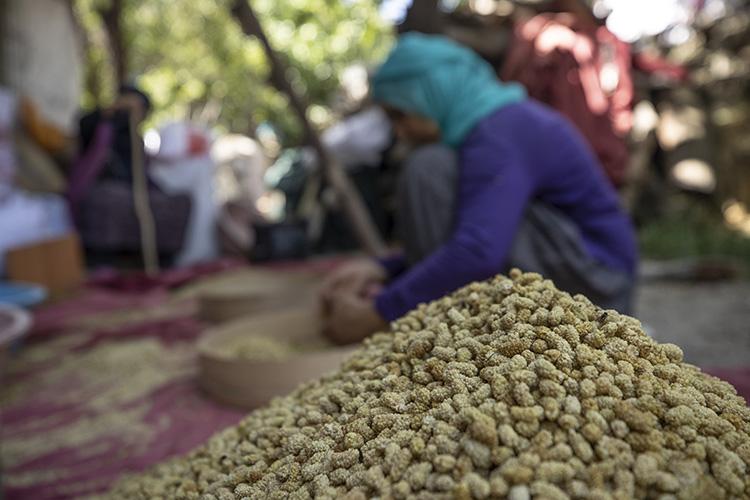
The fruits of Çemişgezek Ulukale mulberry are small and seedless. Fresh fruits are white in color, while dried fruits turn whitish-yellow. According to pomological measurements, fruit weight ranges from 0.60 to 2.40 g, fruit width from 7.17 to 17.71 mm, and fruit length from 14.00 to 29.67 mm. The fruit stalk length varies between 6.10 and 22.14 mm. The Soluble Solid Content (SSC) of juice extracted from ripe fruits during harvest ranges from 26.00% to 35.00%. The juice yield of fresh ripe fruits is between 45.00% and 59.79%, while the drying yield ranges from 25.27% to 40.00%. The SSC and drying yield of this mulberry are higher compared to mulberries from other regions.
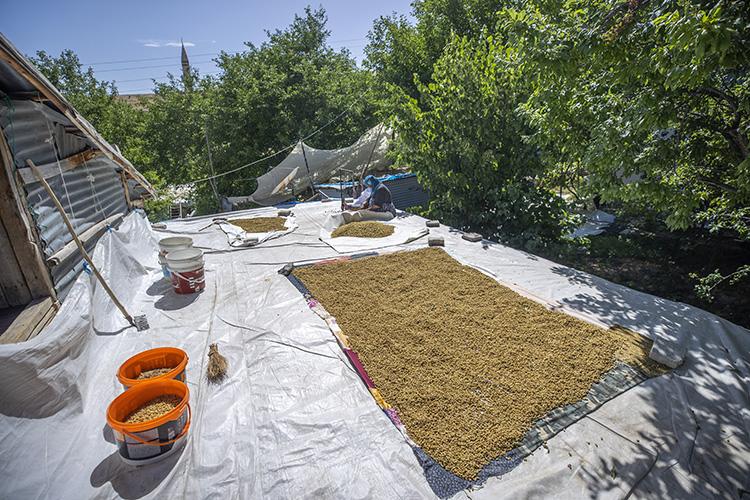
Çemişgezek Ulukale Mulberry Drying Process (Anadolu Agency)
Full bloom of Çemişgezek Ulukale mulberry occurs in early May, fruit color change takes place in the third week of May, harvest begins in the third and fourth weeks of May, and ends in mid-July. The variety produces fruit for approximately two months. Complete leaf drop occurs in the first and second weeks of November.
Vegetative propagation is carried out by grafting scions from Çemişgezek Ulukale mulberry onto rootstocks obtained from seed-grown white mulberries. Due to the vigorous growth of the trees, planting distances of 8x8 m, 9x9 m and 10x10 m can be applied. Planting is carried out in autumn after leaf fall and before the trees resume water uptake in spring.
Although Çemişgezek Ulukale mulberry is drought-tolerant, irrigation during dry seasons increases both fruit quantity and quality. Modern irrigation techniques such as drip and mini-sprinkler systems are recommended. Soil tillage can be performed in spring and autumn at a depth that does not damage the root system. Fertilization should be based on soil and leaf analysis. Pruning is conducted in the early years as shaping pruning; in productive trees, crossing and dead branches are removed to maximize light penetration. Pruning must be carried out during the tree’s dormant period and cut surfaces should be sealed with grafting wax.
Harvest is conducted in 7 to 10 rounds, approximately one week apart. Since the fruit is predominantly consumed dried, nets are spread beneath the trees to collect fallen fruits, which are then sun-dried for three days.
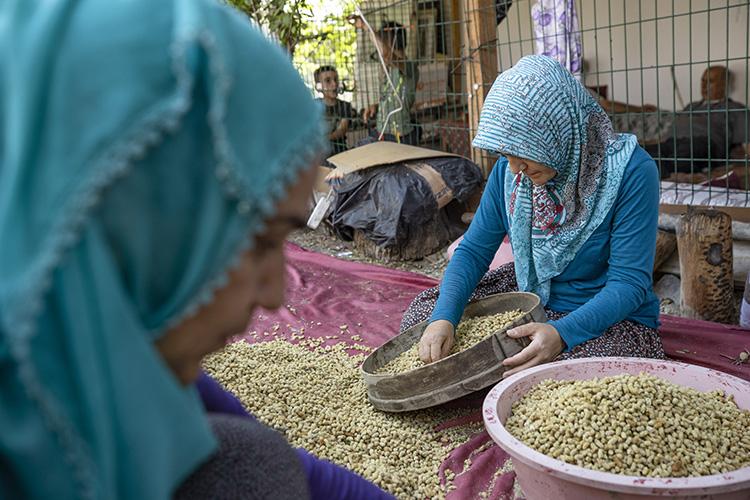
Çemişgezek Ulukale Mulberry Harvesting Operations (Anadolu Agency)
The regions where it is cultivated exhibit a continental climate with significant differences between day and night temperatures. The number of sunny days per year is high. Since temperatures in May do not fall below zero degrees Celsius, the variety is not affected by late spring frosts. The average daily sunshine duration in May, June and July is 10.3 hours, placing it among the provinces in Türkiye with the highest sunshine duration. These climatic conditions enhance the fruit’s SSC levels and improve drying yields.
Monitoring of Çemişgezek Ulukale mulberry is coordinated by the Tunceli Provincial Directorate of Agriculture and Forestry. The monitoring team consists of at least three members, one each from Munzur University, the Tunceli Directorate of Culture and Tourism, and the Tunceli Provincial Directorate of Trade. Monitoring is conducted annually as a routine procedure and may also be carried out whenever necessary or upon complaint. The monitoring authority verifies compliance with production methods and the physical and chemical properties of the product. Legal action is initiated against those who misuse the geographical indication.
Anadolu Ajansı. “Tunceli’de 1500 Dekarda Üretilen Tescilli Dut, Köylülerin Geçim Kaynağı Oldu.” Accessed July 21, 2025. https://www.aa.com.tr/tr/yasam/tuncelide-1500-dekarda-uretilen-tescilli-dut-koylulerin-gecim-kaynagi-oldu/3261459
Turk Patent and Trademark Office. "Çemişgezek Ulukale Dutu." *Coğrafi İşaretler Portalı*. Accessed July 21, 2025. https://ci.turkpatent.gov.tr/cografi-isaretler/detay/38379
Turkish Patent and Trademark Office. "Çemişgezek Ulukale Dutu – Coğrafi İşaret Tescil Belgesi." *Coğrafi İşaretler Portalı*. Accessed July 21, 2025. https://ci.turkpatent.gov.tr/Files/GeographicalSigns/7368908a-e0e7-476d-b95b-38926cfbfc31.pdf

No Discussion Added Yet
Start discussion for "Çemişgezek Ulukale Mulberry" article
Characteristics
Fruit Characteristics
Cultivation and Harvest
Climatic Characteristics
Monitoring