
+2 More


Çınçınlı Sultan Inn is a structure belonging to the Anatolian Seljuk caravanserai architecture, located within the boundaries of Saray Neighborhood, Saraykent district, Yozgat province, Türkiye. The building was commissioned between 1240 and 1241 by Valide Sultan Melike Mahperi Hatun, the wife of Anatolian Seljuk Sultan Alaaddin Keykubat I and the mother of Gıyaseddin Keyhüsrev II Known by different names in historical documents, the inn is situated on one of the important caravan routes in the northern inner regions of Anatolia.

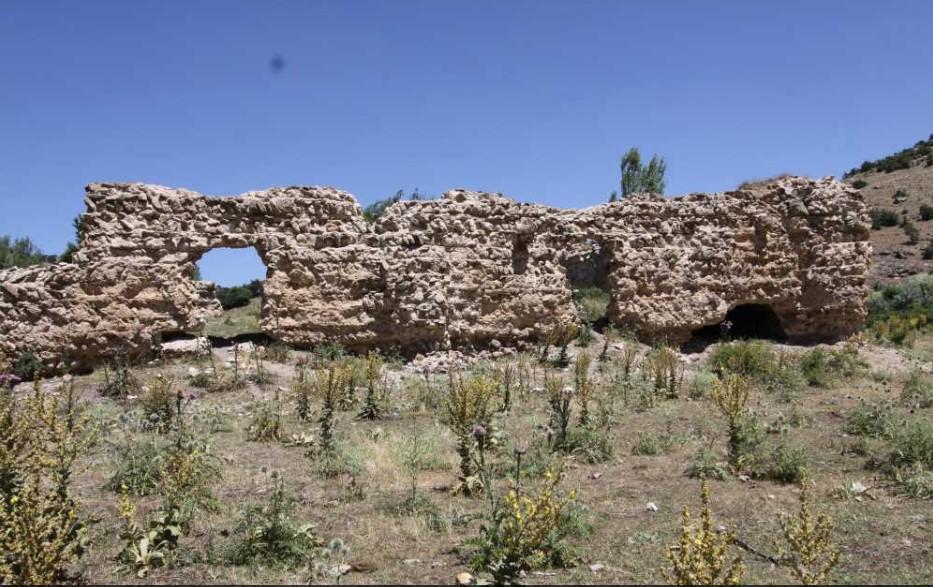
Çınçınlı Sultan Inn (Türkiye Kültür Portalı)
Çınçınlı Sultan Inn is mentioned in historical sources under various names such as "Çimcimli Sultan Inn," "Cimcimli Inn," "Çinçinli Sultan Inn," "Çınçınlı Inn," and "Sarayköyü-Sarayözü Inn." These names are believed to have originated due to the association with a nearby thermal spring bath, which is no longer in use today. The term "Çimçimli" derives from the local verb "çimmek" and over time evolved into the form "Çınçınlı."
Information confirming that Mahperi Hatun commissioned the structure is supported by an inscription located on the east face of the minaret of Karamağara Mosque in Saraykent center. The translated text of the inscription is as follows:
"May God accept and perpetuate the good deed commissioned in 637 AH (1239–1240 CE) by Mahperi Hatun, the knowledgeable, just, pride of religion and the world, the sultan of sultans among the mothers, in need of God's mercy and forgiveness, for the sake of God's pleasure."
Çınçınlı Sultan Inn is a rectangular building extending along the east-west axis. It was constructed using rubble stone and Horasan mortar. The walls are built with a herringbone masonry technique and reinforced with cut stone cladding on both interior and exterior surfaces. Today, the inn is largely in ruins; the western wall has completely collapsed, and the cladding on other main walls has been removed, causing the walls to become thinner. Remains of various annex buildings are found on the southwestern side.
According to K. Erdmann’s plan draft, the building falls under the typology of Anatolian Seljuk caravanserais classified as “caravanserais with a courtyard and shelter.” The courtyard is rectangular in a north-south direction, measuring approximately 34 by 27 meters. The shelter section, oriented east-west, is narrower compared to the courtyard, measuring roughly 23 by 27 meters. On the northern and southern edges of the courtyard, there are four rooms, almost square.
Inside the shelter section, there are four piers aligned along the east-west direction, forming three narrower aisles in the middle. These aisles connect to a five-aisle layout arranged north-south, separated on both sides by pairs of piers. This plan type resembles that of Sarıçakıl Inn on the Ereğli-Aksaray route, built between 1238 and 1240, and is partially applied with a dome feature in the shelter section of the 1249-dated Avanos Sarıhan.
The structure is largely ruined today, with its interior filled with rubble stones. The roofing system has been destroyed. Among the existing remains, parts of the southern main walls and traces of annex buildings to the north, south, and southwest can still be distinguished. It is currently impossible to determine how the vaulted coverings of the interior space were supported or whether there was an open area between the courtyard and the covered section.
Çınçınlı Sultan Inn is situated 16 kilometers north of Saraykent district in Yozgat, along the caravan route of the Anatolian Seljuk State connecting Kırşehir, Yozgat, Zile, and Tokat. This location indicates that the structure occupied an important transit point both commercially and militarily.

Çınçınlı Sultan Inn (Türkiye Kültür Portalı)

No Discussion Added Yet
Start discussion for "Çınçınlı Sultan Inn" article
History and Inscription
Architectural Structure and Plan Features
Current Condition
Location and Access Network
This article was created with the support of artificial intelligence.