


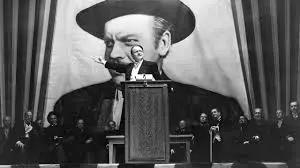
Citizen Kane (Film)
Director(s) | Orson Welles | ||||||||
|---|---|---|---|---|---|---|---|---|---|
Screenplay(s) | Herman J. Mankiewicz Orson Welles | ||||||||
Producer(s) | Orson Welles | ||||||||
Production Company | RKO Radio Pictures | ||||||||
Cinematographer(s) | Gregg Toland | ||||||||
Editing | Robert Wise | ||||||||
Music(s) | Bernard Herrmann | ||||||||
Genre | Drama Mystery | ||||||||
Duration | 119 minutes | ||||||||
Language(s) | English | ||||||||
Release Date(s) | May 1 1941 (USA) | ||||||||
Citizen Kane, the first feature film by American director Orson Welles, was released in 1941. Considered a milestone in the formal development of modern cinema, this work includes various innovative techniques in editing, narrative structure, and cinematography. The film presents a narrative that questions themes of power, media, memory, and identity through the life of the fictional character Charles Foster Kane.
The film begins with the death of American media tycoon Charles Foster Kane. The meaning of Kane’s last word, "Rosebud," becomes the focus of investigation by a journalist named Thompson. Through interviews with various witnesses from Kane’s past, the film gradually reveals his childhood, rise in the media world, political career, personal relationships, and eventual isolation. The film employs a nonlinear timeline, presenting the main character’s life story through multiple perspectives.
Citizen Kane centers on themes such as individual ambition, power, media control, and the fragility of human memory. The character Kane is crafted as a representative of early 20th-century media moguls. While offering a critical view of the relationship between the press and public opinion, the film also focuses on the tension between personal success and emotional isolation. The symbol "Rosebud" serves as a mystery to be unraveled throughout the film, simultaneously pointing to childhood innocence, lost pasts, and the unknowability of subjective experience. The narrative’s reliance on multiple testimonies challenges the possibility of discovering absolute truth.
Trailer of the film Citizen Kane (YouTube)
The film was produced by RKO Pictures, directed by Orson Welles, who also starred in the leading role. The screenplay was co-written by Orson Welles and Herman J. Mankiewicz. Welles’s full creative control over the film marked an exception to the studio system of the time. Cinematography was by Gregg Toland. Various technical elements such as deep focus, low-angle shots, low lighting, and reflective compositions using mirrors are considered pioneering in film history. The film’s structural narrative style is supported by nonlinear editing and a testimonial-based framework.
Citizen Kane premiered in the United States in 1941. Although initially receiving positive reviews from critics, it faced censorship and distribution pressures due to similarities between the film and media tycoon William Randolph Hearst. Over the years, the film has been widely discussed in academic circles and among film historians and is frequently ranked among the "most influential films of all time" by various cinema institutions.
Awards:
Nominations:
Ebert, Roger. “Citizen Kane.” RogerEbert.com. Accessed May 21, 2025. https://www.rogerebert.com/reviews/great-movie-citizen-kane-1941
IMDb. “Citizen Kane (1941) – Full Cast & Crew.” Accessed May 21, 2025. https://www.imdb.com/title/tt0033467/
YouTube. “Citizen Kane | Official Trailer | Warner Bros.” Accessed May 21, 2025. https://www.youtube.com/watch?v=8dxh3lwdOFw

Citizen Kane (Film)
Director(s) | Orson Welles | ||||||||
|---|---|---|---|---|---|---|---|---|---|
Screenplay(s) | Herman J. Mankiewicz Orson Welles | ||||||||
Producer(s) | Orson Welles | ||||||||
Production Company | RKO Radio Pictures | ||||||||
Cinematographer(s) | Gregg Toland | ||||||||
Editing | Robert Wise | ||||||||
Music(s) | Bernard Herrmann | ||||||||
Genre | Drama Mystery | ||||||||
Duration | 119 minutes | ||||||||
Language(s) | English | ||||||||
Release Date(s) | May 1 1941 (USA) | ||||||||
No Discussion Added Yet
Start discussion for "Citizen Kane (Film)" article
Plot
Thematic Structure
Production and Release Information
Cast
Release and International Impact
Awards and Nominations


