

+1 More

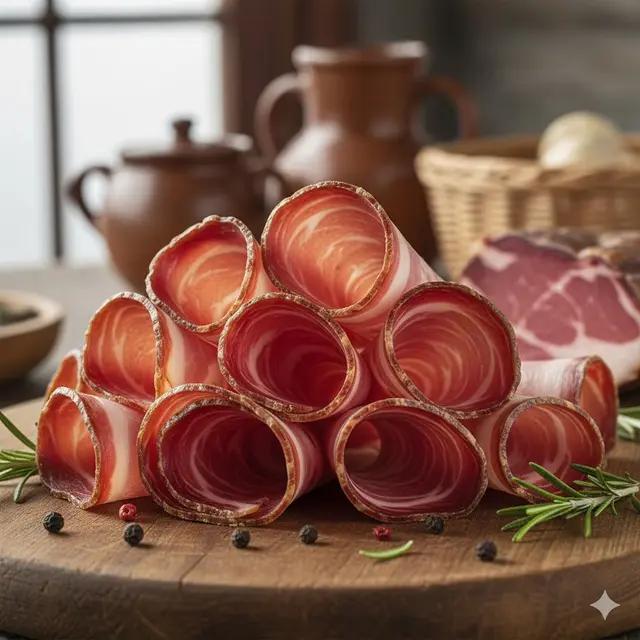
Coppa Piacentina ( Generated by Artificial Intelligence.)
Name(s) | Coppa Piacentina | ||||||||
|---|---|---|---|---|---|---|---|---|---|
Type of Origin | Protected Designation of Origin (PDO) | ||||||||
Control Body | ECEPA Agri-food Product Certification Body | ||||||||
Minimum Meat Weight | 2.5 kg (raw) | ||||||||
Coppa Piacentina is a traditional pork delicatessen product, native to the province of Piacenza, Italy, and registered with a Protected Designation of Origin (DOP). It is made from the neck muscles of pigs. Its origins date back to Roman times.
The raising of pigs used for the production of Coppa Piacentina is limited to the regions of Lombardy and Emilia Romagna. These pigs must comply with the breed, feeding, and raising methodology established nationally for hams originating from Parma and San Daniele. The pigs must be at least nine months old and weigh 160 kg, possessing the characteristics of an "Italian heavy pig." Due to the specific climatic conditions, processing of the product is only carried out in regions below 900 meters in the province of Piacenza. Coppa Piacentina is obtained from the muscles in the upper neck (cervical) of pigs, weighing at least 2.5 kg, and after bleeding.
The production process begins with dry salting. The meat is brought into contact with a mixture of salt, sodium and/or potassium nitrate, sodium nitrite, whole or cracked black pepper and/or white pepper, sugar, and spices such as cinnamon, cloves, bay leaves, and nutmeg. Salting in brine is strictly prohibited. After salting and massaging, the coppas are refrigerated for at least seven days before being covered with the pig's parietal diaphragm or other pork casings. Traditionally, they can be placed in mesh casings before being tied with string, but during the tying phase, these mesh casings are removed and the casings are pierced. The drying phase takes at least seven days in ventilated drying rooms at a temperature between 15 and 25 degrees Celsius and a humidity of 40-90%. This period continues until the "bloom" that determines the typical pinkish color appears.
About the Coppa Piacentina Processing Method ( Emilia Romagna Tourism )
Coppa ripening takes place at a temperature between 10 and 20 degrees Celsius and a relative humidity of 70-90%. Ventilation, exposure to light, and natural humidity are permitted during ripening, taking into account the climatic conditions in the Piacenza valleys. The ripening period lasts at least six months from the date of salting. This stage ensures that the product's microbial load is limited by the natural, slow ripening effect. Part of the ripening should be carried out in semi-basements or cellars that can provide optimal conditions.
When offered for consumption, Coppa Piacentina should weigh no less than 1.5 kg. Its external appearance is cylindrical, with slightly thinner ends. In cross-section, the slice is compact and uniform, red interspersed with white-pink fatty acids. Its texture is compact and elastic. Its aroma is sweet and characteristic, and its flavor, which develops with ripening, can be packaged whole, in pieces, or sliced, under vacuum or modified atmosphere conditions. Packaging and slicing must be carried out only in the production and processing area (province of Piacentina) and under the supervision of a regulatory body to preserve the product's original characteristics.
Emilia Romagna Tourism. " Coppa Piacentina | In the Food Valley with Francine Segan." YouTube video . July 18, 2018. 00:49. https://www.youtube.com/watch?v=KTf7uqddkLU.
MASAF – Ministry of Agriculture, Food and Forestry Policies. “Coppa Piacentina (DOP)”. Accessed October 20, 2025. https://www.masaf.gov.it/flex/cm/pages/ServeBLOB.php/L/IT/IDPagina/20244.

Coppa Piacentina ( Generated by Artificial Intelligence.)
Name(s) | Coppa Piacentina | ||||||||
|---|---|---|---|---|---|---|---|---|---|
Type of Origin | Protected Designation of Origin (PDO) | ||||||||
Control Body | ECEPA Agri-food Product Certification Body | ||||||||
Minimum Meat Weight | 2.5 kg (raw) | ||||||||
Production Area and Raw Material
Processing Method
Maturation
Presentation Method and Commercial Features
This article was created with the support of artificial intelligence.