


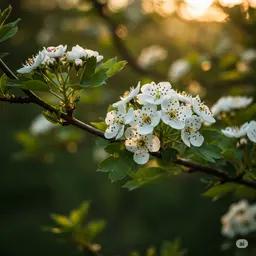
Crataegus Monogyna
Common Name | Hawthorn | ||||||||
|---|---|---|---|---|---|---|---|---|---|
Scientific Name(s) | Crataegus spp. | ||||||||
Family | Rosaceae | ||||||||
Life Form | Small Tree Thorny Shrub | ||||||||
Distribution Range | North America North Africa Asia Europe | ||||||||
Habitat | Steppe–Forest Ecotones Shrub Zones Forest Clearings | ||||||||
Flowering Period | April–June | ||||||||
Fruit Ripening | August–October | ||||||||
Major Compounds | Triterpenic Acids Proanthocyanidins Flavonoids | ||||||||
Utilization Areas | Ecological Restoration Phytotherapy Food | ||||||||
The hawthorn plant (Crataegus spp.), a member of the Rosaceae (rose) family, is a thorny shrub or small tree native to the temperate zone of the Northern Hemisphere. Due to its morphological diversity, broad ecological tolerance, and long-standing use both ecologically and culturally, it has been extensively studied in botanical literature. The genus, which includes approximately 200 recognized species, has garnered attention in the fields of food science, pharmacology, and public health due to the presence of phenolic compounds and flavonoids concentrated especially in its fruits. In Türkiye's flora, Crataegus species with high endemism rates stand out as key components of biodiversity, particularly in forest clearings and forest-steppe transition zones.
Crataegus species typically grow to heights between 3 and 10 meters, characterized by a short trunk and dense branching. The sharp thorns on the shoots are often modified short lateral branches. Leaves are alternately arranged, and may be lobed or entire with varying degrees of segmentation; most species possess short petioles supported by broadly-based stipules. The flowers are up to 2 cm in diameter, generally five-petaled, white to pinkish in color, and occur in compound corymbs or pseudo-umbels. The androecium consists of 15–20 free stamens, while the gynoecium comprises carpels with 1–5 ovules. The fruit, a fleshy pseudocarp, displays drupe-like characteristics and contains hard stones (pyrenes) within the endocarp region.
The genus is classified within the subfamily Amygdaloideae (formerly Maloideae) of the Rosaceae family. Nearly 40 sections have been defined within its internal classification. In the flora of Turkey, more than 30 native taxa have been reported, including primarily C. monogyna, C. orientalis, C. pontica, C. azarolus, and C. tanacetifolia. Species identification relies on diagnostic features such as leaf lobation patterns, stamen number, number of pyrenes, bract and calyx structure, and morphology of the androecium and gynoecium. The high propensity for hybridization has reinforced the necessity of molecular data in taxonomic studies.

Seed Structure (Created by Artificial Intelligence)
Anatolia serves as the genetic center of the genus. Species diversity increases in the transitional zones between the Euro-Siberian phytogeographical region in Northern Anatolia and the Irano-Turanian elements of Central Anatolia. Particularly, the humid valleys of the Eastern Black Sea region and the rocky limestone slopes of Western Anatolia exhibit high taxonomic diversity. Recent revision studies have led to the identification of local varieties that were not previously recorded in the existing literature.
The leaves typically display anomocytic stomatal type on the epidermis. Pollen grains are of the tricolporate type, with exine ornamentation that is either psilate or reticulate. In the fruit epidermis, cuticle thickness varies among species; such variation has been found to correlate with differences in phytochemical composition.
Flowering generally occurs between April and June, while fruit ripening takes place from August to October. The flowers are entomophilous and primarily attract pollinators belonging to the Diptera and Hymenoptera orders. Apomictic reproduction is a common phenomenon, especially in polyploid populations, and it enhances local adaptation while limiting gene flow between species.

Seed Internal Structure (Created by Artificial Intelligence)
Crataegus exhibits a Holarctic distribution, ranging from the northern coasts of Europe to Western Asia, from the steppe zones of North Africa to the mid-latitudes of China, and across much of North America. The genus shows a distinct Laurentian–Eurasian distribution pattern, suggesting an independent expansion across these two landmasses.
Although Crataegus species are widespread throughout Türkiye, they are more frequently observed in moist elevations and calcareous substrates outside the Black Sea belt. They are prominent shrub elements in the karstic plateau zones of the Western and Central Taurus Mountains and in the maquis–forest mosaics of the Marmara Region. Preferred cover types include forest clearings, ridge lines, riparian gallery forests, agricultural boundary hedgerows, and rocky slopes. Optimal growth conditions involve neutral to alkaline soil reactions, coarse-silty textures, and well-drained substrates.
Crataegus species are cold-hardy, capable of tolerating temperatures down to –30 °C. Xeromorphic leaf anatomy-characterized by reduced surface area and thick cuticlesenables adaptation to arid periods.
Hawthorns provide substantial nectar and pollen in their blossoms, serving as a critical early-spring food source for pollinators. Their dense branching architecture offers nesting habitats for small mammals and birds. Fruits (haws) contribute to zoochorous dispersal, being consumed and spread by avian species. Some narrowly endemic taxa are under threat due to habitat contraction. Agricultural expansion, wildfires, and urban development can reduce population sizes. Nevertheless, the genus as a whole is generally considered low-risk in conservation categories owing to its high ecological plasticity.
Amrati, F. E., I. Mssillou, S. Boukhira, M. D. Bichara, Y. E. Abdali, R. G. De Azevedo, C. Mohamed, M. Slighoua, R. Conte, S. Kiokias, G. S. Pontes, ve D. Bousta. “Phenolic Composition of Crataegus monogyna Jacq. Extract and Its Anti-Inflammatory, Hepatoprotective, and Antileukemia Effects.” Pharmaceuticals 17, no. 6 (2024): 786. Access date: May 27, 2025. https://doi.org/10.3390/ph17060786.
Dönmez, A. Ali, ve Sevgin Özderin. “Additional Contributions to Taxonomy, Nomenclature and Biogeography of the Turkish Crataegus (Rosaceae) Taxa.” PhytoKeys 122 (2019): 1–13. Access date: May 27, 2025. https://doi.org/10.3897/phytokeys.122.33002.
Guo, Wenjing, Ting Shao, Yu Peng, Hong Wang, Zheng Chen, ve Hong Su. “Chemical Composition, Biological Activities, and Quality Standards of Hawthorn Leaves Used in Traditional Chinese Medicine: A Comprehensive Review.” Frontiers in Pharmacology 14 (2023). Access date: May 27, 2025. https://doi.org/10.3389/fphar.2023.1275244.
Woerdenbag, Herman J., M. Ursidae, C. Ekhart, M. Schmidt, Alessandra Vitalone, ve F. P. A. M. Van Hunsel. “Analysis of Adverse Reactions Associated with the Use of Crataegus-Containing Herbal Products.” Pharmaceuticals 17, no. 11 (2024): 1490. Access date: May 27, 2025. https://doi.org/10.3390/ph17111490.
Zhang, Juan, Xiaoyu Chai et al. “Food Applications and Potential Health Benefits of Hawthorn.” Foods 11, no. 18 (2022): 2861. Access date: May 27, 2025. https://doi.org/10.3390/foods11182861.
Öztürk, Nilgün, ve Muzaffer Tunçel. “Assessment of Phenolic Acid Content and In Vitro Antiradical Characteristics of Hawthorn.” Journal of Medicinal Food 14, no. 6 (2011): 664–669. Access date: May 27, 2025. https://doi.org/10.1089/jmf.2010.0063.

Crataegus Monogyna
Common Name | Hawthorn | ||||||||
|---|---|---|---|---|---|---|---|---|---|
Scientific Name(s) | Crataegus spp. | ||||||||
Family | Rosaceae | ||||||||
Life Form | Small Tree Thorny Shrub | ||||||||
Distribution Range | North America North Africa Asia Europe | ||||||||
Habitat | Steppe–Forest Ecotones Shrub Zones Forest Clearings | ||||||||
Flowering Period | April–June | ||||||||
Fruit Ripening | August–October | ||||||||
Major Compounds | Triterpenic Acids Proanthocyanidins Flavonoids | ||||||||
Utilization Areas | Ecological Restoration Phytotherapy Food | ||||||||
Morphological and Taxonomic Characteristics
Botanical Description
Taxonomic Position
Species Richness and Micromorphological Characteristics in Turkey
Reproductive Biology and Phenology
Geographical Distribution, Habitat, and Ecology
Global Distribution
Distribution Patterns and Habitat Preferences in Turkey
Phenological Adaptation and Climate Tolerance
Ecological Functions and Conservation Status
This article was created with the support of artificial intelligence.