Geographical Indication Type(s) | Protected Geographical Indication | ||||||||
|---|---|---|---|---|---|---|---|---|---|
Registration Number | 686 | ||||||||
Registration Date | 09.03.2021 | ||||||||
Product / Product Group(s) | Dishes and Soups | ||||||||
Province(s) | Aydın | ||||||||
Applicant/Registrant(s) | Nazilli Chamber of Commerce | ||||||||
Dedebağ Keşkek is a traditional dish that has been prepared for seven centuries in Dedebağ Plateau, Karacasu district, Aydın province, Türkiye. Also known as “Karacasu Keşkek,” it is protected as a “Mahreç” (Protected Geographical Indication) geographical indication under Law No. 6769 on Industrial Property and was registered on March 9, 2021, by Nazilli Chamber of Commerce.
Dedebağ Keşkek is named after a charitable figure from Horasan, Dedebağ, whose primary occupation was shepherding. He was known for personally serving keşkek to passing caravans and the needy. After his death, his grave became associated with the Dedebağ charitable meal, which the local community continues through collective effort. Every year, in the last week of August, the “Dedebağ Keşkek Charity” event is held to preserve this cultural heritage.
The most distinctive feature of Dedebağ Keşkek is that only carcass meat from young male goats (bucks) is used. Typically, bucks weighing around 20 kg are selected, and no other type of meat is allowed. Wheat used is either hulled or cracked. Meat and wheat are used in equal proportions—for example, 20 kg of meat is paired with 20 kg of wheat, with approximately 500 grams of salt added.
Preparation begins a day in advance. Meat and wheat are boiled separately in copper cauldrons. Bones, fat, and sinews are manually removed from the meat, which is then cut into small pieces. The meat and wheat are combined in a single cauldron and cooked with salt. The characteristic texture is achieved through manual pounding with food-safe wooden paddles and mallets. This process, lasting about seven hours, produces a sticky, dough-like consistency, indicating that the meat and wheat are thoroughly integrated.
Dedebağ Keşkek is traditionally cooked over a wood fire in copper cauldrons. This method imparts a smoky and unique flavor to the dish. No mechanical or electric tools are used; all steps are completed by hand.
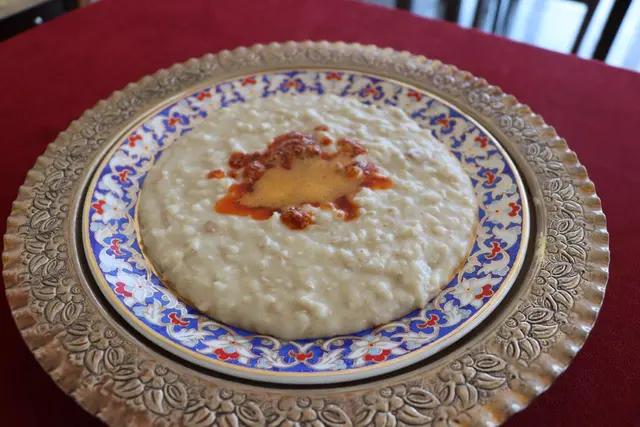
Dedebağ Keşkek is generally served with a tarator sauce made from fresh peppers, olive oil, and garlic. During service, hot butter mixed with red pepper powder is preferably poured on top.
All stages of production must take place within the boundaries of Karacasu district, Aydın province. This requirement is directly linked to the product’s historical context and the artisanal production techniques.
Production and use of the Mahreç mark for Dedebağ Keşkek / Karacasu Keşkek is supervised by a three-member inspection committee coordinated by Nazilli Chamber of Commerce. This committee includes representatives from the Nazilli Chamber of Commerce, Karacasu District Directorate of Agriculture and Forestry, and Karacasu Municipality. Inspections are conducted at least once a year, with additional checks as needed or upon complaint. Results are reported to the Turkish Patent and Trademark Office.
Türk Patent ve Marka Kurumu. "Dedebağ Keşkeği / Karacasu Keşkeği Coğrafi İşaret Sicil Belgesi." Accessed October 25, 2025. https://ci.turkpatent.gov.tr/Files/GeographicalSigns/4ac95576-e8b2-420a-b0b7-8313f8f8aa80.pdf
Türk Patent ve Marka Kurumu. "Dedebağ Keşkeği / Karacasu Keşkeği." Coğrafi İşaretler Portalı. Accessed October 25, 2025. https://ci.turkpatent.gov.tr/cografi-isaretler/detay/1004

Geographical Indication Type(s) | Protected Geographical Indication | ||||||||
|---|---|---|---|---|---|---|---|---|---|
Registration Number | 686 | ||||||||
Registration Date | 09.03.2021 | ||||||||
Product / Product Group(s) | Dishes and Soups | ||||||||
Province(s) | Aydın | ||||||||
Applicant/Registrant(s) | Nazilli Chamber of Commerce | ||||||||
No Discussion Added Yet
Start discussion for "Dedebağ Keşkek / Karacasu Keşkek" article
Historical Background
Product Characteristics
Serving
Geographical Link and Production Conditions
Supervision
This article was created with the support of artificial intelligence.