


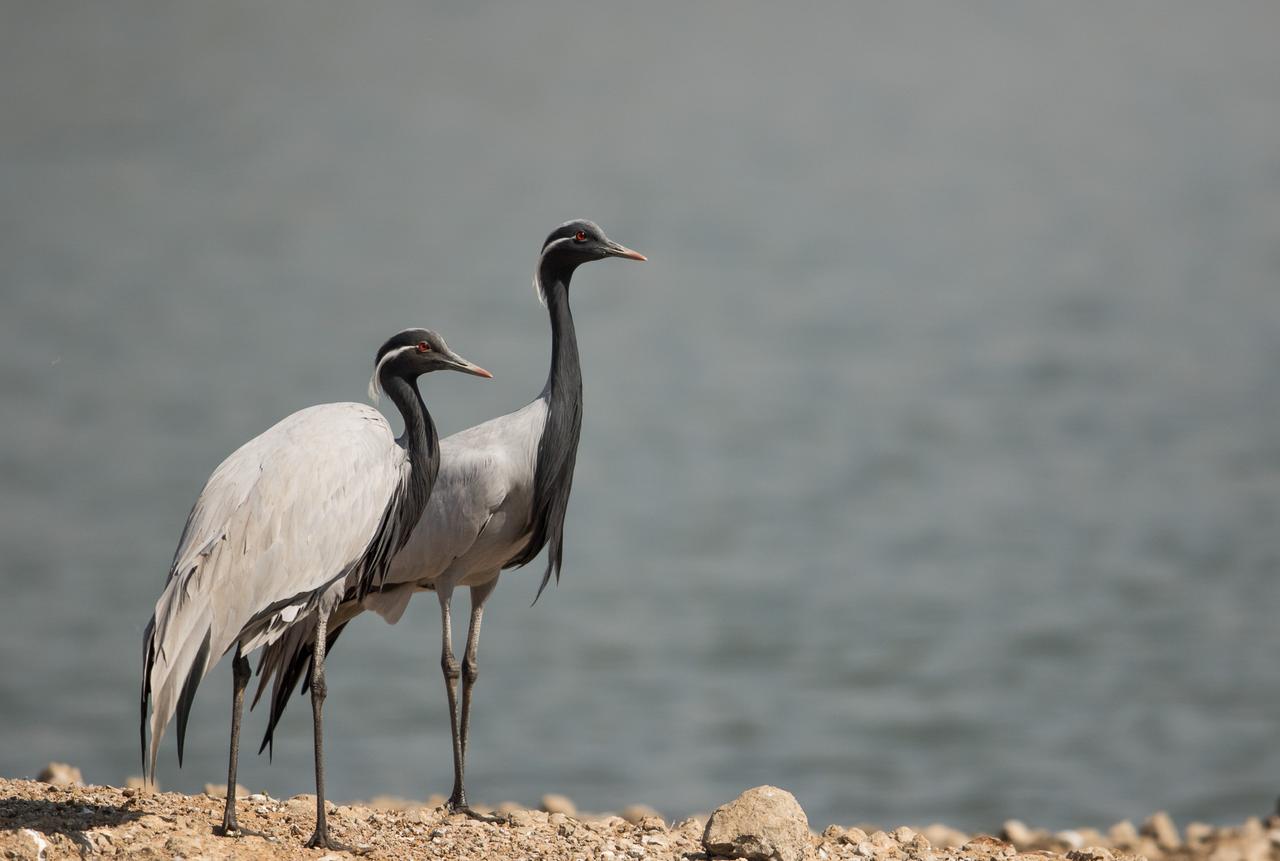
Pair of demoiselle cranes
Kingdom(s) | Animalia | ||||||||
|---|---|---|---|---|---|---|---|---|---|
Class | Aves | ||||||||
Phylum | Chordata | ||||||||
Family | Gruidae | ||||||||
Genus | Anthropoides | ||||||||
Specie(s) | G. virgo | ||||||||
The demoiselle crane (Grus virgo) belongs to the crane family (Gruidae). Known as the smallest crane species in the world, it is notable for its slender build and the tuft of feathers trailing from behind its eyes. Demoiselle cranes migrate in large groups, especially during their migratory seasons, and hold both cultural and ecological significance across various regions of the world.

Feathers of the demoiselle crane
The demoiselle crane has long, slender legs and an elegant body covered in gray feathers. Its wingspan ranges from 155 to 180 cm, and its height is between 85 and 100 cm. The species derives its name from the fine and delicate white feathers extending from the corners of its eyes to its cheeks. These feathers are its most distinguishing feature. While its overall plumage is gray, the head and neck are a darker shade of gray and black. Male and female cranes appear similar, though males are slightly larger.

Flying demoiselle crane
Demoiselle cranes are found across a broad range from the steppes of Central Asia to Mongolia, China, and India. Their primary habitats are open landscapes surrounded by wetlands and grasslands. As migratory birds, they travel to northern Africa and India during the winter months.

Distribution map of demoiselle cranes
Turkiye lies along the migratory routes of demoiselle cranes. Wetlands in the Eastern Anatolia region, including areas around Lake Van, are the most common sites where these birds are observed. Additionally, Sultan Marshes National Park in Central Anatolia serves as a vital breeding and resting ground for the species.

Flock of demoiselle cranes
Demoiselle cranes are highly social birds, often living in communities with a hierarchical structure. During migration, they fly in a "V" formation to conserve energy, enhancing the group's endurance during long journeys.

Pair of demoiselle cranes
Demoiselle cranes emit a high-pitched, resonant call, which is primarily used for group communication and mating. These calls can be heard across long distances.
Call of the demoiselle crane
Demoiselle cranes typically lay eggs in April and May. Females usually lay two eggs, spaced a day apart. Once the first egg is laid, the incubation process begins. Both male and female cranes participate in incubation, although the female assumes a greater share of responsibility. The incubation period lasts approximately 27 to 29 days, and the chicks hatch sequentially.

Egg of the demoiselle crane
Newly hatched chicks have downy feathers that are light brown on the upper body and grayish-white on the underside. Both parents feed and protect the chicks, which take about 55 to 65 days to develop the ability to fly. Demoiselle cranes generally begin breeding at around two years of age.

Chick of the demoiselle crane
Demoiselle cranes are omnivorous, feeding on grains, grass seeds, insects, and small invertebrates. During migration, they rely heavily on grains to meet their energy needs.
Classified as "Least Concern" by the International Union for Conservation of Nature (IUCN), the demoiselle crane faces threats from habitat loss and human activities. Protecting wetland areas like Sultan Marshes in Türkiye is critical for the survival of this species.
The demoiselle crane symbolizes grace and peace in many cultures. In Asian mythology, it represents longevity and loyalty. In Türkiye, it is often featured in folk literature and fairy tales.
In Indian culture, the crane holds symbolic importance. Known as "koonj" or "kurjan" in northern Indian languages, it is a prominent figure in regional literature, poetry, and idioms. Its slender and graceful appearance is often likened to beautiful women. Additionally, it serves as a metaphor for individuals embarking on distant or perilous journeys.
According to legend, Valmiki, the author of the Hindu epic Ramayana, composed his first poetic verse after witnessing a hunter kill a male crane courting its mate. Moved by the grieving female crane, Valmiki cursed the hunter in a metrical verse. This event is traditionally regarded as the origin of human-composed poetry.
The flight formations of cranes inspired ancient Indian infantry battle formations. In the epic Mahabharata, the "koonj formation" is described as being used by both sides during the second day of the Kurukshetra War.
BirdLife International. Grus virgo species factsheet. Erişim: 30 Aralık 2024.
IUCN Red List. Demoiselle Crane (Grus virgo). Erişim: 30 Aralık 2024.
Kılıç, D., & Eken, G. (2004). Türkiye'nin Önemli Kuş Alanları. İstanbul: Doğa Derneği Yayınları.
Meine, C. D., & Archibald, G. W. (1996). The Cranes: Status Survey and Conservation Action Plan. IUCN.
Snow, D. W., & Perrins, C. M. (1998). The Birds of the Western Palearctic. Oxford: Oxford University Press.
Erce (6 Haziran 2019). Grus virgo MHNT.ZOO.2010.11.65.1 [JPG]. Wikimedia commons. Erişim adresi:https://commons.wikimedia.org/wiki/File:Grus_virgo_MHNT.ZOO.2010.11.65.1.jpg
Rawpixel. Demoiselle crane, bird photography. Free public domain CC0 image [JPG]. Rawpixel. Erişim adresi: https://www.rawpixel.com/image/6038643/photo-image-public-domain-nature-bird
Calistemon (18 Nisan 2024).Demoiselle crane (Grus virgo) adult and chick at Tierpark Hellabrunn, April 2024 07 [JPG]. Wikimedia commons. Erişim adresi: https://commons.wikimedia.org/wiki/File:Demoiselle_crane_(Grus_virgo)_adult_and_chick_at_Tierpark_Hellabrunn,_April_2024_07.jpg
Vysotsky (1 Nisan 2023). Demoiselle Crane (Grus virgo) (49209849596) çhttps://commons.wikimedia.org/wiki/File:Demoiselle_Crane_(Grus_virgo)_(49209849596).jpg
Udaykiran28 (22 Nisan 2018). Demoiselle crane [JPG]. Wikimedia commons. Erişim adresi: https://commons.wikimedia.org/wiki/File:Demoiselle_crane.jpg
Arghyadeeo98 (25 Nisan 2016). The Demoiselle Cranes ( Grus virgo) [JPG]. Wikimedia commons. Erişim adresi: https://commons.wikimedia.org/wiki/File:The_Demoiselle_Cranes_(_Grus_virgo).jpg
Fae (1 Nisan 2018). Grus virgo - Demoiselle Crane XC156368 [MP3]. Wikimedia commons. Erişim adresi: https://commons.wikimedia.org/wiki/File:Grus_virgo_-_Demoiselle_Crane_XC156368.mp3

Pair of demoiselle cranes
Kingdom(s) | Animalia | ||||||||
|---|---|---|---|---|---|---|---|---|---|
Class | Aves | ||||||||
Phylum | Chordata | ||||||||
Family | Gruidae | ||||||||
Genus | Anthropoides | ||||||||
Specie(s) | G. virgo | ||||||||
Physical Characteristics
Habitat and Distribution
Habitat in Turkiye
Behavior and Ecology
Vocalization
Reproduction
Diet
Conservation Status
Cultural Significance