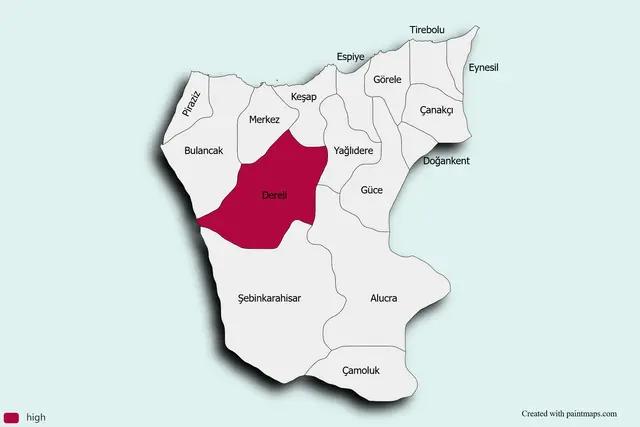
Dereli (District)
Province(s) | Giresun | ||||||||
|---|---|---|---|---|---|---|---|---|---|
Area(s) | Eastern Black Sea Region | ||||||||
Population (2024) | 20,180 people | ||||||||
Administrative Units | 6 neighborhoods 34 villages | ||||||||
Postal Code | 28950 | ||||||||
Mayor(s) | Kazim Zeki Senlikoglu | ||||||||
District Governor | Emrah Azman | ||||||||
Dereli is a district located in the Aksu Valley, southeast of Giresun province, at the 32nd km of the Şebinkarahisar road. The region , which covers approximately 820 km² , is bordered by Keşap and Yağlıdere to the east, Ordu and Bulancak to the west, Giresun city center to the north , and Alucra and Şebinkarahisar to the south. The terrain is extremely steep and rugged, and access to the district is via the asphalt Şebinkarahisar highway, which connects to the coast , stabilized village roads. While production forms the basis of agricultural activity, animal husbandry and freshwater in the economy . According to the Address Based Population Registration System, as of 2024, Dereli had a population of 20,180.
The history of Dereli, a settlement located on the shores of the Aksu Valley, demonstrates a layered development trajectory extending from antiquity to the present day. The region's geographical location, situated along a corridor formed by river valleys extending inland past ancient ports on the Black Sea coast, has it vulnerable to the dominance of various civilizations.
Traces of Azzi communities can be seen around Dereli, which was within the Hittite Empire's sphere of influence in prehistoric times, around 1300 BC. During the decline of Hittite rule, Mushki tribes penetrated the region . Then, in the 7th century BC, the Milesians established Giresun as a base, one of five ports on the Black Sea coast, and, following deep valleys, they reached the interior—today's Dereli. Persian and Cappadocian kingdoms ruled the area in the 6th–4th centuries BC; Alexander the Great's Macedonian forces in the 4th century BC; and then the Roman Empire. Following the division of the empire, Byzantine rule continued uninterrupted in the region.
Following the fall of Constantinople by the Latin invasion in 1204 and the reorganization of the Eastern Roman Empire centered around Trabzon , the region remained within the borders of the Greek Empire of Trebizond, founded by the Komnenos Dynasty. During this period, the Black Sea routes and inland transit corridors retained both economic and strategic importance. In the following centuries, the region experienced periods of interim rule between the Akkoyunlu Dynasty and Timur, until its incorporation into Ottoman territory .
The period of Turkish domination began with the settlement of Oghuz and Turkmen tribes in the Kelkit Valley following the 1071 Battle of Manzikert. The Chepni Turkmens advanced eastward from Sinop and into the interior of Giresun, opening the villages around Dereli to Turkish settlement. In 1398, Yıldırım Beyazıt's to liquidate the Canik Principality accelerated the local population's participation in Ottoman rule; Timur's temporary occupation following the Battle of Ankara was a rights relations in the region .
Following Mehmed the Conqueror's 1461 campaign against Trabzon, Dereli was permanently annexed to Ottoman territory as a result of the activities of principality units under the command of Seyyid Vakkas. Throughout the Ottoman period, Dereli was initially administered as a sub-district of the Giresun district. With the Tanzimat reforms, it was transferred to the Şebinkarahisar Sanjak within the Trabzon Province, but according to various yearbooks, it was sometimes considered a sub-district of Trabzon. The settlement of Georgian Muslim groups migrating due to the Russian occupation in 1892 in the villages of İçmesuyu and Akaya added a new dimension to the district's demographics.
In the early years of the Republic, Dereli, whose township status was consolidated in 1926, was made a district of Giresun on April 1, 1958, by Law No. 7033. That same year, organization was established in the center of Dereli, strengthening local government; the current administrative division was established with the neighborhoods of Kuşluhan, Sütlüce, Kuzca, and Bahçeli. The establishment of the Yavuzkemal town municipality in 1998–99, through the merger of the villages of Kulakkaya, Şıhlar, and Hapan, served to provide a more flexible structure for regional administrative units.
The district of Dereli is located within the borders of Giresun province, in the inland area of the Eastern Black Sea Region . The district center is located on the 32nd kilometer of the Giresun-Şebinkarahisar highway, 28 km inland from the Black Sea coast, in a narrow area that straddles both banks of the Aksu Stream, following a deep valley corridor. Topographically, the district's overall slope slopes down rapidly from north to south along the Aksu Valley; numerous side canyons and narrow passages feed this valley, making the terrain extremely rugged and difficult access .
Dereli, which covers an area of approximately 820 km², has an elevation above sea level of 199 m in the district center, while the peaks of the Giresun Mountains rise 3,000 m . The mountain ranges that make up the region are represented by high peaks Karagöl Mountain (3,107 m), Abbas Musa Mountain (3,331 m), Cankurtaran (3,278 m), and Gavur Mountain (3,248 m) . These mountain ranges are dissected by numerous streams and rivers that feed the Aksu Valley, with Eğribel Pass (2,075 m) standing out as the only critical passage to the Black Sea coast. This steep and fractured topography restricts settlements to the valley floor and only limited, large, flat areas.
The hydrological system is centered on the Aksu River, which collects spread throughout the interior of the valley . Fed by spring snowmelt and autumn precipitation, stream flows low in summer and high in winter . While there are no prominent large lakes within the district, small glacial lakes such as Karagöl and Sağrak Lake, which bear traces of the glacial formations of the Giresun Mountains, are found here and there.
Dereli's climate exhibits transitional characteristics between the humid coastal regime of the Black Sea and the continental conditions of Central Anatolia . Summers are cool, with average high temperatures ranging from 22–24°C, while winters are mild and rainy. Average annual precipitation in the district center exceeds 1,300 mm per square meter, distributed among four seasons; the rainiest period is autumn and late winter , and the driest is . Snow cover rarely persists for ; except on high-altitude slopes, the number of snow-covered days in winter is limited.
This topo-climate combination enables the existence of both a highland culture and agricultural lands on the alluvial valley floors in Dereli. The vegetation, which rises to the forest belt at the foothills of the mountains , increases ecosystem within the district borders , while the limited plains within the valley provide microclimates suitable for grain, hazelnut, and vegetable production. The transportation corridor opened by Eğribel contributes to the economic and social integration of the region by connecting the national highway system with inland settlements.
The district of Dereli is located in a narrow corridor along the Aksu Valley in southeastern Giresun province, covering an area of 820 km². According to 2024 Address-Based Population Registration System data, 20,180 people live within the district, corresponding to an average density of 24.6 people per square kilometer. This value , which is well below the Turkish average , is explained by Dereli's rugged topography and extensive forest cover.
The gender composition of the population is 10,484 (51.95%) male and 9,696 (48.05%) female. This ratio indicates the male-dominated workforce common in inland rural districts and the relatively high level of female participation in family agricultural activities. The total population's trend in recent years began with 22,902 in 2007 and remained stable until 22,840 in 2016. Then, due to internal migration and demographic aging trends, it declined to 18,696 in 2022. It then showed a partial recovery, rising again to 19,308 in 2023 and 20,180 in 2024. This fluctuating trend is directly linked to economic opportunities, increases in agricultural productivity, and waves of migration to urban centers.
The settlement pattern in the region consists of six neighborhoods , which constitute the district center, and 34 surrounding villages. The neighborhood population accounts for approximately 35% of the total (7,122 people), while those living in villages and hamlets constitute the majority at 65% (13,058 people). Rural settlements, particularly in highland villages, exhibit fluctuations above their actual population numbers to migration to the plateaus , whose registered population is partially affected by seasonal fluctuations between summer and winter .
Household size is a key indicator of demographic structure. In Dereli, where families of four to five people are common, younger generations are moving to metropolitan areas for education and employment, leading to an increase in the proportion of elderly people in villages and a decrease in the natural growth rate. This increases ratio due to advanced age and diversifies social service needs.
While detailed official data on age groups is limited, based on general inland demographic trends, it is estimated that the proportion of the population aged 0–14 is below 20%; the working -age population (15–64) comprises approximately 65% of the total; and the 65+ age group is around 15–18%. The increasing rate of youth migration from rural to urban areas increases the demand for education and healthcare services in district centers and increases the risk of social isolation in villages.
Migration, whether seasonal (highland migrations) or permanent (for work or education), directly impacts Dereli's population stability. Highland migration, which begins in late spring, results in a higher village population than the established population during the summer months , while returns in the fall and winter increase the burden on infrastructure in the city center . Furthermore, due to the constant waves of migration, the district faces the need to develop local employment opportunities, particularly those attracting young and educated residents.
The Dereli district's economy is primarily focused on the primary sector, shaped by the geomorphological and climatic characteristics of a deep valley corridor in the Black Sea's interior. The agricultural lands confined to the narrow base of the north-south Aksu Valley, along with the timber and pasture resources of the surrounding steep slopes, shape the region's production model.
Hazelnut production, with its resilient yields and economic value unique to the region, forms the backbone of agricultural activity in the district. The year-round, evenly distributed rainfall, combined with the alluvial soils of the valley floor, creates a favorable environment for both high-quality hazelnuts and planting arrangements . In addition to hazelnuts, secondary crops such as potatoes , corn, broad beans , and beans are cultivated on the valley plains, albeit on a limited scale. In settlements with forest village status, the utilization of forest products (logs, bark, mushrooms) through cooperatives provides additional income for agricultural production.
The natural pastures on the region's hillside pastures allow for the maintenance of cattle and sheep farming using traditional transhumance methods. During the migration period, which begins in April, herds move to the cooler plateaus, where they utilize the pastures' food resources throughout the summer to increase their milk and meat yields. The freshwater reserves in the Aksu Stream and its tributaries are suitable for local trout farming and fishing; small-scale fish farms are becoming increasingly popular, particularly due to demand from rural tourism facilities.
While Dereli lacks a widespread factory or large-scale production facility, the recently constructed hydroelectric power plant in the region offers potential for both contributing to the local energy supply and creating employment, albeit limited. -style facilities, which perform the crushing and crushing of primary sector products , partially increase the added value of the local economy through hazelnut cracking, flour, and feed production.
In the Dereli economy, diaspora income, which drives a large segment to seek income through work and seasonal migration abroad and to major cities, contributes to household budgets. In turn, cooperatives established in villages to support forest villagers help organize producers through technical training, collective marketing, and credit mechanisms. However, comprehensive strategies aimed at ensuring the permanence of the young population have have a limited impact.
Although Dereli offers biodiversity and a favorable climate and soil profile for to urban areas hinders the widespread adoption of organic farming. To unlock the region's potential, certification processes must be streamlined, small producers must come together to form cooperatives, and organic products must be promoted in both domestic and international markets.
The state highway, which connects the coast and the Eastern Black Sea Region's main transportation lines, makes Dereli a critical corridor for both agricultural inputs and product output. While seasonal road closures and tight curves increase logistics costs, highway improvements could increase investment incentives.
Nestled among the deep canyons and forested slopes of the Aksu Valley, the district of Dereli boasts unique tourism, cultural , and culinary potential. The region's rich ecotourism opportunities, centuries-old local traditions, and distinctive highland cuisine make this inland settlement in the Eastern Black Sea region ripe for both academic study and sustainable development models.
Among Dereli's natural attractions are the Kuzalan- , known as the "White Stone ," and the surrounding nature park. Terraces formed over time by mineral water filtering through a moss -covered ground in a forested area of approximately 500 hectares, they constitute a unique geomorphological example, the second largest travertine area to form within a forest after Yellowstone in . Located within the same corridor, near Alancık Village, Kuzalan Waterfall is a focal point for nature tourism enthusiasts thanks to its 20-meter drop, observation decks, and surrounding macro- and microhabitats.
Additionally, Düzyatak Waterfalls, located on the borders of Eğriambar Village, offer visual variety with their three-tiered flow: starting with a thin, five- to six-meter curtain, followed by two separate 20- to 25-meter falls, ending in small pools, this structure can be easily observed from hiking trails. Cehennem Creek, connected to Pınarlar Village, attracts geotourism enthusiasts, particularly with its natural soda springs and the narrow canyons eroded by these waters. Blue Lake, recently known as a "mini Pamukkale," also creates a recreational attraction with the cool blue of the calcium-rich waters emerging from beneath the travertines .
Highland tourism in Dereli goes beyond simply being a nature-based activity and also encompasses cultural festivals. Kümbet Plateau, 60 km from Giresun, Festival , held annually in the third week of July in the Aymaç area . Originating in the tradition of the "Otçu Göçü," this event today brings together 30,000-40,000 people, showcasing highland culture to both locals and visitors through programs such as folk dances, musical performances, and the "Highland Agha" competition . , the Bektaş Highland Festival and the Sağrak Lake Festival extend the season by integrating outdoor sports such as winter skiing and cross -country skiing into rituals aimed at promoting regional and revitalizing highland tourism.
Dereli's historical fabric, extending from the city center to its villages, encompasses a multilayered heritage stretching from the Byzantines to the Genoese, from the Ottomans to the Republic. Hisar Castle and the Virgin Mary Monastery in Village , the Hanalanı Ruins in the Yavuzkemal district, and the Genoese Kuşluhan Castle in the Kuşluhan neighborhood bear traces of stonemasonry dating back to various periods. Throughout the district, protected bridges (Çifteler, Güdül, Alancık, Kızıltaş), mausoleums (Hacı Mustafa Tomb), and church ruins (İçmesu Village, Hisar, Yavuzkemal) offer valuable documentation of both transportation history and the history of religious beliefs.
Intangible cultural heritage elements also play a central role in Dereli's identity. Kuşdili (whistled language), a language practiced for generations in Kuşköy, has enabled communication between two settlements many kilometers apart in the narrow canyons of the valley. The district's modern cultural life is nourished by the theater , vocal, and music competitions organized by the Public Education Center and schools, as well as free art performances organized by the Dereli Municipality before festivals . Local clothing and handicrafts, in particular, are part of the traditions and customs preserved by older generations; coppersmithing, weaving, and wood carving have retained some of their vitality from past to present.
Dereli cuisine combines the meat and grain resources offered by the region with the traditions of the highlands. Lamb meat, particularly from the highlands, stands out with its intense aroma, described as "highland fragrant." This meat is often served with Kümbet Pide, cooked on barbecues or in stone ovens . The pita dough is thin and crispy on the edges and filled with lamb, onions , peppers, and local spices. a type of flatbread made from highland milk) , tulum cheese, and butter are essential elements of village breakfast tables. Menus complemented by cornbread are complemented by a variety of pickles (pickled peppers and beets) and jams that can withstand the winter months. Natural mineral waters are also prominent for both human health and the local beverage culture.
Dereli Municipality. “Geography.” Dereli Municipality. Access date: April 21, 2025. https://www.dereli.bel.tr/detay/cografya/
Dereli Municipality. “Cultural Structure.” Dereli Municipality. Access date: April 21, 2025. https://www.dereli.bel.tr/detay/kulturel-yapi/
Dereli Municipality. “Socio-Economic Structure.” Dereli Municipality. Access date: April 21, 2025. https://www.dereli.bel.tr/detay/sosyo-ekonomik-yapi/
Dereli Municipality. “History.” Dereli Municipality. Access date: April 21, 2025. https://www.dereli.bel.tr/detay/tarihce/
Dereli Municipality. “Tourism.” Dereli Municipality. Access date: April 21, 2025. https://www.dereli.bel.tr/detay/turizm/
Dereli District Directorate of National Education. “Geographical Structure and Climate.” Dereli District Directorate of National Education. Access date: 21 April 2025. https://dereli.meb.gov.tr/www/cografi-yapi-ve-iklim/icerik/5
Dereli District Directorate of National Education. “History.” Dereli District Directorate of National Education. Access date: 21 April 2025. https://dereli.meb.gov.tr/www/il/icerik/4
Dereli District Governorship. “Hell Creek.” TC Dereli District Governorship. Access date: 21 April 2025. http://www.dereli.gov.tr/cehennem-deresi
Dereli District Governorship. “Düzyatak Waterfalls.” TC Dereli District Governorship. Access date: 21 April 2025. http://www.dereli.gov.tr/duzyatak-selaleleri
Dereli District Governorship. “Kuzalan Nature Park.” TC Dereli District Governorship. Access date: 21 April 2025. http://www.dereli.gov.tr/kuzalan-tabiat-parki
Dereli District Governorship. “Population.” TC Dereli District Governorship. Access date: 21 April 2025. http://www.dereli.gov.tr/nufusu
Dereli District Governorship. “History.” TC Dereli District Governorship. Access date: 21 April 2025. http://www.dereli.gov.tr/tarihce
Dereli District Governorship. “Lamb and Pide in the Yayla.” TC Dereli District Governorship. Access date: 21 April 2025. http://www.dereli.gov.tr/yaylada-kuzu-eti-ve-pide
Giresun Provincial Directorate of Culture and Tourism. “Dereli.” Giresun Provincial Directorate of Culture and Tourism. Access date: 21 April 2025. https://giresun.ktb.gov.tr/TR-57997/dereli.html
Giresun Provincial Directorate of Culture and Tourism. “Cultural and Natural Assets of Dereli District.” Giresun Provincial Directorate of Culture and Tourism. Access date: 21 April 2025. https://giresun.ktb.gov.tr/TR-275827/dereli-ilcesi-kulturel-ve-dogal-varliklar.html
Ministry of Culture and Tourism Cultural Portal. “Dereli: Kuzalan Göksu Travertines.” Republic of Turkey Ministry of Culture and Tourism Cultural Portal. Access date: 21 April 2025. https://www.kulturportali.gov.tr/turkiye/giresun/gezilecekyer/dereli-kuzalan-goksu-travertenleri
Ministry of Culture and Tourism Cultural Portal. “Dereli: Kuzalan Waterfall.” Republic of Turkey Ministry of Culture and Tourism Cultural Portal. Access date: 21 April 2025. https://www.kulturportali.gov.tr/turkiye/giresun/gezilecekyer/dereli-kuzalan-selalesi
Paintmaps. “Turkey Provinces Map – Highlighting Dereli, Giresun.” Access date: April 15, 2025. https://paintmaps.com .
Turkish Statistical Institute (TurkStat). Address Based Population Registration System Results, 2024. Access date: April 20, 2025. https://data.tuik.gov.tr/Bulten/Index?p=Adrese-Dayali-Nufus-Kayit-Sistemi-Sonuclari-2024-53783

Dereli (District)
Province(s) | Giresun | ||||||||
|---|---|---|---|---|---|---|---|---|---|
Area(s) | Eastern Black Sea Region | ||||||||
Population (2024) | 20,180 people | ||||||||
Administrative Units | 6 neighborhoods 34 villages | ||||||||
Postal Code | 28950 | ||||||||
Mayor(s) | Kazim Zeki Senlikoglu | ||||||||
District Governor | Emrah Azman | ||||||||
History
Geography and Climate
Population and Demography
Economy
Tourism - Culture - Cuisine
This article was created with the support of artificial intelligence.