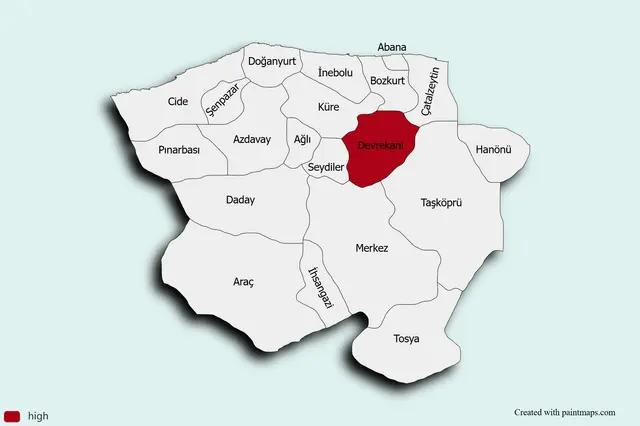
Devrekani (District)
Province(s) | Kastamonu | ||||||||
|---|---|---|---|---|---|---|---|---|---|
Area(s) | Black Sea | ||||||||
Altitude | 1,070 m | ||||||||
Population (2024) | 12,544 | ||||||||
Mayor(s) | Engin Altıkulaç | ||||||||
District Governor | Huseyin Camkerten | ||||||||
Postal Code | 37700 | ||||||||
License Plate Code | 37 | ||||||||
Climate(s) | Black Sea and continental climate | ||||||||
Economy | Agriculture animal husbandry and forestry | ||||||||
Devrekani is a district located northeast of Kastamonu. Agriculture and animal husbandry are the district's primary economic activities. The district also boasts several historical and tourist sites.

Devrekani (Devrekani Municipality)
The district of Devrekani and its surrounding area boasts a historical settlement. Archaeological findings indicate settlement dating back to the Lower Paleolithic period. Chipped stone axes in the villages of Taktak and Malak indicate that the first settlements in the region date back to very ancient times. Artifacts unearthed during excavations in Kınık Village in the 1990s revealed finds dating to the Hittites around 3000 BC. Throughout history, the region has been under the rule of states such as Assyria, Lydia, Persia, Macedonia (Alexander the Great), Pontus, Rome, and Byzantium. The region came under the rule of the Persian Empire, particularly in the 7th century BC, and later came under the rule of Alexander the Great and the Pontus Kingdom. It was also occupied during the Roman and Byzantine periods.
Under Turkish rule, the region first encountered Seljuk and Danishmend rule, and in the 13th century, the Candaroğulları (İsfendiyaroğulları) Principality came to dominate the region. The Ottoman Empire conquered the Kastamonu region in the early 15th century and annexed it to Ottoman territory. The region's relationship with the Ottomans was strengthened by the political marriage between Murat II and Candaroğlu İsfendiyar Bey in 1424. The district's name derives from "Devlethane," a caravanserai (inn) used during the İsfendiyaroğulları period, and over time, it became "Devrekani" in the public discourse. During the Republican era, Devrekani gained municipality status in 1880 and district status in 1944. Within the district's borders are various historical structures from the Ottoman and Beylik periods, including mosques, bathhouses, and fountains.
Devrekani is located within the borders of Kastamonu province in the Western Black Sea Region. The district center has an elevation of approximately 1,090 meters. The district's terrain is generally mountainous and forested; the İsfendiyar (Küre) Mountains lie to the north and the Ilgaz Mountains to the south. Devrekani has a slightly rugged topography, with cultivated poplar and fruit trees found in the lower elevations, while rich forest cover of conifers such as oak, beech, fir, and pine is found in the higher elevations. Approximately 53% of the district's land is agricultural and 22% is forested.
The district's climate exhibits the characteristics of the continental Black Sea climate. Summers are hot, while winters are cold and rainy. The temperature difference between day and night is generally around 25 °C. The average annual temperature is approximately 7.6 °C; the lowest average temperature is −2 °C in January, and the highest in August is 16.8 °C. The average annual precipitation is 550 mm. Because snowfall and frost are frequent in the winter months, an average of 133 frosty days occur annually. The average relative humidity is around 68 percent annually; the lowest humidity rate was measured in August at 59%, and the highest in December at 76%. An increase in the number of foggy days is observed, especially in autumn and winter.
The total population of Devrekani district was 13,742 in 2007, but decreased to 12,544 in 2024. During this period, increases of 136, 1,455, and 1,849 people were observed in 2012–2013, 2017–2018, and 2022–2023, respectively, while decreases were observed at varying rates in the other years. According to 2024 data, the male population was 6,432 (51.28%) and the female population was 6,112 (48.72%), with the gender gap generally remaining at a few hundred people. Annual population changes have followed a fluctuating course, which can be explained by various factors such as local registry updates and migration movements.
Devrekani's economy is largely based on agriculture and animal husbandry. Crops such as barley, wheat, vetch (a type of legume), potatoes, sugar beets, and silage corn are grown extensively in the region. Approximately 70 percent of the district's population is engaged in agriculture. However, because a large area of the district is forested or hilly, agricultural land is limited; there are approximately 150,000 decares of arable land. Due to the extensive pastureland, livestock farming, primarily in the form of cattle, is practiced. The district has a total of 30,444 head of cattle, approximately 50 percent of which are cultivated breeds, 35 percent are crossbreds, and 15 percent are local breeds. Daily milk production in the district is approximately 85,000 liters, comprising an average of 45,000 liters of quality milk and 40,000 liters of regular milk. Agricultural animal husbandry is carried out through pasture farming and family operations. The district also has two large, modern livestock farms and nine small- to medium-sized farms with capacities of 100-200 head. As part of preventive animal health measures, 50,000 doses of foot-and-mouth vaccine were administered in 2014, and 11,968 head of cattle were artificially inseminated.
The forest presence in Devrekani also contributes to the regional economy. The rich forest cover is a vital source of income, particularly for landless families. Furthermore, efforts to develop an agriculturally-based industrial infrastructure are ongoing; the planned agriculturally-based specialized organized industrial zone in the district is expected to bring significant economic development and employment benefits.
The district of Devrekani boasts numerous natural and historical sites. Akdoğan Waterfall, located within the district's borders, is located between the villages of Akdoğan and Pınarözü, 30 km away. This waterfall consists of six cascading steps; its water is fed by lakes within a cave adjacent to the waterfall. It is possible to reach this cave, which is approximately 300 meters high. The historic Bridal Bath in Çayırcık Village is a structure dating back to the Ottoman period. Legend has it that it hosted henna nights and bath rituals for brides-to-be when Ottoman Sultan Murad II was to marry the daughter of Candalı İsfendiyar Bey. This bathhouse, which dates back approximately 600 years, has been restored but is no longer in use. The "Aslan Taşı" (Aslan Taşı), located in the same village, is the remains of a Roman-era statue, indicating that the area was a significant settlement in the past.
Other important tourist attractions in the region include the Kınık Dam, its waterfall, and the ruins of an ancient Hittite city. Built for irrigation purposes, 10 km from the triangle of Fakılar, Karayazıcılar, and Beyler villages, Beyler Dam, with its carp and sea bass, is a popular weekend spot for fishermen. The area surrounding the dam, which also boasts a bird-watching tower, has been designed as a picnic area. Artifacts dating back to the Hittite period discovered near the Kınık Dam (or Kınık Dam Irrigation System) in the 1990s have revealed traces of ancient settlement in the area. The district also boasts high plateaus such as Yaralıgöz Mountain, with its elevation of 2,050 meters, and the caves in Sarpunalınca and Alçılar Village (especially the caves that freeze in summer) attract nature hikers.
The tombs of religious figures in the district hold a significant place in terms of cultural heritage. The tombs of Hüseyin Dede (Kurtşeyh Dede) and Hacı Merdane Veli Efendi are among the sacred sites visited by locals. Historic Ottoman mosques such as the 15th-century İsmail Bey Mosque (dating from the Candaroğulları period) and the Merkez Çarşı Mosque are also among the protected cultural assets. Furthermore, Mustafa Kemal Atatürk visited Devrekani on August 28, 1925, and stayed in a house in a nearby village; this building is now preserved as a memorial house.
The cuisine of the Devrekani region parallels the traditional food culture of Kastamonu. Local dishes such as banduma, tarhana soup, mantı, etli ekmek, ekşili pilaf, haluşka, gözleme, and samsı are frequently prepared in the district. Wedding böreği (wedding pastry) made with wheat flour, corn flour, and meat, as well as various desserts, are among the local delicacies enjoyed at weddings and holidays. These dishes are generally prepared using locally grown grains, vegetables, and meat products and served in a stone oven. While Devrekani cuisine shares the general characteristics of Kastamonu cuisine, it also features unique regional variations.
Republic of Turkey Devrekani District Governorship “Akdoğan Waterfall and Cave” Devrekani District Governorship. Access date: May 12, 2025. http://www.devrekani.gov.tr/akdogan-selalesi-ve-magarasi
Republic of Turkey Ministry of Culture and Tourism Kastamonu Provincial Directorate of Culture and Tourism "Devrekani" Kastamonu Provincial Directorate of Culture and Tourism. Access date: May 12, 2025. https://kastamonu.ktb.gov.tr/TR-63816/devrekani.html
TC Devrekani Municipality “Economy” Devrekani Municipality. Access date: May 12, 2025. https://www.devrekani.bel.tr/ekonomi/
TC Devrekani Municipality "Let's Travel and See" Devrekani Municipality. Access date: May 12, 2025. https://www.devrekani.bel.tr/gezelim-gorelim/
TC Devrekani Municipality “Climate and Geography” Devrekani Municipality. Access date: May 12, 2025. https://www.devrekani.bel.tr/iklim-ve-cografya/
TR Devrekani Municipality "Local Flavors" Devrekani Municipality. Access date: May 12, 2025. https://www.devrekani.bel.tr/yoresel-lezzetler/
TR Devrekani District Governorship “Alcılar Village: Foggy and Mysterious Cave” Devrekani District Governorship. Access date: May 12, 2025. http://www.devrekani.gov.tr/alcilar-koyu-sisli-ve-gizemli-magara
TR Devrekani District Governorship "Beyler Dam" Devrekani District Governorship. Access date: May 12, 2025. http://www.devrekani.gov.tr/beyler-baraji-2
TR Devrekani District Governorship “History of Our District” Devrekani District Governorship. Access date: May 12, 2025. http://devrekani.gov.tr/devrekanimizin-tarihcesi
Turkish Statistical Institute (TurkStat). Address Based Population Registration System Results, 2024. Access date: April 20, 2025. https://data.tuik.gov.tr/Bulten/Index?p=Adrese-Dayali-Nufus-Kayit-Sistemi-Sonuclari-2024-53783

Devrekani (District)
Province(s) | Kastamonu | ||||||||
|---|---|---|---|---|---|---|---|---|---|
Area(s) | Black Sea | ||||||||
Altitude | 1,070 m | ||||||||
Population (2024) | 12,544 | ||||||||
Mayor(s) | Engin Altıkulaç | ||||||||
District Governor | Huseyin Camkerten | ||||||||
Postal Code | 37700 | ||||||||
License Plate Code | 37 | ||||||||
Climate(s) | Black Sea and continental climate | ||||||||
Economy | Agriculture animal husbandry and forestry | ||||||||
No Discussion Added Yet
Start discussion for "Devrekani (District)" article
History
Geography and Climate
Population and Demography
Economy
Tourism, Culture and Cuisine
This article was created with the support of artificial intelligence.