Type of Geographical Indication | Protected Geographical Indication | ||||||||
|---|---|---|---|---|---|---|---|---|---|
Registration Number | 170 | ||||||||
Registration Date: February 22, 2013 | February 22, 2013 | ||||||||
Product / Product Group(s) | Cheese | ||||||||
Province(s) | Diyarbakır | ||||||||
Applicant/Registrant(s) | Diyarbakır Chamber of Commerce and Industry | ||||||||
Diyarbakır Örgü Peyniri (Diyarbakır Braided Cheese) is a traditional cheese unique to Diyarbakır province in Türkiye's Southeastern Anatolia Region, registered as a Protected Geographical Indication under Industrial Property Law No. 6769. Registered on February 22, 2013, effective from February 15, 2010, by the Diyarbakır Chamber of Commerce and Industry, its production is limited to Diyarbakır province and its districts.
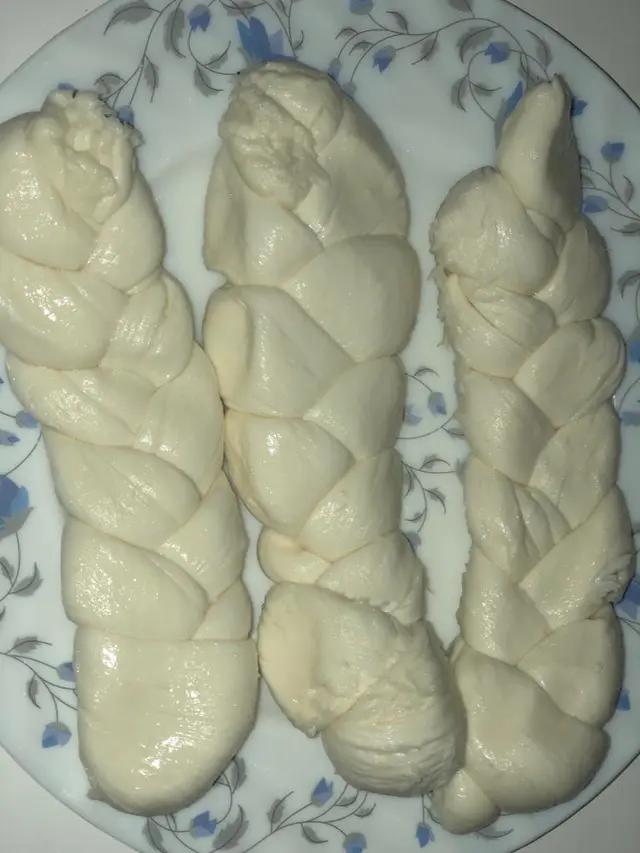
Diyarbakır Örgü Peyniri combines characteristics of white cheese in composition and kashar cheese in production technique. It is notable for its high fat content, homogeneous and elastic texture, semi-hard consistency, and distinctive taste and aroma. Its signature braided (örgü) shape sets it apart visually. The cheese ranges in color from creamy white to slightly yellow, with a glossy, flexible surface that can be pulled apart into strands by hand. Unlike kashar cheese, it lacks a rind, and unlike white cheese, it has no gas bubbles.
The cheese is traditionally made in spring from freshly milked raw sheep’s milk, though goat or cow milk, or their mixtures, may be used when sheep’s milk is unavailable. The preparation process includes:
In a household method, fresh unsalted white cheese is softened in hot water, kneaded, braided, and placed in cold water to set its shape.
The cheese can be consumed fresh or matured in brine. It is placed in lacquered tin or plastic containers, covered with 10–12% brine, and matured at 4–6°C for an average of 90 days. Under proper conditions, it has a shelf life of up to 12 months, which can extend further at 2°C.
The cheese’s distinctive taste and aroma stem from the milk of local sheep breeds (Karakaş, Karacadağ Zom, İvesi) and the diverse flora they graze on, with 534 plant species from 269 genera and 66 families in the region. This biodiversity directly influences milk quality and the cheese’s uniqueness. Traditional knowledge and skill are integral to production. In areas without cold storage, cheese is buried in wet soil under north-facing trees during summer and retrieved in autumn, enhancing its flavor.
Inspections occur biannually, coordinated by the Diyarbakır Provincial Directorate of Agriculture and Forestry, Diyarbakır Chamber of Commerce and Industry, Dicle University Veterinary Faculty, Diyarbakır Food Control Laboratory, Sheep and Goat Breeders’ Association, and Milk Producers’ Association. Additional inspections may occur based on complaints. Checks include the braided shape, taste, aroma, color, salt content, physical and chemical properties, packaging, and labeling compliance.
Türk Patent ve Marka Kurumu. "Diyarbakır Örgü Peyniri Coğrafi İşaret Sicil Belgesi." Accessed October 26, 2025. https://ci.turkpatent.gov.tr/Files/GeographicalSigns/4cc1580b-ab43-4c72-9ad1-080b20329563.pdf.
Türk Patent ve Marka Kurumu. "Diyarbakır Örgü Peyniri." Coğrafi İşaretler Portalı. Accessed October 26, 2025. https://ci.turkpatent.gov.tr/cografi-isaretler/detay/38018.

Type of Geographical Indication | Protected Geographical Indication | ||||||||
|---|---|---|---|---|---|---|---|---|---|
Registration Number | 170 | ||||||||
Registration Date: February 22, 2013 | February 22, 2013 | ||||||||
Product / Product Group(s) | Cheese | ||||||||
Province(s) | Diyarbakır | ||||||||
Applicant/Registrant(s) | Diyarbakır Chamber of Commerce and Industry | ||||||||
No Discussion Added Yet
Start discussion for "Diyarbakır Örgü Peyniri" article
Distinctive Features
Physical and Chemical Properties
Preparation
Maturation and Storage
Geographical and Ecological Context
Inspection
This article was created with the support of artificial intelligence.