


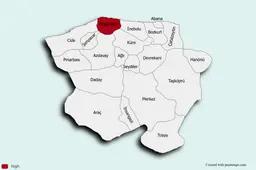
Doğanyurt (District)
Province(s) | Kastamonu | ||||||||
|---|---|---|---|---|---|---|---|---|---|
Area(s) | Black Sea | ||||||||
Altitude | 13 m | ||||||||
Population (2024) | 5.173 | ||||||||
Mayor(s) | Ahmet Kaya | ||||||||
District Governor | Halil Affan Erdoğan | ||||||||
Postal Code | 37550 | ||||||||
Plate Code | 37 | ||||||||
Climate(s) | Black Sea climate | ||||||||
Economy | Fishery Forestry Animal Husbandry Agriculture | ||||||||
Doğanyurt is a coastal district located on the Black Sea coast, north of Kastamonu. Agriculture, animal husbandry, forestry and fishing activities are carried out in the district center and surrounding villages.

Doğanyurt (Doğanyurt Municipality)
The history of Doğanyurt dates back to the 4th century BC, and a settlement called "Gereas" was established during the Pontus Kingdom. The first settlement of the district was formed around a castle on the coast. Today, only the foundations of the castle have survived. During the Ottoman period, the region was called Hoşalay. In 1846, Hoşalay was organized as a district center affiliated to Kastamonu. In the same year, a police station was established to ensure security against pirate attacks from the sea, and the kadı system began to be operated in the local administration. In 1923, the district was separated from Cide and connected to İnebolu district, gaining the status of a district. With a law enacted in 1962, the name of the district Hoşalay was changed to Doğanyurt. After the abolition of the district organization in 1990, Doğanyurt, which remained in village status for a while, was made a district with the law dated May 9, 1990, and officially began operating as a district center on September 1, 1990. On this date, Doğanyurt district and its municipality were also established.
Doğanyurt district is located in the coastal area of Kastamonu province in the Western Black Sea region of Türkiye. The district center is located close to the Black Sea and is quite low above sea level. The population density per km² of the district, which has a surface area of approximately 272 km², is quite low (approximately 23 people/km²). The north of the district is adjacent to the Black Sea, and the east and west are adjacent to other Kastamonu districts. The land is generally mountainous and forested. There are 12,489 hectares of forest area within the provincial borders. Tree species such as beech, oak, chestnut, pine and fir are predominant in the forest cover. Evergreen plants such as cornel (pine tree), laurel and strawberry tree are also common in the forests.
The Black Sea climate prevails in Doğanyurt. Summers are generally cool, while winters are rainy. Winters are mild on the coast, while harsher winter conditions are observed in the interior. While snowfall is seen in the winter months, especially in the inner neighborhoods, precipitation is concentrated as rain on the coast. The average annual precipitation is high (approximately 1076 mm, and effective precipitation is usually seen in spring and autumn). Wind speeds in the region vary between 3-4 m/s on average. Fog layers can be encountered in areas close to sea level in the summer months. These climatic conditions create a humid and cool environment for regional agriculture.
The total population of Doğanyurt district was 8,940 in 2007, but decreased to 5,173 in 2024. During this period, limited increases of 160 and 91 people were observed in 2017–2018 and 2022–2023, respectively; and regular decreases were observed in the population in other years. According to 2024 data, the male population is 2,676 (51.73%), the female population is 2,497 (48.27%), and the difference between the genders is 179 people. Annual population changes have a fluctuating structure that can be explained by factors such as regional migration movements and administrative record updates.
Doğanyurt district does not have a developed infrastructure in terms of industry and large-scale trade due to the difficult geographical conditions. The district economy is generally based on primary sectors such as agriculture, forestry and fishing. Fishing is done along the coastline, while in the inland areas, agricultural production (especially products such as corn, beans, potatoes) and animal husbandry are important, albeit limited, as sources of income. The abundance of forested areas allows for forest products and non-mining forestry activities.
According to the State Planning Organization, the socioeconomic indicators of Doğanyurt remain below the general level of Kastamonu. The limited economic opportunities in the region cause the people of the district to earn their living through traditional methods. In recent years, efforts to support rural development and tourism have led to steps being taken towards diversification in the district economy. Despite this, the industrial infrastructure is largely underdeveloped and a significant portion of the people turn to outside employment opportunities in the public sector, education or service sectors.
Doğanyurt has potential for tourism with its natural geographical features and location on the Black Sea coast. There are bays and forested areas that reach the sea within the district borders. Sea tourism, beach and bay opportunities, nature tourism, plateaus and forest walking areas can be diversified thanks to the opportunities. Cumayanı Mosque located in Cumayanı district close to the district center is a historical structure and is one of the prominent examples of local cultural tourism. Another structure from the Ottoman period, Şeyh İsmail Rumi Mosque, is also one of the important structures preserved as a foundation work in Doğanyurt. Such structures attract attention as elements reflecting the traditional Ottoman architecture of the district center. In addition, the traditional clothing, handicrafts, folk music and games of the people in the region are kept alive in a way that reflects the general cultural heritage of Kastamonu. Local festivals and holiday events, especially organized in the summer months, contribute to the continuation of folk culture.
As is the case with Kastamonu cuisine in general, the local food culture in Doğanyurt is diverse. The dishes made in the district and its surroundings reflect the Black Sea cuisine and the traditional flavors of Kastamonu. Corn bread, legume dishes, and vegetable soups are widely consumed. Kastamonu's famous etli ekmek (also known as "et ekmek" or "saç kavurması" in the region) is a typical product of the regional cuisine. In addition, the traditionally prepared and consumed halva and broad bean dishes prepared by the people of the district are consumed with pleasure, as in similar regions in Kastamonu. In coastal villages that make a living from fishing, fresh seafood comes to the fore in the cuisine. Plants such as mushrooms, sage, and thyme that grow in their natural environment also play a role in the local people's dishes and their local healing uses.
Republic of Turkey Ministry of Culture and Tourism Kastamonu Provincial Directorate of Culture and Tourism. “Doğanyurt.” Kastamonu Provincial Directorate of Culture and Tourism . Access date: May 12, 2025. https://kastamonu.ktb.gov.tr/TR-63817/doganyurt.html
TC Doğanyurt Municipality. “Doğanyurt.” Doğanyurt Municipality . Access date: 12 May 2025. http://www.doganyurt.bel.tr/index.php?modul=10_3&id=1
TC Doğanyurt District Governorship. “Cumayani Mosque.” Doğanyurt District Governorship . Access date: 12 May 2025. http://www.doganyurt.gov.tr/cumayani-camii
TC Doğanyurt District Governorship. “Doğanyurt.” Doğanyurt District Governorship . Access date: 12 May 2025. http://www.doganyurt.gov.tr/doganyurt
TC Doğanyurt District Governorship. “Views from Doğanyurt.” Doğanyurt District Governorship . Access date: 12 May 2025. http://www.doganyurt.gov.tr/doganyurttan-manzaralar
Turkish Statistical Institute (TurkStat). Address Based Population Registration System Results, 2024. Access date: April 20, 2025. https://data.tuik.gov.tr/Bulten/Index?p=Adrese-Dayali-Nufus-Kayit-Sistemi-Sonuclari-2024-53783

Doğanyurt (District)
Province(s) | Kastamonu | ||||||||
|---|---|---|---|---|---|---|---|---|---|
Area(s) | Black Sea | ||||||||
Altitude | 13 m | ||||||||
Population (2024) | 5.173 | ||||||||
Mayor(s) | Ahmet Kaya | ||||||||
District Governor | Halil Affan Erdoğan | ||||||||
Postal Code | 37550 | ||||||||
Plate Code | 37 | ||||||||
Climate(s) | Black Sea climate | ||||||||
Economy | Fishery Forestry Animal Husbandry Agriculture | ||||||||
No Discussion Added Yet
Start discussion for "Doğanyurt (District)" article
History
Geography and Climate
Population and Demography
Economy
Tourism, Culture and Cuisine
This article was created with the support of artificial intelligence.