

+2 More

Duh Turks
Location | Hövsgöl Aymag Mongolia Tsagaannuur Region | ||||||||
|---|---|---|---|---|---|---|---|---|---|
Population | Approximately 300–400 people | ||||||||
Language(s) | classified as an endangered language by UNESCO) Dukha Turkish (closely related to Tuva Turkish | ||||||||
Ethnic Origin | Siberian Turks – closely related to the Tuva Turks | ||||||||
Main Sources of Livelihood | Reindeer herding, Hunting, Fishing, Limited tourism | ||||||||
Housing | Conical tents called “urts” made from reindeer hides | ||||||||
Clothing | Traditional attire primarily made from leather and wool | ||||||||
Belief System | Shamanism (Worship of nature spirits under the guidance of shamans), A small number of Buddhist and Christian individuals | ||||||||
Socioeconomic Structure | Semi-nomadic, Collective decision-making, Traditional family-based division of labor | ||||||||
Threats | Language loss, Urbanization among younger generations, Environmental changes, Increasing use of Mongolian in education | ||||||||
Key Features | Living with reindeer, A living example of Siberian Turkic culture | ||||||||
The Duh Turks (or Dughlat Turks) were a Turkic tribe that originated in Central Asia. They were part of the larger Turkic Khaganate and played an important role in the political and military history of the region, particularly during the period of the Seljuk Empire. The Duh Turks were involved in various historical conflicts and were known for their military prowess. They later became influential in the history of the Karakhanid Khanate and other Central Asian states. They are often recognized for their contributions to the expansion of Turkic influence in the region.

Duh Turks (AA)
The Dukha Turks live in the Tsagaannuur Sum district of the Hövsgöl Aymag, located in northern Mongolia. This region spans the forested and mountainous terrain between the Mongolian Altai and Sayan mountains. The population is estimated to be around 300–400 people, making up a very small fraction of Mongolia's total population. Their settlement patterns follow a semi-nomadic lifestyle, migrating several times a year and adjusting their camp locations based on the feeding needs of the reindeer.
While precise data on the history of the Dukha Turks is limited, they are believed to have close ties with the Tuva Turks in Siberia. It is unclear when they arrived in Mongolia, but it is assumed that they migrated southward from Tuva to the present-day Hövsgöl region during the 17th century. After the Soviet Union brought Tuva under its sphere of influence, some Turkic communities crossed into Mongolia, where they began settling. In this context, the Dukha Turks are historically and culturally linked to both the Siberian Turks and the Altai peoples.
Dukha Turkish is a dialect closely related to Tuva Turkish, a member of the Northeast (Siberian) group of the Turkic language family. While it shares similarities with Tuva Turkish in terms of phonology, vocabulary, and grammar, it also incorporates some local variations due to the influence of the surrounding languages, such as Mongolian and Russian. UNESCO classifies Dukha Turkish as one of the "languages at risk of extinction." The increasing number of young people receiving education in Mongolian and growing contact with the outside world has reduced the usage of Dukha Turkish.
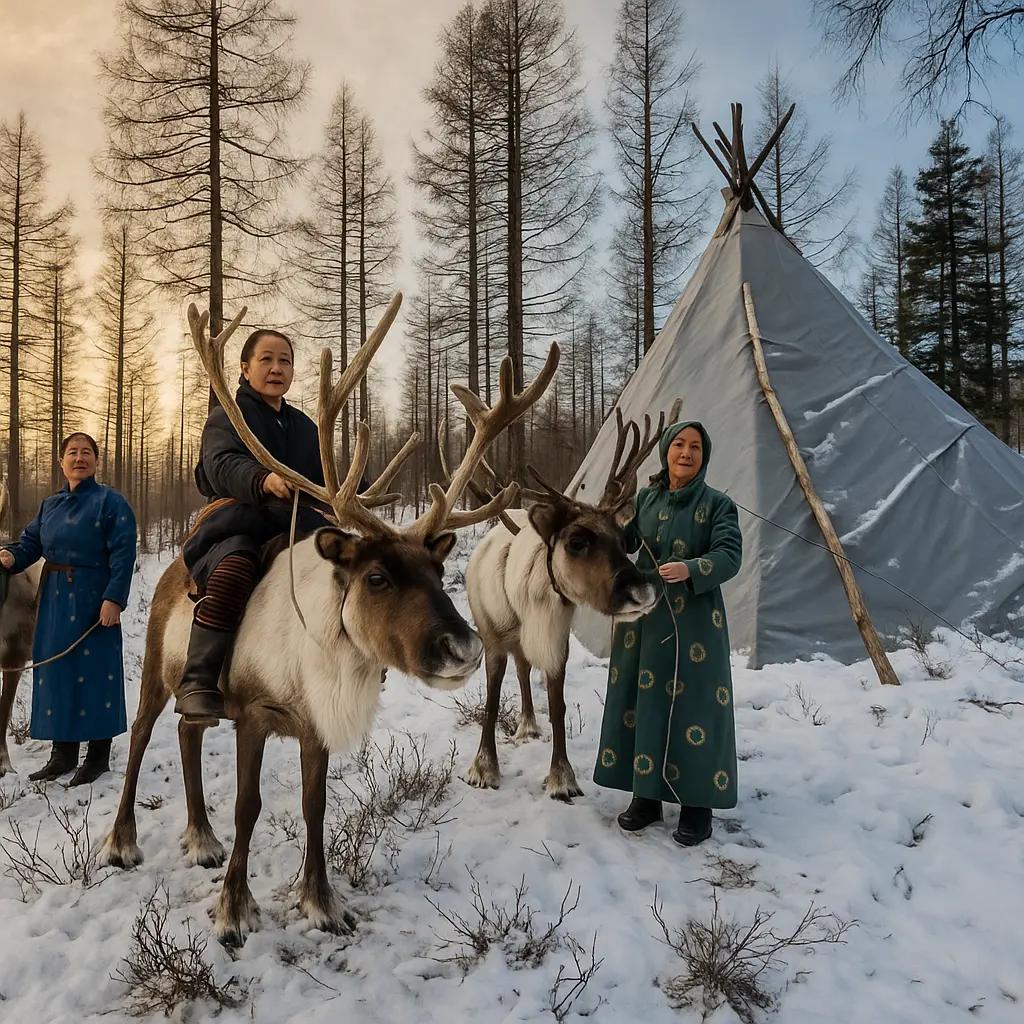
The lifestyle of the Dukha Turks is largely based on reindeer herding. Reindeer are used for both transportation and meeting basic needs. From reindeer, they obtain milk for yogurt, skin for clothing and tent coverings, antlers for tools, and meat for consumption during ceremonies and special occasions. In addition to herding, the Dukha Turks sustain themselves through hunting, fishing, and gathering forest products.
In recent years, due to increasing external interest, tourism has also become a limited source of income. Anthropologists, ethnologists, and nature tourism enthusiasts, in particular, visit Dukha campsites.

Duh Turks (Created with Artificial Intelligence)
The social structure of the Dukha Turks is based on nuclear families, typically consisting of 5–7 members. Marriages are traditionally conducted under the influence of patriarchal values. Elderly individuals hold a respected position within the community. Women are typically responsible for household chores, milking the reindeer, leatherworking, and child-rearing.
The Dukha community exhibits a cooperative structure. During camp transitions, tasks such as load sharing and decision-making processes are handled collectively.
The Dukha Turks live in conical, portable tents called “urts.” These tents are covered with reindeer skins and equipped with a traditional stove that has a smoke vent in the center. These structures are highly functional for cold climates and are used during both summer and winter camping periods.
Leather and wool are dominant materials in clothing. Men wear long, belted robes, while women wear headscarves and embroidered dresses. Reindeer skin boots are common and are essential for harsh winter conditions.
The Dukha people largely maintain a Shamanistic belief system. The shaman, known as the "kam," serves as the spiritual guide within the community. Worship of nature spirits, ancestors, and sacred beings related to the forest is still practiced. Rituals are performed for healing diseases, spiritual purification, as well as during birth, death, and migration periods.
The shaman drum is the most important tool of the kam. It is believed that shamans enter a trance and communicate with gods and spirits during their rituals. Additionally, there has been some observation of individuals turning towards Buddhism and Christianity, indicating a shift in the belief system.
Aksoy, Mustafa. “Duha Türkleri ve Moğolistan Gezi Notları.” Türk Dünyası Tarih Kültür Journal. Accessed May 29, 2025. https://www.academia.edu/35548801/Mustafa_Aksoy_Duha_T%C3%BCrkleri_ve_Mo%C4%9Folistan_Gezi_Notlar%C4%B1.
Anadolu Ajansı. “Issızlığın Ortasındaki Bir Avuç Türk: Duhalar.” Anadolu Ajansı. Accessed May 29, 2025. https://www.aa.com.tr/tr/dunya/issizligin-ortasindaki-bir-avuc-turk-duhalar/1426551.
Atlas, Burcu. “Duha Türkleri: Ren Geyiği ile Yaşayan Kuzeyliler.” Evren Atlası. Accessed May 29, 2025. https://evrenatlasi.com.tr/kultur/duha-turkleri/.
Azatkhan, Madinye. ''Duha Türklerinde Geçiş Dönemleri.'' Ankara Hacı Bayram Veli University Graduate School of Education. Accessed May 29, 2025. https://acikbilim.yok.gov.tr/bitstream/handle/20.500.12812/375164/yokAcikBilim_10264347.pdf.
Kalan, Ekrem. “Moğolistan’da Türk Topluluklarının Dünü, Bugünü ve Yarını.” Akdeniz University. Accessed May 29, 2025. https://www.tuba.gov.tr/files/yayinlar/bilim-ve-dusun/Cengiz%20Han%20ve%20Mirasi/TUBA-978-605-2249-76-5_Ch9.pdf.
TRT Belgesel. ''Duha Türkleri.'' TRT Belgesel Youtube Channel. Accessed May 29, 2025. https://www.youtube.com/watch?v=-Mbr_ocqNeU.
Yeni Şafak. “Kayıp Türk boyu: Gelenekleriyle herkesi şaşırttı.” Yeni Şafak. Accessed May 29, 2025. https://www.yenisafak.com/foto-galeri/hayat/duha-turkleri-kimlerdir-duha-turkleri-nerede-yasiyor-duha-turkleri-gelenekleri-2058243.


Duh Turks
Location | Hövsgöl Aymag Mongolia Tsagaannuur Region | ||||||||
|---|---|---|---|---|---|---|---|---|---|
Population | Approximately 300–400 people | ||||||||
Language(s) | classified as an endangered language by UNESCO) Dukha Turkish (closely related to Tuva Turkish | ||||||||
Ethnic Origin | Siberian Turks – closely related to the Tuva Turks | ||||||||
Main Sources of Livelihood | Reindeer herding, Hunting, Fishing, Limited tourism | ||||||||
Housing | Conical tents called “urts” made from reindeer hides | ||||||||
Clothing | Traditional attire primarily made from leather and wool | ||||||||
Belief System | Shamanism (Worship of nature spirits under the guidance of shamans), A small number of Buddhist and Christian individuals | ||||||||
Socioeconomic Structure | Semi-nomadic, Collective decision-making, Traditional family-based division of labor | ||||||||
Threats | Language loss, Urbanization among younger generations, Environmental changes, Increasing use of Mongolian in education | ||||||||
Key Features | Living with reindeer, A living example of Siberian Turkic culture | ||||||||
Geographical Settlement and Demographic Structure
Historical Background
Language and Ethnolinguistic Structure
Economic Structure and Livelihood
Social Life and Family Structure
Housing and Clothing Culture
Belief System and Rituals
This article was created with the support of artificial intelligence.