

+2 More


Stuck Song Syndrome is a widespread cognitive phenomenon experienced by approximately 98% of the population in Western societies. 【1】 In medical literature, it is generally referred to by the names Earworm (derived from the German word Ohrwurm) or Stuck Song Syndrome. This condition is defined as the involuntary emergence of a melody and its persistence in the mind in a repeating loop. Stuck Song Syndrome is also described by the term "cognitive itch," in the sense that the song cannot be dislodged and its repetition cannot be prevented.
Although stuck songs can begin spontaneously, they are often triggered by factors such as emotional states, word associations, or having recently listened to the melody.
Research shows that musicians and individuals who report that music is a significant part of their lives experience this condition more frequently. This may be because those who are professionally involved with music often use repetition as a method for perfecting a skill. Demographically, women and young people are among the highest risk groups, while clinically, it has been determined that patients with Obsessive-Compulsive Disorder (OCD) have a higher likelihood of experiencing Stuck Song Syndrome.【2】
The experience of Stuck Song Syndrome has attracted considerable interest from neurologists in recent years. Studies conducted at Dartmouth College by David Kraemer and his team using functional magnetic resonance imaging (fMRI) have revealed the neurological basis of the phenomenon.【3】
In the studies, it was observed that when participants listened to a song, the left primary auditory cortex, the main region associated with hearing, was activated. A more interesting finding was that the same brain region was activated when participants thought about the song or mentally imagined its unplayed parts. This suggests that an earworm is sustained by the memory mechanism of the auditory cortex.
One of these memory systems is called the "phonological loop," which is associated with auditory short-term memory. Located in the temporal lobe, this loop functions like a "short recording tape loop" that continuously stores a small amount of auditory information. Although most auditory information is either recorded into long-term memory or forgotten, songs are observed to be held in this form of short-term memory for longer periods.
The Repetition Theory, developed by James Kellaris of the University of Cincinnati, suggests that some songs, due to features like rhythm or melody, encourage the brain to react abnormally. These features, which capture the brain's attention, lead to the song being replayed in a loop, thus producing a cognitive itch and prolonging the earworm's existence.

An image representing Stuck Song Syndrome (Generated by artificial intelligence)
Although generally found to be neutral or amusing in the general population, stuck songs were labeled as disturbing by 30% of survey respondents.【4】 In patients with Obsessive-Compulsive Disorder (OCD), it can become more pronounced and debilitating. In this context, for OCD patients, this condition may represent a subtype of obsessions (intrusive thoughts), which are unwanted and intrusive thoughts. Individuals who label the songs as extremely annoying and stressful are more likely to report typical OCD symptoms.
Stuck songs must be strictly distinguished from auditory hallucinations, in which patients are convinced that the source is external. In rare cases, this syndrome can also be seen in conjunction with serious neurological symptoms such as "release hallucinations" that occur after a loss of auditory input, migraine, complex epilepsy, or palinacousis (the perception of a sound continuing even after its physical source has disappeared).
When Stuck Song Syndrome causes significant distress and impairment in daily functioning, it may be treated as a symptom of OCD, and a psychiatric referral may be necessary. The primary goal of treatment is not to completely eliminate the songs but to develop successful coping strategies.
Due to the ironic process theory, a mental process, actively trying to block the songs can increase their intrusive force. Therefore, adopting a more passive and accepting approach seems to be more successful than actively trying to block the songs. In addition, engagement methods such as singing the song out loud or distraction methods like exercising, listening to different music, or chewing gum are effective strategies.
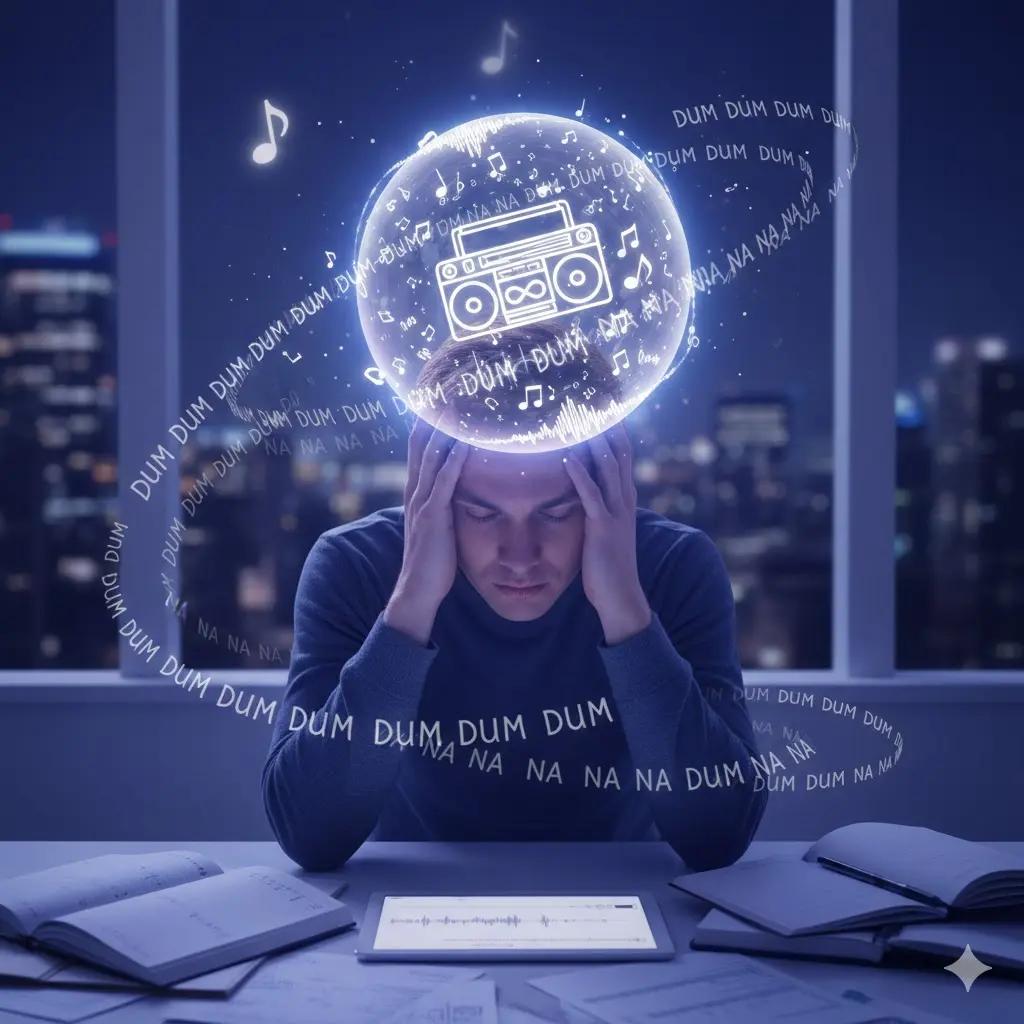
An image representing Stuck Song Syndrome (Generated by artificial intelligence)
In cases of severe distress and accompanying symptoms of Obsessive-Compulsive Disorder, clinical treatment options come into play:【5】
Warning: The content in this article is for general encyclopedic informational purposes only. The information provided should not be used for diagnosis, treatment, or medical guidance. Before making any health-related decisions, it is essential to consult a physician or a qualified healthcare professional. The author of this article and KÜRE Encyclopedia do not accept any responsibility for situations that may arise from the use of this information for diagnostic or therapeutic purposes.
[1]
News Medical. “Earworms: Why do Songs Get Stuck in Your Head?” News Medical. Accessed October 9, 2025. https://www.news-medical.net/health/Earworms-Why-do-Songs-Get-Stuck-in-Your-Head.aspx
[2]
News Medical. “Earworms: Why do Songs Get Stuck in Your Head?” News Medical. Accessed October 9, 2025. https://www.news-medical.net/health/Earworms-Why-do-Songs-Get-Stuck-in-Your-Head.aspx
[3]
News Medical. “Earworms: Why do Songs Get Stuck in Your Head?” News Medical. Accessed October 9, 2025. https://www.news-medical.net/health/Earworms-Why-do-Songs-Get-Stuck-in-Your-Head.aspx
[4]
Euser, A. M., M. Oosterhoff, and I. van Balkom. “Stuck song syndrome: musical obsessions — when to look for OCD.” British Journal of General Practice. 2016 Jan; 66(642): 44–45. https://www.ncbi.nlm.nih.gov/articles/PMC4723199/
[5]
Euser, A. M., M. Oosterhoff, and I. van Balkom. “Stuck song syndrome: musical obsessions — when to look for OCD.” British Journal of General Practice. 2016 Jan; 66(642): 44–45. https://www.ncbi.nlm.nih.gov/articles/PMC4723199/

No Discussion Added Yet
Start discussion for "Earworm (Stuck Song in Mind Syndrome)" article
Triggers and Risk Groups
Neurological Basis and Memory Mechanism
Pathological Aspect and Clinical Relationship
Differential Diagnosis
Management and Treatment Approaches
Self-Help Strategies
Clinical Treatment
This article was created with the support of artificial intelligence.


