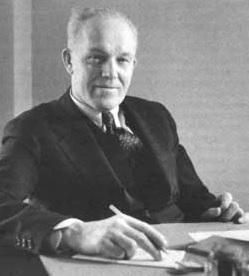
Date of Birth | 1885-05-09 | ||||||||
|---|---|---|---|---|---|---|---|---|---|
Place of Birth | Michigan St. Clair | ||||||||
Date of Death | 1953-04-13 | ||||||||
Eduard Lindeman was born on May 9, 1885, in St. Clair, Michigan. After working in various occupations, he turned to formal education at the age of 21. He graduated from Michigan State College and pursued studies in social philosophy, serving for many years as a professor at the New York School of Social Work. He also held temporary positions at institutions such as Columbia University, Stanford University, and the University of New Delhi. Lindeman passed away on April 13, 1953, leaving a lasting impact on the development of adult education theory.
Eduard Lindeman’s educational philosophy is built upon a democratic and participatory understanding of learning that centers on the life experiences of the individual. He did not consider education merely as an activity confined to the school years but as a dynamic process that continues throughout life and is intertwined with social transformation. In this regard, Lindeman’s approach to education possesses both progressivist and social reconstructionist characteristics.
Lindeman’s andragogical approach emphasizes that the learning needs and characteristics of adult individuals are fundamentally different from those of children. The theoretical foundations of the andragogical model, later systematized by Malcolm Knowles, are largely based on Lindeman’s views. According to Lindeman, adult education should rest on the following four basic principles:
This approach aligns with Paulo Freire’s concepts of “dialogic education” and the “pedagogy of the oppressed.” Lindeman viewed education not only as a tool for personal development but also as a lever for the construction of social justice. He argued that the educational process should be conducted in a democratic, inclusive, and learner-centered manner, rather than through authoritarian, prescriptive, and exam-centered structures.
According to Lindeman, adult education is not merely a process of acquiring knowledge; it is a journey toward self-realization. In this respect, his educational philosophy closely relates to humanist educational theories. Lindeman interpreted education as a process that allows individuals to discover their potential and identified learning with life itself, offering a horizon that transcends the boundaries of formal education.
These views of Lindeman form the philosophical background for modern lifelong learning policies, community education centers, and open education practices, and they remain key reference points for researchers and educators working in the field of adult education.
Eduard Lindeman, with his original approach to adult education theory, was one of the figures who led the institutionalization of andragogy in the early 20th century. Unlike pedagogy, his approach advocates a self-directed learning model that develops based on adults’ life experiences and practical knowledge.
Lindeman’s approach parallels John Dewey’s experiential learning philosophy. Learning is not merely the acquisition of knowledge but an active process linked to real needs and problems in an individual’s life. According to Lindeman, adult learning becomes effective when supported by content that directly touches the learner’s life. For this reason, life itself, rather than formal educational institutions, should be considered a learning environment.
Lindeman identified five fundamental assumptions for adult education:
Lindeman also viewed education as a tool for social participation. He emphasized that values such as social justice, democratic engagement, and the realization of individual potential must be considered in the learning process. In this respect, he defined education as a mechanism not only for personal development but also for social transformation (Brookfield, 1987).
Lindeman’s theoretical approach remains a cornerstone of adult education programs today. Especially in lifelong learning policies, the principles of experience-based, individual-difference-sensitive, and self-directed learning demonstrate the continued influence of his work.
Although Eduard Lindeman’s philosophy of adult education was not directly transferred to Turkey, its influence can be observed indirectly, particularly in adult education policies and institutions shaped from the second half of the 20th century. Adult education in Turkey has long been considered within the framework of social development, literacy improvement, and modernization ideology. In this context, initiatives such as Halk Evleri (1932–1951), the reopening of Halkevleri, and the expansion of Halk Eğitim Merkezleri aimed to involve individuals in lifelong learning, paralleling principles advocated by Lindeman.
Lindeman’s pedagogy, centered on the life experiences of learners, is particularly reflected in open education systems and modular community education courses. Programs shaped according to learners’ interests and needs, the encouragement of active participation in learning, and the inclusion of experience-sharing in learning environments align with his approach.
Furthermore, in Turkey, post-1980 EU-supported adult education projects (e.g., Lifelong Learning Program, Strengthening of Vocational Education and Training Systems) adopted learning strategies consistent with Lindeman’s andragogical principles. However, these influences mostly remained implicit, and Lindeman’s name was often not directly cited in practice.
Eduard Lindeman’s ideas played a transformative role in the institutionalization and theoretical foundation of adult education in the 20th century. His work, particularly The Meaning of Adult Education (1926), anticipated an andragogical rather than pedagogical approach to adult learning far ahead of its time.
According to Lindeman, adult education is not merely a process of transmitting information; it serves to help individuals make sense of their lives, understand social issues, and become active participants in a democratic society. In this sense, education also has a liberating dimension that strengthens social participation. His theory, influenced by John Dewey’s pragmatist education philosophy, carries both individual and social transformation objectives.
From the 1960s onward, Lindeman’s work was reinterpreted by many scholars, notably Malcolm Knowles, and expanded to form the theoretical framework of adult education. Knowles’ development of andragogy has its roots directly in Lindeman’s ideas. Therefore, many researchers recognize him not only as a pioneer but also as a founding figure of the modern andragogical paradigm.
In the United States, Lindeman’s influence is visible in labor education, union movements, community colleges, and community-centered learning programs. Traces of his approach are also found in UNESCO and international educational policies. His conceptualization of adult learning as an integrated, experience-based, and liberating process remains valid and influential today.
Bilir, Mehmet. “Eduard Christian Lindeman: One of the Leaders on Modern Adult Education (1885-1953): Lindeman’s Life, Contributions and Views.” Ankara Üniversitesi Eğitim Bilimleri Fakültesi Dergisi 37, no. 2 (2004): 15–25. https://dergipark.org.tr/en/pub/auebfd/issue/38405/445414.
Henschke, John A. “Eduard C. Lindeman on Adult Education – A 21st Century Reconsideration.” PAACE Journal of Lifelong Learning 25 (2016): 1–15. https://www.iup.edu/pse/files/programs/graduate_programs_r/instructional_design_and_technology_ma/paace_journal_of_lifelong_learning/volume_25%2C_2016/henschke-1.pdf.
Knowles, Malcolm S, “The Modern Practice of Adult Education”, CAMBRIDGE Adult Education Prentice Hall Regents, Englewood Cliffs, Nj 07632, s.40-59, https://studylib.net/doc/8362284/the-modern-practice-of-adult-education.
Loeng, Svein. "Alexander Kapp–the first known user of the andragogy concept." International Journal of Lifelong Education 36, no. 6 (2017): 629-643. https://www.researchgate.net/publication/319017490_Alexander_Kapp_-_the_first_known_user_of_the_andragogy_concept.

Date of Birth | 1885-05-09 | ||||||||
|---|---|---|---|---|---|---|---|---|---|
Place of Birth | Michigan St. Clair | ||||||||
Date of Death | 1953-04-13 | ||||||||
No Discussion Added Yet
Start discussion for "Eduard Christian Lindeman" article
Educational Philosophy and Andragogical Contributions
Theoretical Approach and Other Contributions
The Lindeman Effect in Turkey
Impact on Adult Education and Theoretical Legacy
This article was created with the support of artificial intelligence.