

+1 More

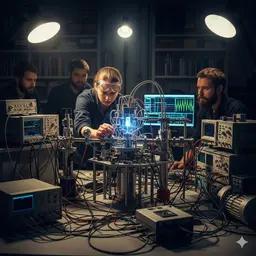
Experimental Physics (Generated with AI)
Purpose(s) | Testing Hypotheses Verifying Theories Discovering New Phenomena | ||||||||
|---|---|---|---|---|---|---|---|---|---|
Method(s) | Observation Controlled Experiment Data Collection Statistical Analysis | ||||||||
Example Experiments | Cavendish Experiment Millikan’s Oil Drop Experiment Double-Slit Experiment Large Hadron Collider (LHC) | ||||||||
Related Field(s) | Theoretical Physics | ||||||||
Key Concepts | Heisenberg Uncertainty Principle Wave–Particle Duality Peer Review | ||||||||
Experimental physics is a branch of physics that observes and systematically studies physical phenomena to obtain reliable and measurable data about how the universe operates. This field uses controlled experiments and empirical evidence to understand natural laws and fundamental principles. Experimental physicists design experiments within the framework of hypotheses and existing theories to answer specific research questions, establish the necessary apparatus, and carefully record the data obtained from these setups.
During the experimental process, careful control of independent and dependent variables, calibration of measuring instruments, and consideration of error margins are essential requirements. This method enables the acquisition of more detailed information about the behavior of matter and energy, the verification of existing theoretical models, or their revision when necessary. Furthermore, experimental studies allow the identification of previously unknown phenomena, thereby contributing to the emergence of new research areas concerning physical reality.
Experimental physics is significant not only in fundamental science research but also in applied fields. The methods, data collection techniques, and laboratory practices used across various subfields—from particle physics to condensed matter physics, from quantum optics to astrophysical observations—expand the boundaries of knowledge. Thus, the experimental approach encompasses the entire process of observation, measurement, and verification in physics and plays a fundamental role in understanding the universe.
The methods of experimental physics vary significantly depending on the scale, objectives, and technologies used in research. Historically, these methods have evolved from relatively simple setups to modern large-scale, high-technology facilities. For example, in the 18th century, Henry Cavendish’s experiment to measure the gravitational constant represented a simple but carefully designed approach to directly observe a fundamental theoretical quantity. By contrast, the 21st-century Large Hadron Collider (LHC) at CERN is an extremely complex, collaborative project in which billions of particles are collided to observe the most fundamental building blocks of matter and energy.
Experimental physics is based on testing hypotheses to answer research questions. This process includes experimental design, setup construction, measurements, data collection, and statistical analysis. A historical example is Robert A. Millikan’s oil-drop experiment, which precisely determined the elementary electric charge of the electron and contributed to the advancement of modern particle physics. Similarly, experiments in optics, condensed matter, or nuclear physics have tested theoretical predictions and led to the determination of new physical constants.
The use of control groups in the experimental process is critically important for distinguishing the effects of independent variables and increasing the reliability of results. The control group provides a reference point for comparisons with the experimental group. Furthermore, repeating experiments multiple times helps reduce random effects and enhances the validity of findings.
This systematic and repeatable approach has made experimental physics one of the methodological cornerstones not only of physics but of all natural sciences. Experimental methods enable the development of a more robust and comprehensive understanding of how the universe operates, both through direct observation and through indirect data obtained by technological means.
Experimental physics holds a fundamental position in the production of scientific knowledge and the emergence of technological innovations. It serves as the primary testing ground for models and hypotheses developed by theoretical physics. When theoretical predictions align with experimental findings, the theoretical framework is strengthened; when inconsistencies arise, theories must be reexamined, adapted, or even abandoned. This cycle clearly reflects the self-correcting and evolving nature of science. In this respect, experimental physics functions not only as a tool for verification but also as a source of discoveries that open new theoretical horizons.
Modern experimental physics has also become a discipline based on large-scale collaboration. Projects in fields such as high-energy physics, nuclear physics, astrophysics, and condensed matter physics bring together hundreds or even thousands of scientists, engineers, and technical experts from various countries and research institutions. These teams work in coordination at every stage—from experiment design and the construction of large-scale detectors and accelerators to data collection and analysis using high-performance computing systems. International collaborations such as ATLAS and CMS at CERN are among the most prominent examples of this multidimensional partnership.
Another dimension of collaboration involves the reliable dissemination of results within the scientific community. Experimental physics studies undergo peer review before publication in scientific journals to ensure the quality, validity, and originality of the data. This practice guarantees that experimental findings are open to scrutiny by the broader scientific community, contributing to the transparent and rigorous advancement of knowledge.
The interdisciplinary nature of experimental physics further broadens the scope of collaboration. Advanced materials technology, computer engineering, electronic design, and data science are indispensable components in conducting large-scale experiments. This diversity makes experimental physics not only crucial for testing natural laws but also a key driver of technological innovation.
Experimental physics employs a wide range of tools, devices, and methods to study phenomena across different scales. These range from simple laboratory instruments to complex, high-precision measurement systems developed for the needs of various research areas. For instance, devices such as ammeters, voltmeters, and oscilloscopes are essential for measuring electrical quantities. In optical experiments, spectrometers analyze the wavelengths and spectral components of light, providing information about its structure and interaction with matter. The X-ray diffraction (XRD) technique, used to investigate the atomic and molecular structures of materials, is indispensable in solid-state physics due to its ability to reveal the order and symmetry of crystal structures. Similarly, methods such as electron microscopy, magnetic resonance, and neutron scattering are used to study the microscopic properties of materials.
The emergence of quantum mechanics in the 20th century expanded the conceptual boundaries of experimental physics and brought about a profound transformation in our understanding of nature. In this context, Werner Heisenberg’s Uncertainty Principle demonstrated that conjugate quantities—such as a particle’s position and momentum—cannot be measured simultaneously with absolute precision. This reflects not merely a limitation of measurement techniques but a fundamental property of quantum systems.
Among the experimental evidences of quantum mechanics, Thomas Young’s double-slit experiment was a historic milestone, revealing the wave–particle duality of light and matter. The experiment showed that light can produce interference patterns like a wave yet behave as discrete particles. Similarly, the photoelectric effect—where a high-energy photon ejects an electron from an atom—demonstrated that light behaves as quantized energy packets known as photons, contributing to the development of quantum theory.
These examples illustrate that experimental physics shapes not only measurement techniques but also the conceptual frameworks that transform our understanding of nature. Experimental tools and methods have simultaneously enabled technological progress and produced evidence that deepens knowledge of the universe’s most fundamental workings.
The development of experimental physics is directly linked to the emergence of modern science. In the 17th century, Galileo Galilei placed systematic observation and measurement at the heart of the scientific method through his experiments on falling bodies. His inclined-plane experiments contributed to the mathematical formulation of the laws of motion and laid the groundwork for subsequent studies. Later, Isaac Newton established the laws of motion that form the foundation of classical mechanics, demonstrating how theoretical frameworks and experimental findings could be unified.
In the 19th century, the focus of experimental physics shifted to electromagnetism. The work of Michael Faraday and James Clerk Maxwell integrated the experimental observations of electricity and magnetism into a comprehensive theory. In 1897, J. J. Thomson discovered the electron through experiments with cathode rays, proving that the atom was not indivisible and opening the way for subatomic physics. Meanwhile, the 1887 experiment of Albert A. Michelson and Edward W. Morley failed to detect the existence of the hypothetical “aether” that was believed to carry light waves. This unexpected result indicated that the speed of light is constant regardless of the observer, paving the way for Albert Einstein’s theory of special relativity.
The 20th century witnessed the emergence of new methods and instruments in experimental physics. The cyclotron, developed by Ernest Lawrence in the 1930s, was the first practical particle accelerator capable of propelling particles to high energies, giving rise to the field of high-energy physics. This technology enabled the discovery of numerous new particles—such as pions, muons, and kaons—and provided critical data for the construction of the Standard Model.
One of the milestones of experimental physics was the discovery of the Higgs boson, proposed theoretically in 1964 as the particle responsible for giving mass to other particles. Long considered purely theoretical, it was finally observed in 2012 through experiments at CERN’s Large Hadron Collider (LHC), confirming a missing component of the Standard Model. These developments demonstrate that experimental physics has not only tested theories throughout history but has also been at the foundation of discoveries that have reshaped scientific thought.
Experimental physics and theoretical physics are the two fundamental domains of modern science, complementing one another. Theoretical physics develops mathematical models and conceptual frameworks to explain natural phenomena, while experimental physics generates measurable data to test these models. The validity of a theory depends on its consistency with experimental findings.
Many theoretical predictions in the history of science have been confirmed through experiments. Paul Dirac’s relativistic wave equation, developed in 1928, predicted the existence of antimatter, which was verified by Carl Anderson’s discovery of the positron in 1932. The gravitational waves predicted by Einstein’s general theory of relativity were observed by LIGO in 2015. Young’s double-slit experiment and the photoelectric effect contributed to the birth of quantum mechanics, while the cosmic microwave background radiation discovered in 1965 supported the Big Bang model. Observations in particle accelerators have also driven the refinement of existing theories. Scientific theories may change or be replaced by more comprehensive explanations as new data emerge—reflecting the dynamic and self-updating nature of scientific knowledge.
Deaton, Bryan. The Dirac Equation and the Positron. Accessed September 16, 2025. https://webhome.phy.duke.edu/~kolena/modern/deaton.html.
Dounas-Frazer, Dimitri R., and H. J. Lewandowski. “The Modelling Framework for Experimental Physics: Description, Development, and Applications.” European Journal of Physics 39, no. 6 (October 2018): 064005. Accessed September 16, 2025. https://doi.org/10.1088/1361-6404/aae3ce.
Persson, Jonas R. “History and Presentation of the Cavendish Experiment in Textbooks in the 20th Century.” arXiv, 2025. Accessed September 15, 2025. https://arxiv.org/abs/2501.11943.
Schmidt-Böcking, Horst, Lothar Schmidt, Hans Jürgen Lüdde, Wolfgang Trageser, Alan Templeton, and Tilman Sauer. “The Stern–Gerlach Experiment Revisited.” The European Physical Journal H 41, no. 4–5 (October 2016): 327–364. Accessed September 16, 2025. https://doi.org/10.1140/epjh/e2016-70053-2.
Will, Clifford M. “The Confrontation between General Relativity and Experiment.” Living Reviews in Relativity 17, no. 1 (2014): 4. Accessed September 16, 2025. https://doi.org/10.12942/lrr-2014-4.

Experimental Physics (Generated with AI)
Purpose(s) | Testing Hypotheses Verifying Theories Discovering New Phenomena | ||||||||
|---|---|---|---|---|---|---|---|---|---|
Method(s) | Observation Controlled Experiment Data Collection Statistical Analysis | ||||||||
Example Experiments | Cavendish Experiment Millikan’s Oil Drop Experiment Double-Slit Experiment Large Hadron Collider (LHC) | ||||||||
Related Field(s) | Theoretical Physics | ||||||||
Key Concepts | Heisenberg Uncertainty Principle Wave–Particle Duality Peer Review | ||||||||
No Discussion Added Yet
Start discussion for "Experimental Physics" article
Methods and Scope
Role and Collaboration in the Scientific Process
Fundamental Concepts, Tools, and Techniques
Historical Development and Key Experiments
Relationship with Theoretical Physics
This article was created with the support of artificial intelligence.