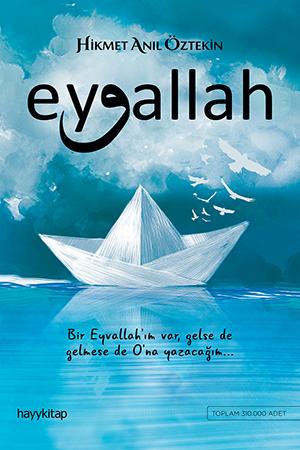
+1 More

Author(s) | Hikmet Anıl Öztekin | ||||||||
|---|---|---|---|---|---|---|---|---|---|
Publisher(s) | Hayykitap | ||||||||
Genre | Inner Monologue Essay | ||||||||
Page Count | 224 | ||||||||
Eyvallah, written by Hikmet Anıl Öztekin and published by Hayykitap in 2017, is a work composed of short and independent texts. Unlike traditional narrative structures, it focuses primarily on individual observations and reflections rather than a linear plot.
The book consists of separate short pieces and does not follow any storyline. The texts address the individual’s relationship with life, the self, and the surrounding world through reflective content. In this non-fictional framework, personal inquiries, inward-oriented tendencies, and existential attitudes toward life are explored at the textual level. Each piece within the book stands as an independent unit, and no overarching narrative structure is employed.
The predominant themes of Eyvallah include patience, trust in divine destiny (tevekkül), inner serenity, acceptance, and personal awareness. The word “eyvallah” in the title is thematically associated with surrender and acknowledgment. The texts reflect these themes either directly or implicitly, portraying the mental and emotional stances an individual develops in response to various circumstances in life.
From a narrative perspective, the book is composed of brief texts that are independent in structure and directly address the reader. The narrator frequently employs the second-person singular form, which lends a personal and dialogic tone to the discourse.
The work contains neither descriptive passages, storytelling, nor fictional characters. Its language is simple and straightforward, avoiding ornamentation or rhetorical devices. The brevity of the texts serves to emphasize the immediate conveyance of thought rather than elaborate literary expression.
Eyvallah belongs to the realm of non-fictional literature and can be characterized as approaching the form of literary essays. However, structurally, it does not possess the intellectual depth or source referencing typical of traditional essays. The texts lack academic argumentation or theoretical frameworks, remaining instead within the scope of personal expression.
Öztekin, Hikmet Anıl. Eyvallah. İstanbul: Hayykitap, 2017. Access Date: 16 July 2025.

Author(s) | Hikmet Anıl Öztekin | ||||||||
|---|---|---|---|---|---|---|---|---|---|
Publisher(s) | Hayykitap | ||||||||
Genre | Inner Monologue Essay | ||||||||
Page Count | 224 | ||||||||
Subject Matter
Themes
Narrative Techniques and Literary Features
Genre and Structure
This article was created with the support of artificial intelligence.