


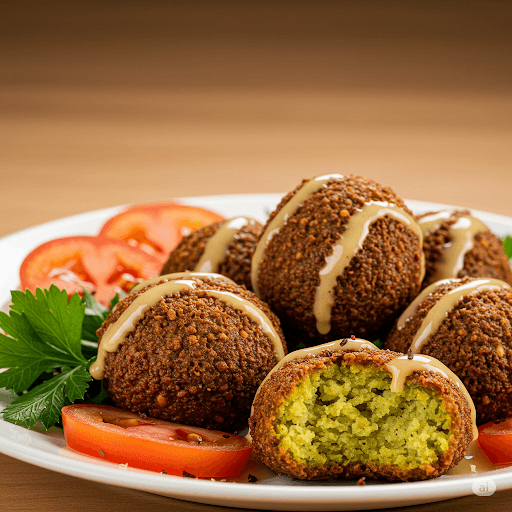
Name(s) | Falafel | ||||||||
|---|---|---|---|---|---|---|---|---|---|
Origin(s) | Fried food based on chickpeas or fava beans | ||||||||
Main Ingredients | Herbs Spices Onion Garlic Chickpeas or fava beans | ||||||||
Cooking Method(s) | Baking (modern alternative) Frying (traditional) | ||||||||
Nutritional Content | Iron Fiber High in plant-based protein | ||||||||
Consumption Styles | Salad Sandwich Meze Wrap | ||||||||
Falafel is a traditional Middle Eastern dish typically made from mashed chickpeas or fava beans, seasoned with spices, and deep-fried. Due to its plant-based ingredients and high protein content, it has gained popularity in both traditional and contemporary cuisines. With historical origins dating back thousands of years, falafel is studied not only from a gastronomic perspective but also as a cultural phenomenon. This dish has become widespread among local communities and internationally, presented with various adaptations in different culinary traditions. Notable for its high nutritional value, plant-based nature, and suitability for vegetarian and vegan diets, falafel has become an integral part of global food culture.
Falafel (Generated by Artificial Intelligence)
Historical sources about the origin of falafel are limited, but it is generally accepted that this food first appeared in Egypt and was originally made by the Christian Coptic communities. The Copts consumed broad bean (fava bean)-based falafel as a protein source, especially during religious periods when meat consumption was restricted. In this context, the earliest versions of falafel were prepared with broad beans and were known as "ta‘miyya" in Arabic. A fundamental component in these early recipes was broad beans, which were inexpensive and readily available.
Over time, falafel spread to the Levant region, where it began to be made with chickpeas. This evolution was related both to agricultural possibilities and local taste preferences. As chickpea use became widespread in areas such as Palestine, Lebanon, Syria, and Jordan, the content of falafel changed accordingly. Due to regional variations, contemporary falafel recipes and presentations differ. For example, some recipes prominently include spices like sesame, cumin, and coriander, while in others these ingredients are less emphasized.
From the second half of the 20th century onwards, falafel became a globally recognized dish due to migration movements and the expansion of international restaurant culture. It was especially adopted as a national dish in Israel, where it is served as part of both Jewish and Arab culinary traditions. The widespread popularity in Israel has sometimes sparked debates about the cultural ownership of the dish. Nevertheless, in gastronomic literature, falafel is regarded as a shared cultural heritage of the Middle East.

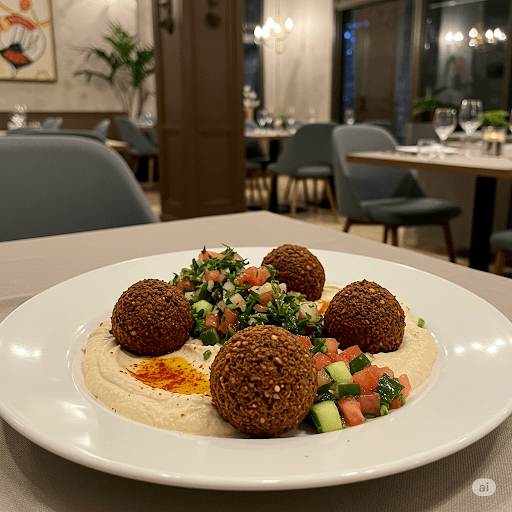
Falafel Delight (Generated by Artificial Intelligence)
Falafel is primarily made from a mixture based on chickpeas or sometimes fava beans. The chickpeas or fava beans are soaked overnight, then ground into a paste. Chopped onions, garlic, fresh herbs (such as parsley and cilantro), and various spices (including cumin, black pepper, and salt) are added to this paste. To help bind the mixture, flour or leavening agents like baking soda may be included. The resulting mixture is typically shaped into round or flat patties and deep-fried. Some modern recipes also use baking or air frying methods as lower-fat alternatives.
Traditionally, falafel is deep-fried, which ensures a crispy exterior and a soft interior. Maintaining the oil temperature between 170–180°C during frying prevents the crust from burning and the inside from remaining raw. After frying, excess oil is drained by resting the falafel on paper towels.
Serving styles vary regionally. Falafel is commonly served inside pita or flatbread, accompanied by salads, pickles, and tahini-based sauces. In some areas, it is also served with hummus and yogurt sauces. As a versatile dish, falafel is widely used in Middle Eastern cuisine both as a main item and as part of mezze assortments.
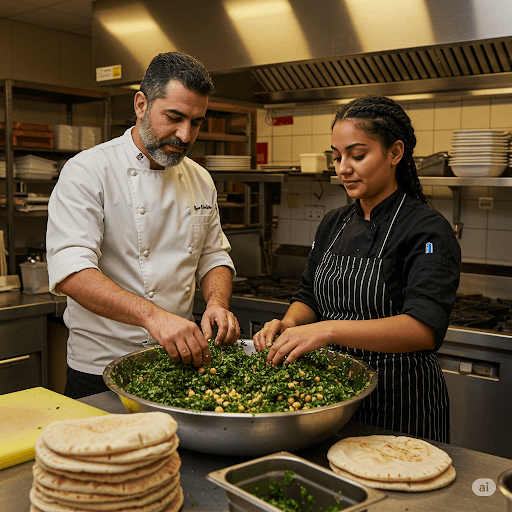
Falafel Preparation (Generated by Artificial Intelligence)
Falafel is rich in plant-based protein, fiber, iron, and folate. Legumes such as chickpeas and fava beans provide low glycemic index carbohydrates and starches that digest slowly. These properties make falafel a food that promotes prolonged satiety. Additionally, falafel contains no cholesterol, contributing to a positive cardiovascular health profile.
However, traditional frying methods result in high fat absorption, increasing the total calorie content. Therefore, alternative cooking methods like baking are considered more suitable for individuals preferring low-fat diets. Moreover, for those following gluten-free diets, gluten-free binding agents should be used when preparing the falafel mixture.
In the 21st century, falafel has established itself in global fast food chains as well as vegan and vegetarian restaurants. Falafel wraps and salads have become popular, especially in Western Europe and North America. The growing trend towards reducing meat consumption has also contributed to the spread of falafel. Additionally, the availability of pre-packaged falafel products on supermarket shelves has facilitated its consumption. Industrial production has developed various forms such as frozen falafel balls, microwaveable ready portions, and products packaged with accompanying sauces.
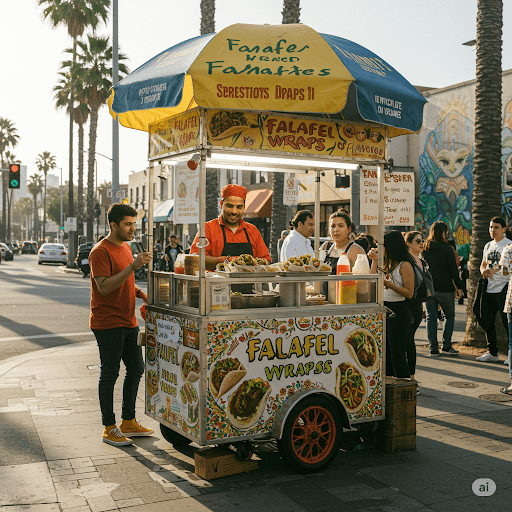
Falafel Vendor (Generated by Artificial Intelligence)
Avieli, Nir. “Food and Power in the Middle East and the Mediterranean.” Food, Culture & Society: An International Journal of Multidisciplinary Research 16, no. 2 (2013): 1–20. https://www.academia.edu/17241779/Food_and_Power_in_the_Middle_East_and_the_Mediterranean. Accessed : 13 May 2025
Gvion, Liora. “Falafel and Hummus as Symbols of National Identity for Palestinians and Israelis: How Are They Mobilized in the Nationalistic Discourses of Palestine and Israel in a Context of Conflict.” ResearchGate, 2017. https://www.researchgate.net/publication/319532155_Falafel_and_Hummus_as_Symbols_of_National_Identity_for_Palestinians_and_Israelis_How_Are_They_Mobilized_in_the_Nationalistic_discourses_of_Palestine_and_Israel_in_a_Context_of_Conflict
Raviv, Yael. Falafel Nation: Cuisine and the Making of National Identity in Israel. Lincoln: University of Nebraska Press, 2015. https://books.google.com/books/about/Falafel_Nation.html?id=dWZ5CgAAQBAJ
Raviv, Yael. “Falafel: A National Icon.” Gastronomica: The Journal of Critical Food Studies 3, no. 3 (2003): 20–25. https://www.researchgate.net/publication/250977051_Falafel_A_National_Icon

Name(s) | Falafel | ||||||||
|---|---|---|---|---|---|---|---|---|---|
Origin(s) | Fried food based on chickpeas or fava beans | ||||||||
Main Ingredients | Herbs Spices Onion Garlic Chickpeas or fava beans | ||||||||
Cooking Method(s) | Baking (modern alternative) Frying (traditional) | ||||||||
Nutritional Content | Iron Fiber High in plant-based protein | ||||||||
Consumption Styles | Salad Sandwich Meze Wrap | ||||||||
Origin and Historical Development
Historical Uncertainties and Regional Claims
Spread in the Modern Era
Composition and Preparation
Basic Ingredients
Cooking Techniques and Serving
Nutritional Value and Global Consumption
Nutritional Content and Dietary Importance
Place in International Cuisines
This article was created with the support of artificial intelligence.