
+1 More


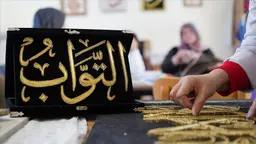
Filography is a traditional handicraft where patterns are created by hammering nails into a wooden surface and wrapping wire around these nails. Derived from the Greek words “philo” (wire) and “graphy” (to write, to draw), the word filography means creating pictures or motifs with wire. In this branch of art, which requires aesthetic and technical integrity, patterns are processed according to a pre-drawn plan; directed lines are formed between the nails using copper, brass, steel, or silver wires.

The Art of Filography (AA)
Although the exact origin of filography cannot be precisely determined, its roots are thought to lie in Central Asia, spreading over time to the Iranian and Ottoman geographies. Its development as an art form, however, has largely occurred in the modern era, through efforts aimed at diversifying and preserving traditional handicrafts.
While direct examples of filography from the Ottoman period are rarely encountered, it is observed to share technical similarities with arts such as filigree (telkâri), inlay (kakma), and hammering (çakma). In modern times, especially in Türkiye, filography has evolved from a hobby to an art form, becoming widespread through various art workshops, courses, and women's cooperatives.
Filography works consist of several stages that require technical attention and planning:
The wires used are generally:
Some artists also apply paint or fabric to the surface to enhance the aesthetic effect.
In filography, both traditional Turkish motifs (tulip, carnation, Seljuk geometry, Ottoman tughra) and modern design elements can be used. Compositions are mostly based on symmetrical arrangements and repetitive rhythmic patterns. Written figures and calligraphic expressions inspired by calligraphy are also frequently preferred themes.

The Art of Filography (AA)
In Türkiye, filography has become more widespread in recent years through workshops supported by individual artists, municipalities, and public education centers. In projects supporting women's employment, especially in cooperative-based production processes, the art of filography is also considered a means of generating economic income.
Apart from individual productions by artists, filography has also been applied for social rehabilitation purposes in some projects. Due to aspects such as strengthening visual memory, improving attention, and supporting motor skills, filography training is included in programs for various age groups.
Artists are taking filography to more experimental dimensions by combining traditional techniques with contemporary art. Since the 2000s, filography works have been featured in various exhibition halls, personal workshops, and digital platforms. Artists who combine traditional Anatolian aesthetics with contemporary forms continue this art as both a cultural and aesthetic means of expression.

Historical Background
Application Techniques and Materials
Motif and Composition Structures
Sociocultural Spread and Educational Activities
Modern Interpretations and Art Galleries
This article was created with the support of artificial intelligence.