

+2 More


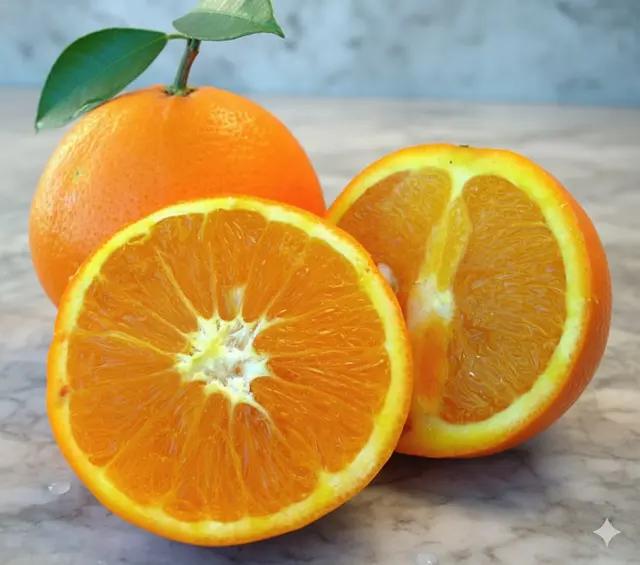
Gargano Orange (Created with Artificial Intelligence.)
The Gargano Orange (originally known as Arancia del Gargano ) is an orange variety with protected geographical indication status, produced in an area of the Gargano Peninsula in the Puglia region of Italy. These oranges are reserved exclusively for those grown in the Promontorio region of Gargano, cultivated using traditional methods, and ripen fully on the tree.
The Gargano Orange is divided into two main cultivars traditionally grown: Biondo Comune del Gargano and Duretta del Gargano (also known locally as "Arancia Tosta").
This type of orange is generally spherical or pear-shaped, with a thin, leathery, and relatively fine-grained, shiny yellow-golden rind. Its juice is yellow-orange. It must meet ripening criteria, such as a minimum sugar content and a certain acidity-to-sugar ratio. It can be used for fresh consumption as well as for processing.
Arancia Duretta del Gargano ("Arancia Tosta") Duretta, a local ecotype native to the Gargano region, is round or oval and is called "Duretta tonda" (round) or "viso lungo" (long-faced). Its rind is a pale orange color of varying density, smooth, and finely papillated. Its flesh is finely textured, amber-colored, crispy, and seedless or with very few seeds. These fruits also have ripening requirements, such as a specific acidity-to-sugar ratio and a minimum sugar content. Furthermore, both types should be heavy, weighing at least 100 grams, with a uniformly colored rind and a vibrant green stem.
About Gargano Orange ( La Gazzetta di San Severo news di Capitanata )
Gargano oranges are cultivated in a specific environment using appropriate techniques to obtain oranges of specific quality, in accordance with the region's traditions. The soils are generally red Mediterranean soils, in small calcareous valleys modeled after valleys and small ravines. Bitter orange (Citrus x aurantium L.) is used as rootstock, in accordance with agronomic tradition. Orange groves are established on sloped land or plateaus facing south, southeast, or southwest, fully respecting the topographic and pedological characteristics that define Gargano citrus cultivation. On slopes, arrangements are made in the form of dry stone walls and terraces. Wind protection is provided, where necessary, with live windbreaks or nets and reed beds composed of yew, laurel, and other agricultural elements. The traditional planting system, the quinconce (conventional grove), is used, and the density per hectare varies between 250 and 400 trees. The tree's shape is hemispherical, called a "cupola" (dome), typical of the region, and its interior is hollow to facilitate air circulation and harvesting. Irrigation is from May to October and is limited to tillage, spring hoeing, and generally organic or superphosphate-based fertilization. Yields should not exceed 30 tons per hectare for Biondo Comune del Gargano and 25 tons for Duretta del Gargano. Harvesting is done manually with shears between April 15 and the end of August for Biondo Comune del Gargano and December 1 to April 30 for Duretta del Gargano.
The production and packaging area for Gargano Orange is the coastal and sub-coastal strip of the Gargano Peninsula, encompassing the regions of Vico del Gargano, Ischitella, and Rodi Garganico. This area is defined by natural and geographical boundaries, such as the beach line between Calenella and Foce Torrente Romondato, the Torrente Romondato provincial road, and the Frazione Isola Varano-Ischitella provincial road. To ensure traceability and control of the product, the packaging of IGP "Arancia del Gargano" may only take place within this defined production area.

Gargano Orange (Created with Artificial Intelligence.)
Features and Varieties
Cultivation Method
Production Area
This article was created with the support of artificial intelligence.