+1 More

Type of Geographical Indication | Designation of Origin | ||||||||
|---|---|---|---|---|---|---|---|---|---|
Registration Number | 448 | ||||||||
Registration Date | 02.09.2019 | ||||||||
Product / Product Group(s) | Processed and Unprocessed Fruits and Mushrooms Vegetables | ||||||||
Province(s) | Gaziantep | ||||||||
Applicant/Registrant(s) | Gaziantep Commodity Exchange | ||||||||
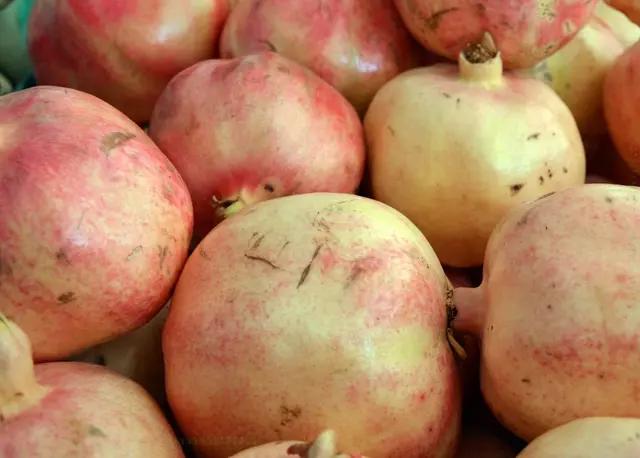
The Gaziantep Oğuzeli pomegranate is a local variety of Punica granatum L. grown in the Oğuzeli district of Gaziantep province, located in Türkiye's Southeastern Anatolia Region. It was registered as a geographical indication with a “designation of origin” on September 2, 2019, by the Gaziantep Commodity Exchange. This status ensures that the product can only bear the name when produced within the specified geographic area using traditional methods.
When ripe, the Oğuzeli pomegranate slightly flattens at its edges, giving it a square-like shape. Its seeds are yellowish-white and notably sweet, lacking sour or tart flavors. Fruit diameter ranges from 7.5–9.5 cm, length from 9–11 cm, and average weight is 380–390 g. The seed-to-fruit ratio exceeds 60%, with the proportion of seed coat to seed being approximately 25–30%. The water-soluble dry matter content is at least 16° Brix.
The region’s warm and temperate climate is favorable for pomegranate cultivation, with an average annual temperature of 15.5 °C and annual precipitation around 529 mm. Pomegranate plants are sensitive to frost, with damage occurring below -10 °C on young shoots and below -18 °C on the main trunk, making Oğuzeli’s climate advantageous for this variety.
The pomegranates are exclusively sourced from the local “Oğuzeli” variety. Fertilization is planned based on leaf and soil analyses. In orchards without nutrient deficiencies, organic fertilizers are preferred, typically applying 2–3 tons per decare of well-rotted farmyard manure mixed into the soil during autumn and winter.
Harvest occurs 5–7 months after full bloom. Fruits are cut from the tree, leaving 1–2 mm of the stem. Sorting may be done in the orchard or designated collection areas. Harvested pomegranates are stored in crates in cool, shaded environments to prevent sun exposure.
A control body coordinated by the Gaziantep Commodity Exchange oversees compliance with the GI specifications. This body includes experts from the Gaziantep Provincial Directorate of Agriculture and Forestry, the Gaziantep Gastronomy and Tourism Association and the Gastronomy and Culinary Arts Department of Gaziantep University’s Faculty of Fine Arts. Inspections are conducted at least once a year or as needed, and complaints can trigger immediate checks. The registrant is responsible for the legal protection of the product’s name and characteristics.
Türk Patent ve Marka Kurumu. "Antep Oğuzeli Narı / Gaziantep Oğuzeli Narı" Registration Certificate. Accessed October 20, 2025. https://ci.turkpatent.gov.tr/Files/GeographicalSigns/268eced6-a2c0-4d4c-ba04-e90b0a04fe54.pdf
Türk Patent ve Marka Kurumu. "Gaziantep Oğuzeli Narı / Antep Oğuzeli Narı." Geographical Indications Portal. Accessed October 20, 2025. https://ci.turkpatent.gov.tr/cografi-isaretler/detay/38401

Type of Geographical Indication | Designation of Origin | ||||||||
|---|---|---|---|---|---|---|---|---|---|
Registration Number | 448 | ||||||||
Registration Date | 02.09.2019 | ||||||||
Product / Product Group(s) | Processed and Unprocessed Fruits and Mushrooms Vegetables | ||||||||
Province(s) | Gaziantep | ||||||||
Applicant/Registrant(s) | Gaziantep Commodity Exchange | ||||||||
No Discussion Added Yet
Start discussion for "Gaziantep Oğuzeli Pomegranate" article
Distinctive Features
Production Method
Inspection and Protection
This article was created with the support of artificial intelligence.