Gerze (District)
Province(s) | Sinop | ||||||||
|---|---|---|---|---|---|---|---|---|---|
Area(s) | Black Sea | ||||||||
Population (2024) | 30,100 | ||||||||
Mayor(s) | Osman Belovacikli | ||||||||
District Governor | Yıldız Büyüker | ||||||||
Postal Code | 57600 | ||||||||
License Plate Code | 57 | ||||||||
Climate(s) | Temperate Black Sea climate | ||||||||
Economy | Fishery agriculture forestry and small-scale tourism | ||||||||
Gerze is a coastal district of Sinop province, located on the Black Sea coast. Its economy is based on fishing, agriculture, and forestry. The district joined the International Cittaslow (Slow City) network in 2017.

Gerze's oldest known name is "Carusa," and it is believed to have existed as a small settlement on the ancient Paphlagonian coast since the 7th century BC. Granted district status in 1901, Gerze is mentioned in the notes of researchers who observed the region in the mid-19th century as a port and a transportation route for timber and agricultural products to Istanbul. The fire that destroyed a large portion of the city center on February 13, 1956, caused the destruction of much of the wooden settlement. Therefore, the traces of this disaster are kept alive with annual commemoration ceremonies. Various archives and traveler records, dating back to the early Republican period, demonstrate that Gerze has an uninterrupted history of settlement stretching from the Ottoman Empire to the Republic.
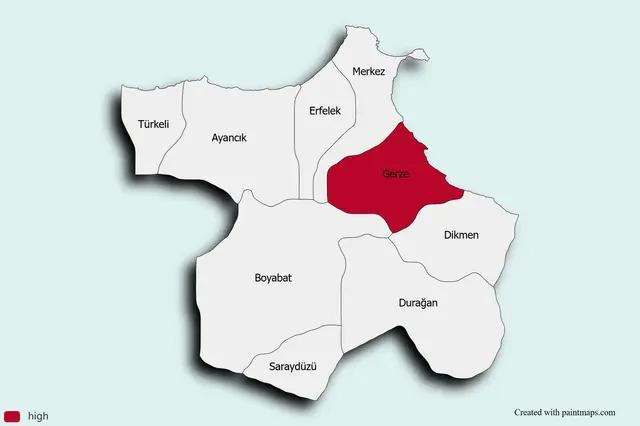
Gerze, situated on a cape of the same name on the northeastern coast of Sinop province, has a surface area of 594 km². Bordered by the Black Sea to the north, Boyabat and Durağan to the south, Dikmen to the east, and Sinop to the west, the district center is 13 miles (approximately 24 km) from the sea, or 39 km by road. The area, with elevations ranging from 0 to 900 m, encompasses the foothills of the Elma, Köse, Dede, and Hasan mountains, as well as coastal plains. The terrain's slopes have divided settlements into four types of zones: "inside the forest," "at the forest edge," "coastal," and "plain." The district center and 42 villages exhibit a scattered settlement pattern.
Influenced by the Black Sea climate, Gerze has an average annual temperature of 14 °C; the average winter months are 7 °C and the average summer months are around 20 °C. The hottest month is July, the coldest month is February. Total annual precipitation is 690 mm, one-third of which occurs in the spring. The average number of clear days is 47, the number of overcast days is 123, the number of snowy days is 6.2, and the number of cloudy days is 194.5; and the relative humidity is approximately 79%. The vegetation includes chestnut, pine, oak, beech, fir, and hornbeam forests from the coast inland, with laurel, cranberry, hazelnut, blackberry, strawberry tree, and poplar trees at lower elevations. The Çakıroğlu, Sarıyer, and Iğrava streams pass through the district borders, while the plateaus include Altunyayla, Avlığısökü, Güdekoğlu, and Altmışdörtoğlu.
The total population of Gerze district was 19,847 in 2007 and reached 30,100 in 2024. During this period, the population increased annually, ranging from 279 (2011–2012) to 1,567 (2022–2023). As of 2024, 14,918 of the population were male and 15,182 were female, with a gender gap of 264. This increase can be explained by factors such as administrative record updates and migration movements.
Gerze's economy has a multi-sectoral structure based on both industry and agriculture and livestock.
The Small Industrial Site, completed between 1994 and 2002, has 151 shops producing in the woodwork, metalwork, auto repair, and other occupations categories, employing approximately 300 people. A facility within the municipality (Barbaros Motor) imports and manufactures agricultural machinery and equipment, with a monthly production capacity of 16,000 units, providing machinery and equipment to both domestic and international markets. Another facility (Betareks) produces textile yarn with a monthly production capacity of 300 tons and employs 550 people. A flour mill with an annual capacity of 50,000 tons operates with 10 employees, producing 5,000 tons. In the textile sector, workshops with thousands of employees (Dolunay Tekstil, Yeni Saray Tekstil, Onur Giyim) produce tens of thousands of garments monthly. In the chemical industry, an establishment producing detergents and ammonium chloride has a monthly production capacity of 120–750 tons.
The district's economy is driven by the local breed of "Hacı Kadı Rooster" chickens and poultry farming, known for their green and black feathers. Trout farming, carried out using natural springs and ponds for drinking water, and coastal fishing (bonito, anchovy, shad, mullet, bluefish, whiting, horse mackerel, etc.) are important sources of income. The presence of approximately 8,000 olive trees is being revitalized through operational capacity, olive care, and pest control projects. Seedling production and plans for a modern olive oil production facility are diversifying the economy.
The Black Sea coast boasts over 11 km of sand beaches, popular during the summer months. Gerze, which joined the Cittaslow network in 2017, has adopted a slow city philosophy that aims to preserve local handicrafts, agricultural production, natural landscapes, and traditional lifestyles. Its educational and cultural infrastructure is supported by institutions such as Anatolian, Technical, Industrial Vocational, and Hotel Management-Tourism high schools, independent primary schools, and the Atatürk Library. Theater, music, and sporting events, as well as international festivals organized on a city-wide scale, foster local dynamism.
The district's seafood and freshwater production, including freshly caught fish such as anchovies, bluefish, and shad; rainbow trout raised on trout farms; local chicken called "Hacı Kadı Horozu" (Hadji Kadı Horozu), and olive oil produced through olive cultivation, form the foundation of its culinary culture. Sapling projects developed with olive cuttings and modern olive oil production facilities strengthen the infrastructure that will ensure the sustainability of traditional diets.
Gerze Municipality. “What is Cittaslow?” Gerze Municipality. Access date: May 9, 2025. https://www.gerze.bel.tr/sayfa/cittaslow-nedir/
Gerze Municipality. “About Gerze.” Gerze Municipality. Access date: May 9, 2025. https://www.gerze.bel.tr/sayfa/gerze-hakkinda/
Gerze Municipality. “History of Gerze.” Gerze Municipality. Access date: May 9, 2025. https://www.gerze.bel.tr/sayfa/gerze-nin-tarihcesi/
Gerze District Governorship. “Geography.” Gerze District Governorship. Access date: May 9, 2025. http://www.gerze.gov.tr/cografya
Gerze District Governorship. “Economy.” Gerze District Governorship. Access date: May 9, 2025. http://www.gerze.gov.tr/ekonomi
Gerze District Governorship. “History of Our District.” Gerze District Governorship. Access date: May 9, 2025. http://www.gerze.gov.tr/ilcemizin-tarihi
Gerze District Governorship. “Culture and Tourism.” Gerze District Governorship. Access date: May 9, 2025. http://www.gerze.gov.tr/kultur-turizm
Gerze District Governorship. “Social Structure.” Gerze District Governorship. Access date: May 9, 2025. http://www.gerze.gov.tr/sosyal-yapi
Gerze District Governorship. “History.” Gerze District Governorship. Access date: May 9, 2025. http://www.gerze.gov.tr/tarih
Gerze District Governorship. “Transportation Information.” Gerze District Governorship. Access date: May 9, 2025. http://www.gerze.gov.tr/ulasim-bilgileri
Republic of Turkey Sinop Governorate. “Gerze.” Sinop Governorate. Access date: May 9, 2025. http://www.sinop.gov.tr/gerze
Turkish Statistical Institute (TurkStat). Address Based Population Registration System Results, 2024. Access date: April 20, 2025. https://data.tuik.gov.tr/Bulten/Index?p=Adrese-Dayali-Nufus-Kayit-Sistemi-Sonuclari-2024-53783

Gerze (District)
Province(s) | Sinop | ||||||||
|---|---|---|---|---|---|---|---|---|---|
Area(s) | Black Sea | ||||||||
Population (2024) | 30,100 | ||||||||
Mayor(s) | Osman Belovacikli | ||||||||
District Governor | Yıldız Büyüker | ||||||||
Postal Code | 57600 | ||||||||
License Plate Code | 57 | ||||||||
Climate(s) | Temperate Black Sea climate | ||||||||
Economy | Fishery agriculture forestry and small-scale tourism | ||||||||
History
Geography and Climate
Population and Demography
Economy
Industry and Trade
Agriculture, Livestock and Aquaculture
Tourism, Culture and Cuisine
This article was created with the support of artificial intelligence.