

This article was automatically translated from the original Turkish version.

For over 25 years, the almost exclusive way to access information online has been to type a few keywords into Google’s white search box and then click on the resulting blue links. This habit became so deeply ingrained that the verb “to Google” entered dictionaries in many languages. However, announcements made at the Google I/O conference in May 2026 clearly signaled that this familiar experience is now behind us.【1】 Google is transforming its search engine into an AI-powered “information assistant,” and this shift is not merely an interface update—it is a paradigm change that reshapes the fundamental operation of the internet.
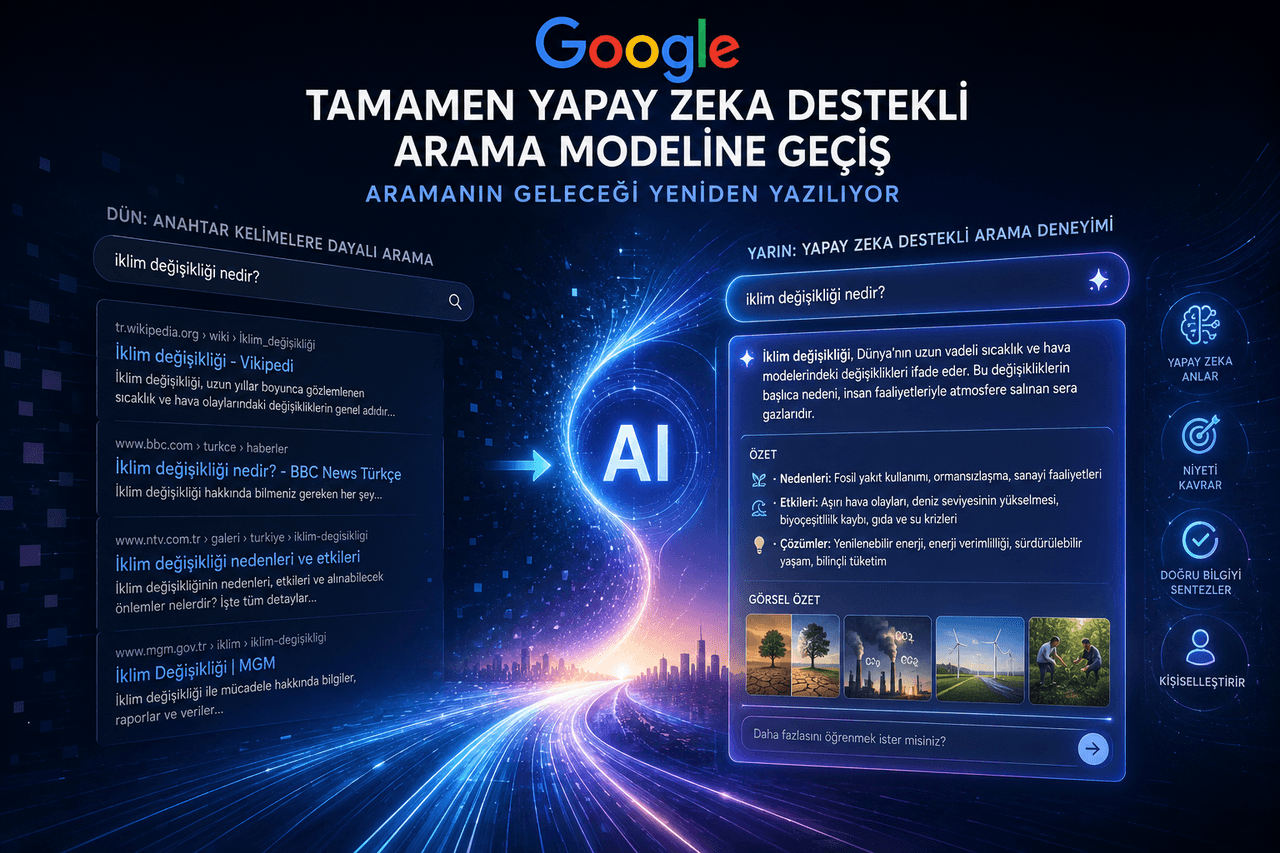
Visual Representing the Transition to the AI-Powered Search Model (Generated by AI)
Google’s journey to redesign search with artificial intelligence began in mid-2024 with “AI Overviews.” These AI-generated summaries appeared at the top of search results pages, offering users concise and synthesized answers to their queries. Although initially criticized for controversial errors, Google maintained that user adoption rates were strong.
In March 2025, Google announced a new search experience called “AI Mode.”【2】 This feature enabled users to ask multi-part, complex questions and receive comprehensive responses generated by AI. Powered by Google’s Gemini language model, AI Mode offered a multimodal architecture capable of processing text, images, and audio inputs. Initially available only to Google One AI Premium subscribers in the United States, the feature was gradually rolled out worldwide.【3】
At this point, the numbers paint a striking picture: According to Google’s official statements, AI Mode reached one billion monthly active users just one year after its launch, and query volume doubled every quarter. Google’s total number of queries also reached its highest level ever in the last quarter. In other words, AI search is not replacing human searching—it is encouraging people to search more.【4】
The announcements at Google I/O 2026 are described by the company itself as “the largest search update in over 25 years.” At the heart of this update are three fundamental changes.
First, the search box has been completely redesigned. Instead of short keyword queries, users can now type long, detailed questions. The box expands dynamically, accepting not only text but also images, files, videos, and even browser tabs. AI-powered question suggestions, going beyond simple autocomplete, help users formulate better queries by anticipating their intent.
The second major innovation is the rollout of the Gemini 3.5 Flash model as the default AI model for AI Mode worldwide. This model delivers “frontier” performance optimized for agents and coding tasks, making the search experience significantly smarter and more context-aware.
Visual Representing the Transition to the AI-Powered Search Model (Generated by AI)
The third and perhaps most striking innovation is the concept of “information agents.” According to Google, these agents can monitor in the background any question a user has asked once. When changes occur—such as price fluctuations, weather updates, real estate trends, or sports results—they proactively notify the user. This represents a shift from the traditional “one-time query-response” model to a continuous monitoring and notification model.【5】
This transformation is fundamentally affecting digital content strategies. Data from the Pew Research Center shows that AI summaries are not universally triggered: Only 8 percent of one- or two-word searches generate an AI summary, while this rises to 53 percent for queries containing 10 or more words. For queries beginning with question words such as “who,” “what,” “when,” or “why,” the trigger rate reaches 60 percent.【6】
This situation presents both a threat and an opportunity for content creators. According to the Reuters Institute, many publishers plan to reduce investment in traditional Google SEO and instead focus on optimizing content for AI platforms. Traffic is not disappearing—it is being redistributed, and new opportunities are emerging for publishers who understand this shift.
Google’s transition to an AI-powered search model will not only change today’s search experience—it will reshape the future of the internet. In the coming years, classic search engines may give way to intelligent digital assistants that communicate naturally with users, anticipate their needs, and not only provide information but also complete tasks.
In the near future, users will no longer merely be “searchers”; they will move alongside digital assistants that continuously interact with AI. Instead of searching for a restaurant, they will book a table; instead of comparing products, they will receive direct recommendations for the best option; they may even delegate complex processes such as travel planning, shopping lists, or academic research to AI.
Visual Representing the Transition to the AI-Powered Search Model (Generated by AI)
The search experience will also become far more personalized. Systems analyzing users’ past preferences, location, interests, and habits will deliver tailored responses rather than showing the same results to everyone. While this accelerates access to information, it also introduces the risk of a “filtered reality,” as individuals may begin experiencing not the same internet but a different internet shaped by their own digital profiles.
For content creators and websites, a new economic transformation is on the horizon. If users obtain the answers they need directly from Google’s AI summaries, visits to websites could decline sharply. This could challenge the advertising-revenue-based digital publishing model and alter the production balance of the internet ecosystem.
Major changes are also expected in education. Students will gain faster access to information, but preserving skills in research, source comparison, and critical thinking will become even more vital. Because in the future, what will truly matter will not be accessing information, but questioning the accuracy of the information presented.
In the long term, the very concept of a search engine may disappear entirely. In its place could come AI agents that speak, understand, analyze, suggest, and even make decisions on behalf of users. In short, the future internet may no longer be a place where we search for information—it may become a system that thinks and acts for us.
Chapekis, Athena, and Anna Lieb. "Google users are less likely to click on links when an AI summary appears in the results." Pew Research Center. Accessed May 22, 2026. https://www.pewresearch.org/short-reads/2025/07/22/google-users-are-less-likely-to-click-on-links-when-an-ai-summary-appears-in-the-results/.
Reid, Elizabeth. "A new era for AI Search." Google. Accessed May 22, 2026. https://blog.google/products-and-platforms/products/search/search-io-2026/#powerful-ai.
Stein, Robby. "Expanding AI Overviews and introducing AI Mode." Google. Accessed May 22, 2026. https://blog.google/products-and-platforms/products/search/ai-mode-search/.
[1]
Elizabeth Reid, "A new era for AI Search," Google, Access date: 22 May 2026, https://blog.google/products-and-platforms/products/search/search-io-2026/#powerful-ai.
[2]
Robby Stein, "Expanding AI Overviews and introducing AI Mode," Google, Access date: 22 May 2026, https://blog.google/products-and-platforms/products/search/ai-mode-search/.
[3]
Robby Stein, "Expanding AI Overviews and introducing AI Mode," Google, Access date: 22 May 2026, https://blog.google/products-and-platforms/products/search/ai-mode-search/.
[4]
Elizabeth Reid, "A new era for AI Search," Google, Access date: 22 May 2026, https://blog.google/products-and-platforms/products/search/search-io-2026/#powerful-ai.
[5]
Elizabeth Reid, "A new era for AI Search," Google, Access date: 22 May 2026, https://blog.google/products-and-platforms/products/search/search-io-2026/#powerful-ai.
[6]
Athena Chapekis and Anna Lieb, "Google users are less likely to click on links when an AI summary appears in the results," Pew Research Center, Access date: 22 May 2026, https://www.pewresearch.org/short-reads/2025/07/22/google-users-are-less-likely-to-click-on-links-when-an-ai-summary-appears-in-the-results/.
From AI Overviews to AI Mode
I/O 2026: The 25-Year Evolution of the Search Box
What Is Changing for Content Creators and the SEO World?
What Lies Ahead?