+1 More

Gülağaç (District)
Province Affiliation | Aksaray | ||||||||
|---|---|---|---|---|---|---|---|---|---|
Population | 19.382 | ||||||||
Elevation(s) | 1170 meters | ||||||||
District Governor | Şeyma POLAT BALAK | ||||||||
Mayor(s) | Doğan BAŞBUĞ | ||||||||
Surface Area | 326 km² | ||||||||
Climate(s) | Continental Climate | ||||||||
Gülağaç is a district in the Central Anatolia Region of Türkiye, affiliated with the province of Aksaray. The district is located on a plateau south of the Kızılırmak River, 25 km southeast of Aksaray. Situated on the southern edge of the Cappadocia Plateau, at the foothills of the Melendiz Mountains, the district has hosted many civilizations throughout history and is a settlement area that draws attention with its natural and archaeological richness. According to TÜİK 2024 data, its population is 19,382.
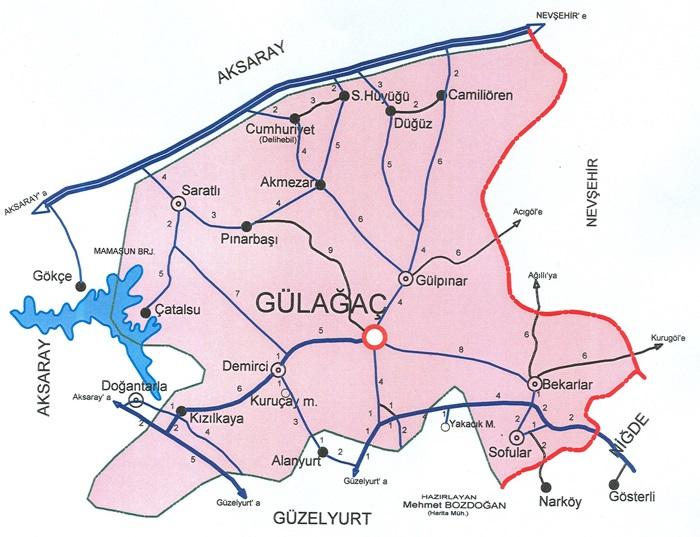
Gülağaç is built on a plateau located in the central part of Central Anatolia, south of the Kızılırmak River. It is bordered by the districts of Derinkuyu and Acıgöl of Nevşehir to the east, Güzelyurt of Aksaray to the south, Aksaray central district to the west, and Ortaköy to the north. The district has an area of 326 km² and an elevation of 1170 meters above sea level.
The region has a cold semi-continental climate. Winters are harsh and snowy, while summers are hot and dry. The natural vegetation consists of steppe, and arable land suitable for agricultural activities is limited. The highest point of the district is Mount Nenezi near Bekarlar, with an altitude of 1712 meters.
Gülağaç is one of the centers with the oldest traces of human settlement in history. Aşıklı Höyük and Musular, located in the region, provide settlement traces dating back to 10,000 BCE. Aşıklı Höyük, located in Kızılkaya Village, is a unique Neolithic archaeological site where historical developments such as the transition to agriculture, sedentary life, and the first brain surgery took place. It holds the first examples of obsidian craftsmanship, animal husbandry, and architectural applications in Anatolia.
Güvercinkayası is a fortress-town model located on the banks of the Melendiz Stream. This settlement, dating to 5200–4750 BCE, is significant in terms of Middle Chalcolithic architecture and early examples of social stratification. It is notable for its separation of inner and outer fortresses, food storage areas, and narrow-street settlement layout. The seals and pottery found in the settlement show connections with Eastern Anatolia and Mesopotamia.
The underground caves in the villages of Camiliören and Saratlı bear characteristics similar to the underground cities of Cappadocia. These caves were intensively used during the Roman and Byzantine periods.
Administratively, Gülağaç became a town under the name "Ağaçlı" in 1957 and gained district status under its current name in 1990. With the annexation of the towns of Sofular and Bekarlar, which were separated from Niğde in 1996, the current administrative structure was formed.
Located near Kızılkaya Village in Gülağaç, Aşıklı Höyük is the oldest known village settlement in Central Anatolia. With a history of 10,500 years, it is an important center where hunter-gatherer communities transitioned to a sedentary lifestyle. Archaeological excavations began in 1989 and are carried out by the Department of Prehistory at Istanbul University. The people of Aşıklı were among the first communities to practice agriculture and mining; it is also scientifically documented that the world’s first brain surgery was performed at this settlement. Tools made from obsidian indicate both the advancement of daily life and trade relations. The settlement features some of the earliest examples of rectangular, adjacent mudbrick houses in architectural history.
Located by the Melendiz River near Apsarı (Çatalsu) Village in Gülağaç, Güvercinkayası dates to the Middle Chalcolithic Period (5200–4750 BCE). Considered the first fortress-town model in Anatolia, it is now situated on a high rock mass within the Mamasın Dam Lake. The settlement is divided into an inner fortress and a lower residential area surrounded by walls, reflecting the class structure and architectural order of the time. Based on an economy of agriculture and animal husbandry, the stamp seals and pottery unearthed demonstrate Güvercinkayası's trade relations with Eastern Anatolia and Northern Mesopotamia.

Güvercinkayası (Gülağaç District Governorship)
In the villages of Saratlı and Camiliören, examples of underground settlements typical of the Cappadocia region can be found. These caves are structurally very similar to those in Göreme, Derinkuyu, Ürgüp, and Kaymaklı. The caves in Saratlı are located beneath the current settlement and can be visited as a tourist attraction. The cave settlement in Camiliören begins with a narrow corridor and expands into a plan with up to forty rooms. Over time, lighting systems have been damaged.
According to TÜİK 2024 data, the population of the Gülağaç district is 19,382. Most of the population lives in the district center and its affiliated towns/villages. There are 5 towns (Saratlı, Gülpınar, Sofular, Bekarlar, and Demirci) and 8 villages (Kızılkaya, Camiliören, Pınarbaşı, Osmanlı, Çatalsu, Akmezar, Süleymanhüyüğü, and others) connected to the district. Migration and urbanization have created significant demographic changes; particularly, the rural population has declined due to the younger population moving to large cities in search of jobs.
The economy of Gülağaç is based on agriculture and animal husbandry. Grain products, especially wheat and barley, are the main agricultural products. Agricultural activities are small-scale and carried out using traditional methods. In livestock, sheep, goats, and cattle are commonly raised.
Ethnographic and architectural studies conducted specifically in the town of Demirci show that the local economic structure is directly related to residential architecture. Traditional stone buildings and arched architectural forms are interpreted as spatial reflections of production methods.
Industry is underdeveloped; commercial life is limited, and there are only small businesses for basic needs.
Located in the town of Gülpınar, the Karaabdal Tomb belongs to the khalifa of Sheikh Turasan Dede and is a religious structure visited by the local people.
Located between Gülağaç and Gülpınar, on the bank of the Karasu Stream, the Bekar Sultan Tomb dates to the Seljuk period and is one of the region's historical heritage sites. The tomb is approximately 45–50 meters high, and its perimeter is about 80–100 meters.
Located on the Aksaray-Niğde border in the Cappadocia region, Narlıgöl is a crater lake and stands out as a thermal water source due to its high mineral content. The thermal water emerges at 65°C and contains minerals that are said to be beneficial for various health issues, particularly rheumatic and skin diseases. The two hotels around the lake indicate the area’s potential for thermal tourism development. In recent years, the heart shape of the lake has given it a romantic silhouette that adds to its natural beauty.

Narlıgöl (Gülağaç District Governorship)
Falay, Burak. Aksaray İli Gülağaç İlçesi Demirci Kasabasında Sosyal ve Sosyo-Ekonomik Yapıların Yerel Mimariye Etkileri ve Bölgedeki Arkeolojik Verilerle Birlikte Değerlendirilmesi. Master’s thesis, Istanbul University, Institute of Social Sciences, 2010. https://nek.istanbul.edu.tr/ekos/TEZ/46957.pdf.
Gülağaç District Governorship. Aşıklı Höyük. Republic of Turkey Gülağaç District Governorship. Accessed June 2025. http://www.gulagac.gov.tr/asiklihoyuk.
Gülağaç District Governorship. Güvercinkayası. Republic of Turkey Gülağaç District Governorship. Accessed June 2025. http://www.gulagac.gov.tr/guvercinkayasi1.
Gülağaç District Governorship. Historical and Geographical Structure. Republic of Turkey Gülağaç District Governorship. Accessed June 2025. http://www.gulagac.gov.tr/tarihi-ve-cografi-yapisi.
Gülağaç District Governorship. Narlıgöl. Republic of Turkey Gülağaç District Governorship. Accessed June 2025. http://www.gulagac.gov.tr/narligol.
Republic of Turkey Ministry of Culture and Tourism, Aksaray Provincial Directorate. "Gülağaç District Map." Accessed June 25, 2025. https://aksaray.ktb.gov.tr/TR-63630/gulagac-ilce-haritasi.html
Republic of Turkey Ministry of Culture and Tourism. Gülağaç. Aksaray Provincial Directorate of Culture and Tourism. Accessed June 2025. https://aksaray.ktb.gov.tr/TR-327028/gulagac.html.
Turkish Statistical Institute (TURKSTAT). "Address-Based Population Registration System Results, 2024." Bulletin No. 53783. Accessed June 25, 2025. https://data.tuik.gov.tr/Bulten/Index?p=Adrese-Dayali-Nufus-Kayit-Sistemi-Sonuclari-2024-53783
Gülağaç (District)
Province Affiliation | Aksaray | ||||||||
|---|---|---|---|---|---|---|---|---|---|
Population | 19.382 | ||||||||
Elevation(s) | 1170 meters | ||||||||
District Governor | Şeyma POLAT BALAK | ||||||||
Mayor(s) | Doğan BAŞBUĞ | ||||||||
Surface Area | 326 km² | ||||||||
Climate(s) | Continental Climate | ||||||||
Geography and Climate
History
Aşıklı Höyük
Güvercinkayası Settlement
Saratlı and Camiliören Caves
Population and Demographics
Economy
Cultural Assets
Karaabdal Tomb
Bekar Sultan Tomb
Natural Beauties
Narlıgöl
This article was created with the support of artificial intelligence.