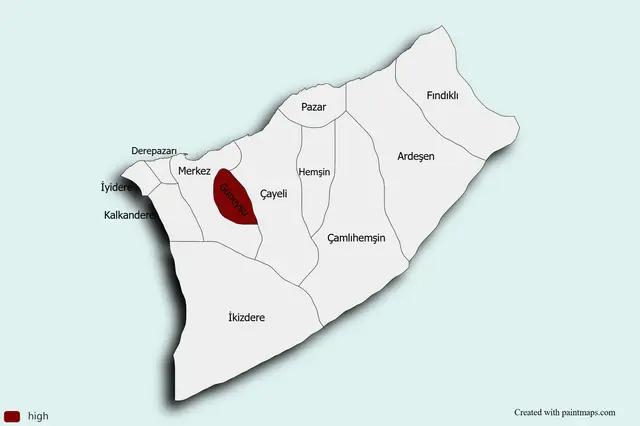
Güneysu (District)
Province(s) | Rize | ||||||||
|---|---|---|---|---|---|---|---|---|---|
Area(s) | Black Sea | ||||||||
Altitude | 152 meters | ||||||||
Population | 8,937 (2022) | ||||||||
Administrative Structure | 1 municipality 22 villages | ||||||||
Economy | Tea cultivation kiwi production beekeeping | ||||||||
Local Products | Cornbread muhlama kale soup organic honey | ||||||||
Mayor(s) | Rifat Ozer | ||||||||
District Governor | Muhammed İkbal Yelek | ||||||||
Tourism Spots | Arapdüzü Recreation Area Qibla Mountain Prayer Hill Handüzü Plateau Potomia Creek | ||||||||
Güneysu is an inland district of Rize Province in Türkiye's Black Sea Region . city center , the district covers an area of 107 km², and the city center rises approximately 152 meters above sea level. Güneysu is bordered by Rize to the north , Çayeli to the east, and İkizdere to the west and south. The district has a mountainous and rugged terrain , with settlements scattered along the Potamya (Güneysu) Stream and the valleys that feed it.

Güneysu ( RİBİAD )
Archaeological and written sources regarding Güneysu's settled history indicate that the region has been inhabited since the Paleolithic ( stone -lithic ) period. The valleys, which were inhabited continuously throughout the Neolithic and Bronze Ages, became a commercial center between 650 and 500 BC, with the Milesian settlement serving as a port and period of Median rule in 606 BC , Persian rule, the Pontus State, and the Roman and Byzantine Empires.
Following the 1071 Battle of Manzikert , the region under Seljuk control , but was re-established under the rule of the Greek Empire foundations, and highland settlements from this period have ensured the survival of an architectural heritage integrated with the geography of the Güneysu valleys.
With Mehmed the Conqueror 's conquest of the Greek Empire of Trebizond in 1461 , Güneysu came under Ottoman rule. Known as "Potomya" at the time and until the early years of the Republic, the settlement's name, meaning "the confluence of three great streams" in Greek , actually reflects its location between the two main tributaries of the Taşlıdere Basin—the Salarha and Potamya streams. In the Ottoman administrative structure of the 19th century, Potomya continued to exist as a sub-district center within the Rize Sanjak, gathering the surrounding village communities at its center.
As part of the geographical naming regulations implemented during the Republic of Türkiye, "Potomya" was removed from official records in the 1930s, and the name "Güneysu" was registered. Governed as a village until 1942, Güneysu was elevated to sub-district center status on that date; it gained district status with Law No. 3392 dated 19, 1987, and began operating effectively on August 9, 1988, having completed its district governorship and municipal organizations.
Today, Güneysu is known as one of the youngest district centers of Rize, with its multi-layered historical development extending from ancient times to the Republic, rich water resources arising from the confluence of three , and a settlement texture that preserves the Black Sea plateau culture.
Güneysu is a district located southeast of Rize province. The district borders extend between longitudes 40°34′–40°44′ E in the west and latitudes 40°50′–41°02′ N in the south. The borders begin 9 km inland from the Black Sea coast and continue to the district center, which is 152 m above sea level. The total surface area is 107 km², and the distance between the city center and the coast is 14 km.
The terrain is extremely rugged, divided by hills and narrow valleys ranging in elevation from 150 to 2,000 meters. Much of the district's land is covered with forests. The main stream, Güneysu Creek, is formed by the confluence of the Çamlık and Potamya (Cimil) streams; a small- scale water springs at Ilıcaköy and Şimşirli, located above the valleys , serve both economic and touristic purposes.
Güneysu falls within the typical Black Sea climate zone, characterized by high humidity and abundant rainfall throughout the year. Average annual precipitation exceeds 2,000 mm, with the heaviest precipitation occurring in autumn and spring. Winters are mild and rainy, while summers are cool and humid. These climatic conditions create suitable microclimates for tea cultivation and forestry products.
Constant rainfall and rugged topography accelerate land erosion, and the risk of floods and landslides is high in narrow valleys. The floods and landslides that occurred on November 12, 2001, and 23 , 2002, highlighted the geomorphological hazards in the region.
Vegetation is stratified by elevation. Colchic flora species (hornbeam, alder, oak, and ) dominate the lower elevations , while coniferous forests such as spruce and fir occur at medium and high altitudes. Alpine -pasture ecosystems near the summits are found on the upper reaches of the mountain ranges. Forest density is high throughout the district; open spaces are limited, and green softens the sharp contours of the valleys, creating a characteristic landscape .
Settlements in Güneysu district exhibit a scattered layout due to the constraints imposed by the land structure . Within the district borders, there are 22 villages and 7 neighborhoods ; settlements are spread over large areas, with residential areas and agricultural lands intertwined. The municipality was established in 1969, and, in addition to general administrative organizations, institutions such as , the Agricultural Credit Cooperative, the Village Services Unit, the Chamber of Drivers, the Chamber of Agriculture, and the Chamber of Tradesmen and Craftsmen serve the district.
In the 2000 general census , the district's population was recorded as 16,522, with 4,914 in the city center and 11,608 in the villages. In subsequent years, according to the Address-Based Population Registration System (ABPRS) results, the population decreased to 12,616, with the urban population being 4,442 and the village population being 8,174. In 2021 TÜİK data, Güneysu's population was announced as 8,722. These figures indicate a continuous population decline over the past two decades.
Economic migration is behind the declining resident population . Migration, particularly to the city center of Istanbul and Rize, is widespread; however, the number of people registered in the district reaches 80,004. The fact that the registered population far exceeds the actual population residing in the district indicates that the region is experiencing long -term domestic and international migration.
The majority of the population lives in rural areas, and traditional lifestyles remain prevalent. Households in rural areas are often multigenerational, with a significant portion of younger generations migrating temporarily or permanently to urban centers or outlying provinces for education or employment opportunities. This demographic trend is resulting in both an aging population and regional disparities in access to services.
The economic structure of Güneysu District is directly shaped by its rugged terrain and limited flat agricultural areas. Of the 10,700 hectares within the district borders, only 3,784 hectares are arable land. Approximately 3,500 hectares of this area are dedicated to tea gardens. This intensive tea cultivation has become the foundation of the district's employment opportunities, supporting both production and processing activities.
A total of 33 different tea factories and workshops in the tea sector: two publicly owned and 31 privately operated (companies and individuals) . These facilities provide direct paid employment for a large portion of the region's population and also create additional job opportunities during harvest seasons, when the demand for mass labor increases seasonally. This concentration in the tea industry has made Güneysu a prominent location among Rize districts in terms of tea processing infrastructure.
In addition to tea cultivation, small-scale kiwi orchards have also contributed to economic diversification in recent years. Approximately 150 families in the district are involved in beekeeping, with a total of approximately 4,000 hives. Annual honey production ranges from 40 to 50 tons, and this product is exported to local markets, neighboring districts, and the city, providing additional income for farm families.
Among non-agricultural activities, the rise of the transportation sector is noteworthy. The proximity to the provincial water resources, coupled with the transportation-based education system, has to an increase in passenger numbers ; nearly 100 families rely on income from commercial transportation services. Furthermore, with the exploitation of the mineral water resources in Ilıcaköy and Şimşirli, the potential for balneotourism has begun to be incorporated into economic planning.
According to social assistance data, the proportion of citizens holding green cards in the district is approximately 9%, while the number of families receiving assistance through the Foundation is around 300. Finance records show 471 active taxpayers, a figure that reflects the scale of regional trade volume and registered economic activity.
Rural migration is the most significant transformation factor in Güneysu's economy. The limited availability of arable land, the limited availability of secondary sectors other than tea, and the near-extinction of transhumance and animal husbandry have led to a shift in population, particularly among young people and working -age populations, towards Istanbul, Rize city center, and other major cities. This exacerbates population losses within the district and, despite the registered—but not actually resident—population reaching 80,000, contributes to a decline in the local workforce.
In terms of construction, traditional wooden architecture has gradually given way to reinforced concrete housing. The increased income from tea cultivation and the modernization of rural settlements have accelerated the transformation of housing. While wooden are still found in higher-altitude villages , reinforced concrete structures predominate in the district center and in villages along main transportation routes.
This multifaceted economic structure has transformed Güneysu from a production center focused on tea cultivation into a more complex sector encompassing beekeeping, kiwi fruit orchards, transportation, and mineral water. However, limited agricultural land, limited secondary sectors, and population migration remain significant challenges to the district's sustainable development goals.
Güneysu's tourist potential is centered on the Handüzü Plateau , 16 km from the town center . Known for its vast plains and clean plateau air, this area has been a favorite among mountain and transhumance tourism enthusiasts, thanks to the plateau festival held in August since 1999. While the plateau currently has no accommodation facilities, its concrete-paved road makes it accessible by all means of transport and suitable for day trips.

Handüzü Plateau ( TC Güneysu District Governorship )
The trout farm in the center, with a capacity to serve 150 people at a time, holds a significant place in the regional cuisine. Additionally, two separate trout farms operating in the villages of Asmalıırmak and Gürgen offer visitors a wide variety of fresh fish options . for their healing properties in the villages of Başköy and Çamlıca , offer potential for balneotourism; their proximity to historical structures like the wooden mosque in Çamlıca complements the region's visit.
Built in 1862 in Kıbledağı Village and later moved to the Ilıca area of Çamlıca, the wooden mosque is an example of the region's traditional architecture. The addition of a new section with a concrete foundation to the north and the preservation of its original elements have allowed the structure to remain open for both use and tourism. The Ayane Mosque (Kıbledağı Hill Mosque), located on the Ortaköy-Asmalıırmak border , is another religious and cultural center frequently visited by visitors.

Kıbledağı Hill Mosque ( TC Güneysu District Governorship )
The Hacı Hafız Yusuf Yılmaz Mosque, built in 2015 on the same hill in a modern architectural style, and the surrounding recreational area offer both prayer and hiking routes. Arapdüzü Nature Park, with its forest-filled recreational areas and opportunities, introduces visitors to both the region's geographical diversity and cultural heritage.
Highland festivals in Güneysu keep regional culture alive with folk dances accompanied by tulum and kemençe , and handicraft stalls. The ongoing hospitality in village houses is reflected in the traditional breakfast served to guests staying on the highlands. Due to limited arable land, highland farming and forest harvesting contribute not only to livelihoods but also to the preservation of cultural identity.
Black tea brewed in Güneysu, a region synonymous with tea cultivation, is an integral part of every meal. Corn flour bread, bazlama (flatbread), and black soup are staples of the region. The local cheese-and-corn flour dish known as muhlama ( kuymak ) provides energy against the chilly high-altitude weather when consumed with tea. Cookies and pestil (fruit rolls) made with Ilıcaköy's mineral water are both local desserts and souvenirs. Honey, produced thanks to trout, highland vegetables, and a diverse flora, also features prominently in the culinary menu; an annual honey production of 40–50 tons provides a wide variety of natural desserts for the table.
Paintmaps. “Turkey Provinces Map – Highlighting Güneysu, Rize.” Erişim tarihi: 15 Nisan 2025. https://paintmaps.com
Republic of Turkey Güneysu District Governorship. “KIBLEDAĞI PRAYER HILL.” Republic of Turkey Güneysu District Governorship. Last access: 21 April 2025. http://www.guneysu.gov.tr/dua-tepesi
Republic of Turkey Güneysu District Governorship. “HANDÜZÜ PLATEAU AND RECREATION AREA.” Republic of Turkey Güneysu District Governorship. Last access: 21 April 2025. http://www.guneysu.gov.tr/handuzuuu
RİBİAD. “Güneysu.” Rize Güneysu Businessmen Association Official Website. Last access: April 21, 2025. https://www.ribiad.com/sayfa/guneysu.html
Güneysu Municipality. “History.” Güneysu Municipality Official Website. Last access: April 21, 2025. https://www.guneysu.bel.tr/Sayfa/tarihce-26.html
TC Güneysu District National Education Directorate. “Let's Get to Know Güneysu.” Güneysu District National Education Directorate. Last access: April 21, 2025. https://guneysu.meb.gov.tr/www/guneysuyu-taniyalim/icerik/175

Güneysu (District)
Province(s) | Rize | ||||||||
|---|---|---|---|---|---|---|---|---|---|
Area(s) | Black Sea | ||||||||
Altitude | 152 meters | ||||||||
Population | 8,937 (2022) | ||||||||
Administrative Structure | 1 municipality 22 villages | ||||||||
Economy | Tea cultivation kiwi production beekeeping | ||||||||
Local Products | Cornbread muhlama kale soup organic honey | ||||||||
Mayor(s) | Rifat Ozer | ||||||||
District Governor | Muhammed İkbal Yelek | ||||||||
Tourism Spots | Arapdüzü Recreation Area Qibla Mountain Prayer Hill Handüzü Plateau Potomia Creek | ||||||||
History
Geography and Climate
Population and Demography
Economy
Tourism, Culture and Cuisine
This article was created with the support of artificial intelligence.