

This article was automatically translated from the original Turkish version.
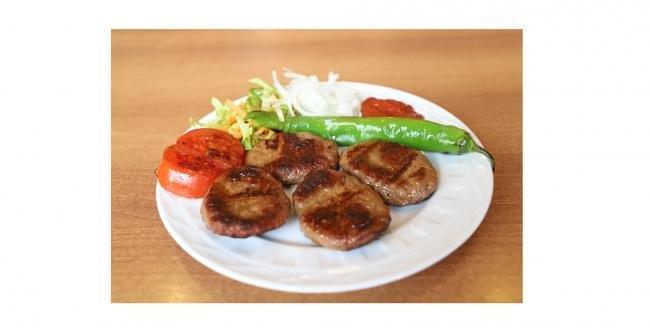
Hayrabolu Çerkezmüsellim köftesi, also known as Hayrabolu Çerkezmüsellim pabuç köftesi, is a meat product unique to the Çerkezmüsellim Neighborhood of Hayrabolu District in Tekirdağ Province and is registered with a geographical indication mark. The meat mixture is prepared by combining beef (from the rib, leg, and neck regions in proportions of 50%, 25%, and 25% respectively), beef suet, stale wheat bread, onion, garlic, and various spices in specific ratios. Before shaping, the dough is rested at 0–4°C for 18 to 24 hours. The oval shape resembling a slipper distinguishes these meatballs, which are traditionally cooked on a ridged grill over wood charcoal and served with roasted tomato and pepper.
Hayrabolu Çerkezmüsellim köftesi has an oval shape resembling a slipper. Each serving consists of four meatballs, each weighing 50 grams. The product is preferably cooked on a ridged grill heated with wood charcoal and served alongside roasted tomato and pepper. Before shaping, the dough is pressed into trays and rested at 0–4°C for a minimum of 18 to 24 hours. This resting process imparts elasticity to the meatball and ensures homogeneous integration of the spices with the meat.
The main components of the meatball include beef (from rib, leg, and neck regions in proportions of 50%, 25%, and 25% respectively), beef suet (maximum 25%), stale wheat bread, dried onion, garlic, cumin, black pepper, ground red pepper, and salt. The beef used in production is sourced from male Holstein and Simmental cattle, aged no more than two years and weighing between 200 and 300 kilograms. These cattle graze on pastures within the geographical boundary that include plant species such as Trifolium apertum var. kilaeum, Trifolium vesiculosum var. rumelicum, Chrysopogon gryllus, Vulpia muralis, Koeleria lobata, Salvia amplexicaulis, Thymus atticus, and Artemisia marschalliana.
The beef used in the production of Hayrabolu Çerkezmüsellim pabuç köftesi is sourced from male Holstein and Simmental cattle, aged under two years and weighing 200–300 kilograms, which graze on pastures within the geographical boundaries of Hayrabolu District, Tekirdağ Province, containing plant species such as Trifolium apertum var. kilaeum, Trifolium vesiculosum var. rumelicum, Chrysopogon gryllus, Vulpia muralis, Koeleria lobata, Salvia amplexicaulis, Thymus atticus, and Artemisia marschalliana.
The dough composition for a 10 kg batch is defined as follows: 7 to 7.5 kg beef (50% rib, 25% leg, 25% neck), 1 to 1.5 kg beef suet, 800–1000 g stale wheat bread, 300–400 g dried onion, 150–250 g garlic, 15–25 g cumin, 30–50 g black pepper, 100–150 g salt, and 30–50 g ground red pepper. After separating the beef from bones, cartilage, nerves, tendons, and connective tissues, it is mixed with beef suet to ensure a fat content not exceeding 25%. Stale wheat bread, onion, and garlic are then added and the mixture is processed once through a meat grinder. After adding the spices, the mixture is ground a second time.
The resulting dough is rested for a minimum of 18 to 24 hours under refrigeration at 0–4°C. After resting, the dough is portioned into pieces each weighing 50 grams in their cooked form and shaped into oval, slipper-like forms. The meatballs are cooked on a ridged grill heated with wood charcoal. Each serving consists of four meatballs accompanied by roasted tomato and pepper.
The product can be frozen in food-safe packaging in its raw state and stored for up to six months at -18°C. When produced fresh, it can be stored for up to four days at 2–4°C. The cold chain must be maintained without interruption.
Production of the product occurs exclusively within the defined geographical boundary of the Çerkezmüsellim Neighborhood. The sourcing of the beef, preparation of the product, and its freezing and packaging must all take place within this boundary. This requirement is based on the established link between the product and the local pasture vegetation and livestock practices.
Inspections regarding the production and use of the geographical indication for Hayrabolu Çerkezmüsellim köftesi are conducted by a minimum three-member inspection body coordinated by the Hayrabolu Municipality, comprising representatives from the Hayrabolu District Directorate of Agriculture and Forestry, the Hayrabolu Chamber of Commerce and Industry, and the Hayrabolu District Directorate of Health. Inspections are carried out at least once annually, and additional inspections may be conducted upon complaint or need. During inspections, key elements such as whether the beef is sourced from within the geographical boundary, compliance with production methods, and portion size are verified. Documentation such as slaughter reports is used to trace the product’s origin, and expert support may be obtained from public or private institutions when necessary.
Hayrabolu Çerkezmüsellim köftesi is frozen in food-safe packaging and can be stored for up to six months at -18°C without interruption of the cold chain. When produced fresh, it can be stored for up to four days at 2–4°C. The product label or packaging must include the geographical indication emblem along with the designation “Hayrabolu Çerkezmüsellim Köftesi” or “Hayrabolu Çerkezmüsellim Pabuç Köftesi.” If this designation cannot be placed on the packaging, it must be displayed in a clearly visible location within the production facility.
Turkish Patent and Trademark Office. "Hayrabolu Çerkezmüsellim Köftesi / Hayrabolu Çerkezmüsellim Pabuç Köftesi Tescil Belgesi (PDF)." Accessed July 20, 2025. https://ci.turkpatent.gov.tr/Files/GeographicalSigns/56cc5005-61d9-4952-9352-3350006a1172.pdf.
Turkish Patent and Trademark Office. "Hayrabolu Çerkezmüsellim Köftesi / Hayrabolu Çerkezmüsellim Pabuç Köftesi." Accessed July 20, 2025. https://ci.turkpatent.gov.tr/cografi-isaretler/detay/5225.

No Discussion Added Yet
Start discussion for "Hayrabolu Çerkezmüsellim Köftesi" article
Physical Characteristics
Ingredients and Composition
Recipe and Production Process
Ingredients
Geographical Boundaries and Production Area
Inspection and Control
Storage and Usage